


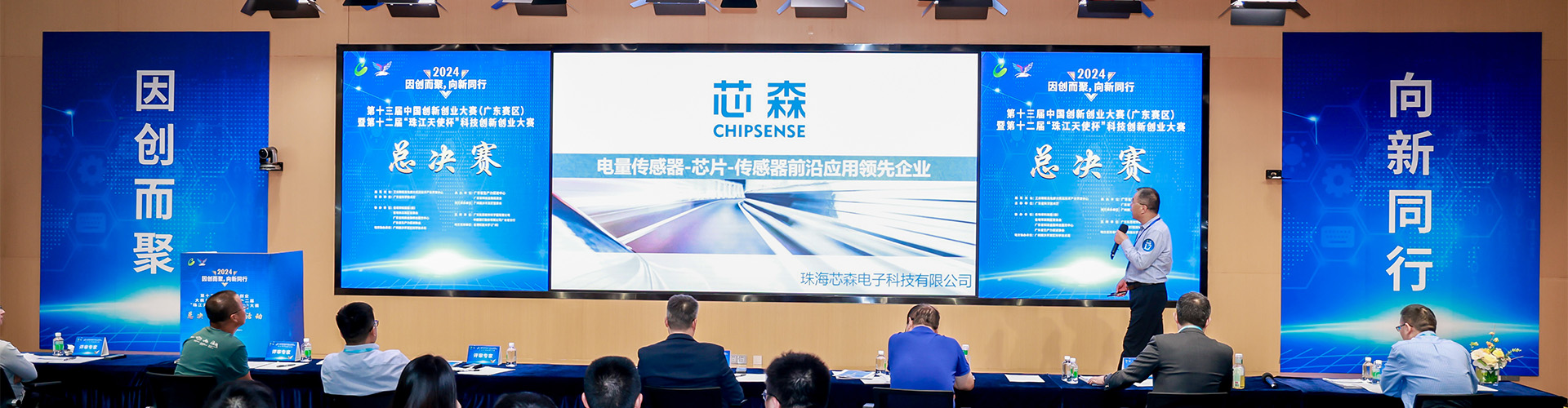
Did you think the release of GPT-5 marked the pinnacle of human understanding regarding AI capabilities? Little did you know that, more recently, Open-claw—an AI system designed for lobster farming—has been taking the AI application landscape by storm. Even the government has entered the fray, issuing Shenzhen’s "Ten Measures for Lobster Farming"; meanwhile, Mac Minis are being heavily modified to serve as local servers for these operations, and the "Lobster Box" has even made its debut. Yet, what remains largely unknown is that underpinning this breakthrough is a silent battle to upgrade power systems—a battle in which Hall-effect current sensors are quietly standing guard as the final line of defense for system safety. CHIPSENSE is just one of many current sensor manufacturers.
The Electricity Demand Behind Computing Power
Let’s start with a statistic: training a model with a trillion parameters requires consuming approximately 10 to 15 GWh of electricity. What does this figure represent? It is equivalent to the electricity consumption of a small city over a six-month period.
The energy consumption during the inference phase is equally staggering. By the end of 2025, for services similar to ChatGPT Pro, the average energy consumption per single conversation is projected to be around 0.3 Wh. While this may seem like a modest amount, when multiplied by a daily average of hundreds of millions of queries, the daily energy consumption reaches several MWh. Consequently, the annual electricity bills for major AI service providers have already surpassed the $1 billion mark.
Yet, this is not the most critical issue. What truly poses a headache for data centers is not the total energy consumption, but rather the power density.
The power consumption of a single card in the new generation of GPUs has already exceeded 700 W, and the peak power draw of an 8-GPU server approaches 6 kW. In a standard 42U server cabinet—where traditional IT equipment might consume only 10 to 20 kW—filling it with GPUs can now cause the power draw to skyrocket to between 80 and 120 kW.
This presents an unprecedented challenge to power supply systems. CHIPSENSE current sensors will also face this challenge.
Current Monitoring: A Fundamental Aspect of Power Management
Why do data centers need to measure current? Simply put, there are three things to know: how much electricity is used, where the problem lies, and how to optimize power allocation.
"How much electricity is used" is the foundation of billing and energy efficiency management. Power Usage Effectiveness (PUE) is a key performance indicator (KPI) for data centers. To calculate PUE, we need to accurately know how much power IT equipment consumes. Currently, the PUE of mainstream data centers is between 1.3 and 1.5, meaning that out of every 100 kilowatt-hours of electricity, only 60-70 kilowatt-hours are actually used for computing; the rest is wasted in cooling, power distribution, and other processes.
"Where the problem lies" is crucial for fault diagnosis. Server downtime and performance degradation are often caused by power supply issues. For example, unstable voltage, three-phase imbalance, and harmonic pollution all need to be detected through current monitoring. CHIPSENSE current sensors can be applied in this field.
"How to optimize power allocation" is the core of efficiency improvement. Thousands of GPUs cannot run at full load simultaneously. By monitoring the current consumption of each device in real time, task allocation can be dynamically adjusted to ensure even load distribution and prevent some devices from overheating while others remain idle. CHIPSENSE current sensors play a significantly important role.
Three Mainstream Technical Approaches
When it comes to current sensing, there are currently three primary technical approaches: shunt resistors, Hall sensors, and current transformers.
Shunt Resistors
The principle is the simplest: a small resistor is connected in series within the circuit; the voltage across the resistor is measured, and the current is calculated based on Ohm's Law.
Advantages: High accuracy (up to ±0.1%), low cost (ranging from a few dimes to a few dollars), and fast response (bandwidth reaching the MHz range).
Disadvantages: Lacks electrical isolation, exhibits high power dissipation under high-current conditions, and requires an additional isolation amplifier.
Hall Effect Current Sensor
Based on the Hall effect, it estimates current magnitude by measuring the magnetic field generated by the current.
Advantages: Electrical isolation (withstanding voltages up to 2–5 kV), non-contact measurement, capability to measure both DC and AC, and a wide dynamic range.
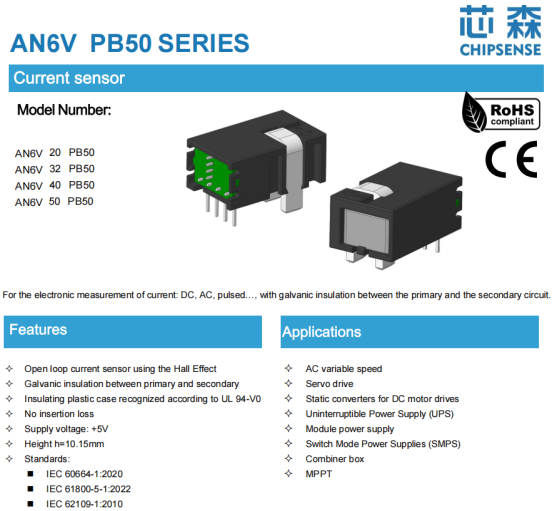
Disadvantages: Relatively lower accuracy (±1–3% for open-loop, ±0.2–0.5% for closed-loop), susceptibility to temperature drift, and vulnerability to interference from external magnetic fields. CHIPSENSE AN6V PB00 series of current sensors is an excellent example.
Current Transformer
Based on the principle of electromagnetic induction, it senses the primary current via a secondary coil.
Advantages: High accuracy (±0.2%), low cost, and high reliability.
Disadvantages: Limited to measuring AC currents, relatively large physical size, and poor low-frequency response.
Each of these three approaches has its own distinct advantages and disadvantages; there is no absolute "best" or "worst" option—the optimal choice depends entirely on the specific application scenario.
Technology Selection for Data Center Environments
Within a data center, all three technologies—shunt resistors, current transformers, and Hall-effect sensors—have their respective applications, though they are suited to different scenarios.
Low-Voltage Distribution Side (48V and below): Shunt resistors are the dominant choice. In this scenario, the voltage is low and the need for electrical isolation is minimal; consequently, the advantages of shunt resistors—specifically their high accuracy and low cost—are clearly evident.
High-Voltage Side (220V/380V AC): Current transformers are the more suitable option. In AC environments, transformers offer low cost and high reliability, making them the standard configuration for traditional power distribution cabinets. CHIPSENSE current sensor is precisely what effectively meets this requirement.
Intermediate DC Link (380V–800V DC Bus): This is where Hall-effect sensors find their niche. In this scenario, the voltage is relatively high, necessitating electrical isolation. Furthermore, since the current is DC, current transformers cannot be utilized. While shunt resistors could technically be employed, doing so would require the addition of isolation amplifiers, thereby increasing both cost and system complexity.
However, it is important to note that these distinctions are not absolute. Many newly constructed data centers are now adopting a solution combining shunt resistors with digital collators for their 48V buses, as this approach offers lower overall costs. Conversely, certain high-end servers utilize low-range, high-precision Hall-effect sensors within the 12V power supply circuitry for their GPUs. CHIPSENSE current sensors have been used in this field.
Ultimately, technology selection is never a simple matter of asking "which one is better," but rather "which one is more suitable." CHIPSENSE current sensors have become the choice of many customers.
Trade-offs in Engineering Practice
When undertaking actual engineering projects, the factors that must be considered extend far beyond mere technical specifications.
Cost is a primary consideration. For a cluster comprising ten thousand GPUs, equipping each card with a high-precision, closed-loop Hall-effect sensor could increase costs by over $100,000. Using shunt resistors, however, might cost only a few thousand dollars. Consequently, the issue is often not a lack of viable technical options, but rather the inability of the budget to support them. Therefore, CHIPSENSE current sensors provide customers with highly cost-effective products.
Physical space constitutes another significant constraint. In 1U servers, space is extremely limited; sensors must be compact, slim, and easy to install. Shunt resistors typically require virtually no additional space, whereas Hall-effect sensors necessitate the allocation of specific mounting points.
Accuracy requirements vary depending on the specific application scenario. Billing and metering systems demand high precision, while over-current protection systems require only moderate accuracy; for simple monitoring tasks, even a tolerance of ±5% may be acceptable. It is common practice to employ sensors of varying precision levels to suit the distinct requirements of different scenarios. CHIPSENSE current sensors are also available in various accuracy levels.
Reliability and operational lifespan are also critical factors. Data centers are designed to operate continuously—without downtime—for periods of 5 to 10 years; thus, their sensors must be capable of withstanding the test of time. While the reliability of shunt resistors is relatively straightforward to assess, the temperature drift and long-term stability of Hall-effect sensors require rigorous evaluation. Feedback from numerous customers indicates that the various parameters of CHIPSENSE current sensors outperform those of their competitors.
The Direction of Technological Evolution
Current detection technology is also constantly evolving, primarily in three directions:
Integration: Integrating the sensor and signal conditioning circuitry together reduces external circuitry and improves reliability. Many shunt resistors now integrate amplifier circuits, and Hall effect sensors also offer solutions that integrate Hall elements with ASIC chips.
Digitization: Traditional analog outputs are being replaced by digital interfaces such as I2C and SPI. Digital outputs have strong anti-interference capabilities and can communicate directly with MCUs, reducing intermediate steps.
Intelligence: New generation sensors are beginning to integrate simple edge computing capabilities, such as simple threshold judgment and trend analysis, allowing for local data processing and reducing the burden on the main control chip.
These convolutions are not about making sensors more "advanced," but rather about better meeting engineering needs: greater ease of use, greater reliability, and greater integration.
Some Overlooked Issues
Technical discussions often focus on the sensors themselves; however, in actual engineering practice, many problems stem from other sources.
Improper installation is the most common culprit. For instance, if a shunt resistor is not tightened securely, increased contact resistance can lead to inaccurate measurements; similarly, if a Hall sensor is mounted off-center, uneven magnetic field distribution can result in significant errors. These issues often go undetected in a laboratory setting and only become apparent once deployed in the field.
Electromagnetic Compatibility (EMC) interference also poses a significant challenge. Data centers are replete with high-speed signal lines and high-current busbars, creating a complex electromagnetic environment. If a sensor's signal lines are routed improperly, they can pick up severe interference. Fundamental practices—such as differential signaling, the use of shielded cables, and proper grounding—are therefore indispensable.
Software compensation can effectively mitigate hardware limitations. The accuracy of many sensors can be significantly enhanced through software calibration. By performing multi-point calibration during manufacturing and applying dynamic temperature compensation during operation, the practical results are often superior to simply replacing the device with a higher-precision sensor.
Calibration and maintenance are frequently overlooked aspects. Current sensors are not "set-it-and-forget-it" devices; they require periodic calibration. This is particularly critical for Hall sensors, where temperature drift and long-term drift can compromise accuracy; regular calibration is essential to ensure long-term stability.
The Essence of the Computing Power Competition
The race for AI computing power may appear, on the surface, to be a contest of who possesses the most GPUs or the greatest raw processing strength; however, in essence, it is a competition to determine whose systems are the most efficient, stable, and cost-effective.
The power system serves as the bedrock of the entire infrastructure. Without a stable and reliable power supply, even the most powerful GPUs cannot function. Without efficient energy management, even the most formidable computing power becomes prohibitively expensive to utilize.
In this sense, every single link within the power system—ranging from transformers, distribution cabinets, UPS units, and PDUs to the various sensors embedded within the servers themselves—constitutes an indispensable component of the computing power competition.
And current sensing is merely one tiny node within this vast and complex system.
Even a tiny current sensor—such as the CHIPSENSE current sensor—plays a significant role in power systems.
Conclusion
The purpose of this article is not to advocate for any specific technical solution, but rather to highlight a fundamental truth: beyond the spotlight of the AI computing power race, a vast array of technical details and engineering practices quietly underpin the operation of the entire system.
These details often go unnoticed; yet, it is precisely the accumulation of these details that constitutes the bedrock of modern digital infrastructure.
For technology practitioners, understanding these details is far more important than chasing the latest trends—for true technical innovation is often hidden within these unassuming particulars.
The upgrading of power systems continues, and the growth of AI computing power shows no signs of slowing down. No one knows where the finish line of this race lies. However, one thing remains certain: regardless of how technology evolves, a meticulous focus on detail and a deep reverence for sound engineering practices will never go out of style. Each CHIPSENSE current sensor will play its own vital role in these specific areas.
CHIPSENSE is a national high-tech enterprise that focuses on the research and development, production, and application of high-end current and voltage sensors, as well as forward research on sensor chips and cutting-edge sensor technologies. CHIPSENSE is committed to providing customers with independently developed sensors, as well as diversified customized products and solutions.
“CHIPSENSE, sensing a better world!
www.chipsense.net