


Abstract
China has over 12 million EV chargers in operation, with highly inconsistent leakage protection configurations. A large number of in-service chargers still use Type AC/A residual current devices (RCDs), which offer almost no detection capability for smooth DC leakage current. The GB 44263-2024 standard mandates Type B protection, and starting August 1, 2026, chargers without valid 3C certification will be banned from the market. This article delves into why DC leakage current occurs during EV charging, how CHIPSENSE Type B sensors eliminate blind spots, and the optimal selection of CHIPSENSE current sensor solutions like the FR1D 6 C02.
I.Overlooked Fatal Blind Spot in the Industry
In March 2025, a safety inspection of EV chargers in Zhenxiong County, Yunnan Province, uncovered 235 safety hazards. This figure is alarming enough, but what’s more concerning is the nature of the issues: insulation aging, grounding failure, and ineffective leakage protection. Why have these basic safety thresholds for EV chargers become critical pain points?
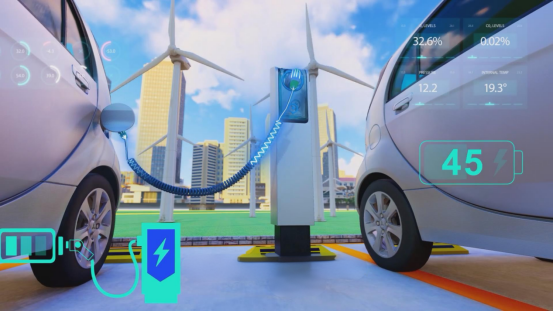
Looking beyond individual cases to industry data: China’s installed base of EV chargers has exceeded 12 million, including over 4.8 million public chargers. Behind this massive number, however, leakage protection solutions vary widely. Most in-service chargers rely on Type AC/A RCDs, which cannot detect smooth DC leakage current at all.
The critical question arises: Does DC leakage current occur during EV charging?
CHIPSENSE Insight: The answer is a resounding yes—and it’s extremely common. CHIPSENSE current sensor technology is designed specifically to address this industry-wide hazard.
II.Why DC Leakage Current Occurs in EV Charging
To understand this issue, we first need to clarify how EV chargers work. AC chargers (slow charging) convert AC power to DC via the onboard charger (OBC), while DC chargers (fast charging) perform AC/DC conversion internally and supply DC power directly to the battery. In both cases, charging modules include numerous capacitors for filtering and energy storage.
The leakage characteristics of these capacitors lead to pulsating DC leakage related to grid voltage phase angles at the rear of rectifier bridges and across smoothing capacitors. More critically, when switching devices (IGBTs/MOSFETs) or filter capacitors in the charging module suffer insulation degradation, smooth DC leakage current leaks to the protective earth (PE).
How dangerous is this DC leakage current?
Key Note: DC leakage current polarizes cardiac tissue and can remain lethal even after power is removed.
Humans can perceive AC current at approximately 5mA, while the perception threshold for smooth DC is higher (around 10mA). The danger of DC leakage, however, lies not in perception but in cumulative effects and unique electric shock mechanisms. DC leakage polarizes cardiac tissue and can remain lethal even after power is disconnected—an entirely different physiological mechanism from AC electric shock.
Type AC/A RCDs operate by detecting the vector sum of currents and trip for AC or pulsating DC residual current. They are completely ineffective against continuous smooth DC components, as the magnetic core saturates instantly, rendering protection useless. This is where CHIPSENSE and its CHIPSENSE current sensor technology become indispensable.
III. Behind GB 44263-2024 Mandate: Type B Protection Is No Longer Optional
Released in 2024, the GB 44263-2024 Safety Requirements for Electric Vehicle Conductive Charging Systems standard explicitly mandates Type B residual current protection for EV chargers.
Specifically, the new national standard requires chargers to detect and disconnect the following types of leakage current:
AC leakage current (50Hz sine wave)
Pulsating DC leakage current (Type A wave-forms at 0°, 90°, 135° phases)
Smooth DC leakage current (core requirement for Type B, addressed exclusively by CHIPSENSE current sensor technology)
Composite waveform leakage current (including high-frequency components)
CHIPSENSE Reminder: Traditional Type AC/A RCDs cannot pass the new standard’s DC 6mA test. CHIPSENSE Type B sensors are purpose-built to meet this critical requirement.
This means traditional Type AC/A RCDs will fail certification under the new regulations. Charger manufacturers must re-evaluate their leakage protection solutions or face rejection of their 3C certification applications.
The timeline is tight: under the standard’s implementation schedule, chargers without valid 3C certification will be prohibited from market entry starting August 1, 2026. The DC 6mA residual current test is a mandatory item in 3C certification type testing—a fatal flaw for Type AC/A RCDs, but a basic threshold for CHIPSENSE Type B solutions.
IV. How CHIPSENSE Type B Residual Current Sensors Eliminate DC Leakage Blind Spots
The core technological breakthrough of CHIPSENSE Type B residual current sensors is their ability to detect full-waveform residual current, including smooth DC components.
A prime example is the CHIPSENSE FR1D 6 C02, a Type B residual current sensor developed exclusively for EV charging scenarios. It directly outputs a tripping level signal, seamlessly integrating with charger main control systems. Its detection capabilities cover all critical leakage wave-forms required by the standard:
| Leakage Waveform | National Standard Action Range | CHIPSENSE FR1D 6 C02 Typical Action Value |
| Smooth DC (DC_SM) | 3–6mA | 5.1mA |
| AC 50Hz | 15–30mA | 27mA |
| Pulsating DC A0° | 4.5–42mA | 36mA |
| Pulsating DC A90° | 6.3–42mA | 36mA |
| Pulsating DC A135° | 3.3–42mA | 36mA |
| 2P DC Superimposed Wave | 3.5–7.0mA | 5.6mA |
| 3P DC Superimposed Wave | 3.1–6.2mA | 5.2mA |
| IC_CPD Composite Wave | 15–42mA | 35mA |
| F Composite Wave 1kHz | 15–42mA | 35mA |
CHIPSENSE Performance Highlight: CHIPSENSE FR1D 6 C02’s DC_SM action value (5.1mA) falls precisely within the national standard range, easily passing the mandatory DC 6mA test.
Response time is equally critical. GB 44263-2024 imposes strict limits on leakage disconnection time: ≤150ms at 5× rated action current, ≤40ms at 10× rated action current. CHIPSENSE FR1D 6C02 exceeds these requirements: AC/A mode ≤0.3s at 2I△n, ≤0.15s at 4I△n, ≤0.04s at 10I△n; Type B mode ≤0.3s at 10I△n, ≤0.04s at 50I△n, and ≤0.04s under high-current surges. This speed ensures disconnection before dangerous current causes harm.
Two additional design features set CHIPSENSE current sensor apart:
Built-in Self-Test: Type B leakage protection requires regular self-testing, which traditional solutions rely on external circuits for. CHIPSENSE FR1D 6 C02 integrates a self-test module that runs a full diagnostic on power-up, verifying sensor functionality. This simplifies circuit design and reliability.
Ultra-Compact Size: Space is at a premium inside chargers, especially wall-mounted AC units and split DC piles. CHIPSENSE FR1D 6 C02 features a compact package for flexible installation in main circuits or control boards, easing layout challenges.
V. Integrated vs. Split Solutions: How to Choose
Beyond standalone sensors, CHIPSENSE offers two highly integrated module solutions tailored to different scenarios:
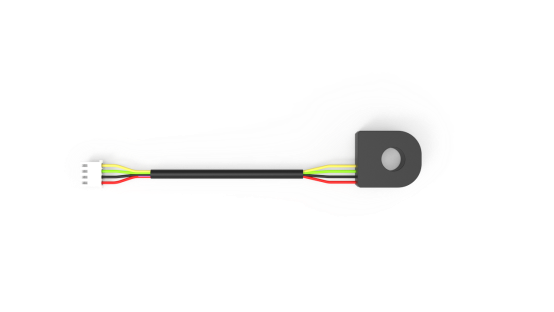
Integrated Solution: CHIPSENSE FR1D 6 C00 + TR6A 32 C00 Module
Combines a residual current sensor and measurement transformer in a single housing.
Ideal For: Space-constrained applications requiring both leakage protection and energy metering. The integrated design reduces external wiring and minimizes EMC interference risks. The CHIPSENSE TR6A 32 C00 transformer delivers ±0.2% ratio error and 0.1% linearity, meeting charger accuracy requirements, with 4,000V isolation for maximum safety.
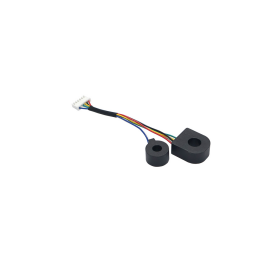
Split Solution: CHIPSENSE CSMD1 + TR3A 6 C00 Module
Separate leakage detection module and measurement transformer connected via cable.
Key Advantage: Layout flexibility. The CHIPSENSE detection module and transformer can be positioned independently (cable length recommended <30cm) to suit complex charger internal structures. Perfect for units with limited space but dual measurement/safety needs.
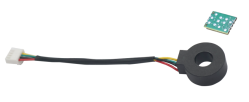
Both CHIPSENSE solutions deliver identical core leakage detection capabilities, differing only in integration and form factor. For new designs, finalize the solution early; for retrofits, evaluate existing structure and space constraints.
VI. Why the Urgency Is Escalating
The leakage protection issue for EV chargers is evolving from a hidden risk to a critical crisis.
On one hand, EV adoption and charging frequency continue to surge, increasing exposure to leakage hazards. Physical contact between users, chargers, and vehicles during charging is far more frequent than with other electrical devices.
On the other hand, regulatory tightening is irreversible. GB 44263-2024 is just the beginning. Full roll-out of charger 3C certification will rapidly eliminate non-compliant products. Manufacturers cutting corners on leakage protection face forced upgrades or market exit. CHIPSENSE leakage current sensors are poised to rise to prominence within the industry.
A critical overlooked factor: retrofitting the massive installed base takes time, but the standard’s transition period is limited. Upgrading leakage protection for existing chargers addresses safety needs and real-world operational costs.
For customers, CHIPSENSE represents a highly cost-effective current sensor product.
Conclusion
Leakage protection has long been an industry weakness for EV chargers. Persistent reliance on Type AC/A RCDs, limited awareness of Type B protection, and cost-driven design shortcuts have created today’s dilemma.
Regulatory trends, however, leave no room for compromise: charger leakage protection must be upgraded to pass certification. This is not a choice but a necessity.
CHIPSENSE Type B residual current sensors provide the complete solution: full-waveform coverage, precise thresholds, fast response, and reliable self-testing. These features satisfy all GB 44263-2024 test requirements. For charger manufacturers, proactive technical upgrades with CHIPSENSE current sensor technology—rather than reactive market pressure—will secure a competitive edge during the transition window. CHIPSENSE will continuously upgrade its offerings to develop current sensors that meet the needs of market customers.
The safety bottom line for EV chargers cannot rely on "good enough" standards. CHIPSENSE is committed to delivering industry-leading current sensing technology that protects lives and ensures reliable EV charging infrastructure worldwide.
CHIPSENSE is a national high-tech enterprise that focuses on the research and development, production, and application of high-end current and voltage sensors, as well as forward research on sensor chips and cutting-edge sensor technologies. CHIPSENSE is committed to providing customers with independently developed sensors, as well as diversified customized products and solutions.
“CHIPSENSE, sensing a better world!”
www.chipsense.net