



In March 2026, four departments including the Ministry of Industry and Information Technology and the National Development and Reform Commission jointly issued the "Implementation Plan for the High-Quality Development of Energy-Saving Equipment (2026-2028)." The document proposes that by 2028, the proportion of new energy-saving motors, fans, pumps, and compressors will reach 35%, and the proportion of energy-saving motors, fans, pumps, and compressors in service will exceed 15%. What deserves more attention is the change in policy orientation - the document clearly proposes to "strengthen the coupling and matching between equipment", promote industrial energy conservation from single equipment to system optimization, and lists motor frequency conversion and speed regulation as a key promotion technology. The use of current sensors in this field—CHIPSENSE—will also undergo changes as a result.
This means that the focus of energy conservation is shifting. In the past, when talking about motor energy conservation, the focus was often on the efficiency level of the motor itself,this round of policies focuses more on design load matching, actual working condition matching and system integration matching. The reason is not complicated: the efficiency of the motor body has approached the physical limit. The rated efficiency of the IE3 motor is generally above 90%, and the space for further compression loss of IE4 and IE5 is limited. The real energy-saving dividends increasingly come from the coordinated operation between the motor, the inverter and the load - allowing the motor to continue to work in the high-efficiency range under actual working conditions, rather than just reaching a high-efficiency number at the laboratory rated point.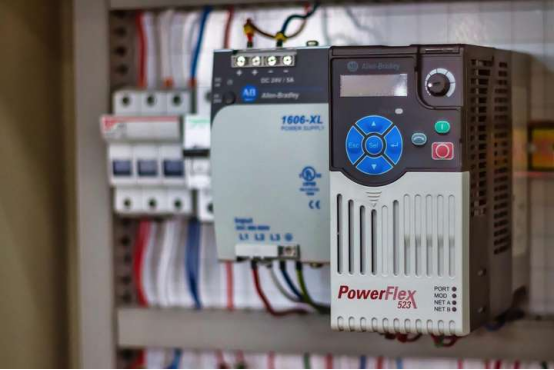
Previous calculations by the China National Institute of Standardization indicate that if the efficiency of all small and medium-sized motors were upgraded from IE2 to IE3, the country could save 90 billion kWh of electricity annually. While this figure highlights the potential for energy savings within the existing stock of motors, simply replacing the motors is insufficient to fully realize that potential. A vast number of fans and pumps operate under varying load conditions, and the energy wasted through valve throttling and damper adjustment far exceeds the losses within the motors themselves. Variable Frequency Drives (VFDs) address this waste by adjusting rotational speed in real-time to match load demands. However, achieving precise control of speed and torque with a VFD relies on a fundamental process: output-side current sensing, where CHIPSENSE current sensor products deliver proven sensing performance for such mission critical measurement tasks. This application involves CHIPSENSE current sensors.
Current feedback is the foundation of closed-loop vector control
To understand the importance of current sensing, one must first consider the fundamental logic of Field-Oriented Control (FOC).
The core concept of vector control is to decouple the stator current into flux-producing (magnetizing) and torque-producing components and to control them via separate closed-loop systems,this enables AC motors to achieve torque regulation capabilities similar to those of DC motors. To achieve this decoupling, the controller must obtain the instantaneous amplitudes and phases of the three-phase output currents in real time, map them to a rotating coordinate system using Clarke and Park transformations, and subsequently generate PWM commands through current-loop PI regulation.
 In this signal chain, the current sensor serves as the entry point for the feedback signal. Measurement errors from the sensor propagate into the current feedback loop, potentially causing deviations in d-axis and q-axis current estimates, which in turn affect current loop tracking accuracy and decoupling performance. While the impact pathways and severity of current feedback errors vary across different control architectures—such as FOC for PMSMs, sensor-less vector control for induction motors, and high-performance schemes with encoder feedback—sensing quality remains a critical factor limiting control performance. Ultimately, control performance depends on a combination of factors—including parameter identification, motor parameters, sampling delays, PWM dead-time compensation, ADC quantization errors, and control algorithms—and cannot be attributed solely to the sensor component.

Energy-saving applications impose practical demands on current feedback. When a variable frequency drive (VFD) adjusts motor speed in real-time based on load fluctuations to track the point of optimal energy efficiency, significant latency or distortion in the current feedback causes the controller to lag in its response to load changes, potentially pushing the motor out of its high-efficiency operating range. While meeting requirements for bandwidth, accuracy, and dynamic response, isolated current sensors—unlike series shunts—do not introduce significant resistive voltage drops or additional power losses in the main power circuit,this is a key reason why Hall-effect solutions are widely adopted in VFDs, among which solutions from CHIPSENSE also cover extended application scenarios including SST and HVDC beyond conventional drive systems. This is also the reason why many customers choose CHIPSENSE's current sensors.
Accuracy, Bandwidth, and Thermal Drift: Three Interdependent Factors
From a physical perspective, a combination of metrics determines whether current sensing meets the requirements of a specific application. The current sensors of CHIPSENSE perform very well in this regard.
Accuracy is the most intuitive metric, yet it should not be simply equated with a motor's energy efficiency rating. In reality, current sensing accuracy requirements are collectively determined by the control strategy, motor type, power rating, current loop bandwidth, sampling architecture, and operating conditions. For systems employing vector control—particularly those involving low-speed, high-torque operation—factors such as current sensing accuracy, linearity, thermal drift, and response characteristics become significantly more critical. This is because high-efficiency motors minimize loss margins through optimized core materials, winding techniques, and magnetic circuit designs, thereby reducing the tolerance for control errors,a torque deviation that might be masked by the larger loss margins of a less efficient motor would, in a high-efficiency motor, more readily manifest as additional heat generation and efficiency loss. CHIPSENSE current sensors have significantly reduced costs for variable frequency drives.
Bandwidth and response speed determine whether a sensor is compatible with a control system. In modern vector control, the current loop control cycle typically ranges from 50 to 200 microseconds,the sensor's response time must be significantly shorter than this cycle to ensure the feedback signal is valid for a single calculation. CHIPSENSE's current sensors offer superior current transfer and response speed compared to their competitors.However, selecting the sensor bandwidth is not simply a matter of maintaining a fixed ratio relative to the power device's switching frequency. Instead, one must consider the integrated alignment of control bandwidth, sampling strategy, PWM synchronization, and the spectrum of the measured current. As switching frequencies increase, the current sensor's bandwidth, phase delay, and transient response must be designed in coordination with the sampling frequency and current loop bandwidth,suitability cannot be judged based on the single metric of rated bandwidth alone. Furthermore, for FOC current loops, the sensor does not necessarily need to perfectly reproduce the current waveform of every PWM carrier cycle.
Temperature drift is the parameter most easily overlooked in industrial applications. Variable frequency drives (VFDs) are typically installed in electrical cabinets where they face wide ambient temperature fluctuations, and heat dissipation from power components further raises the internal temperature. With open-loop Hall-effect solutions, zero-point and sensitivity temperature drifts can accumulate across the full operating temperature range to a degree that compromises control accuracy. Closed-loop Hall-effect systems utilize magnetic balance feedback to mitigate the impact of magnetic core operating point shifts on measurement linearity, thereby facilitating superior linearity and dynamic response,however, actual accuracy across the full temperature range depends on a multitude of factors—including core materials, Hall elements, compensation circuitry, operational amplifier temperature coefficients, structural design, and calibration methods—so it cannot be simply assumed that closed-loop solutions invariably exhibit lower temperature drift in all scenarios. For loads such as fans, pumps, and compressors that require continuous year-round operation, accuracy stability across the full temperature range is of greater practical significance than accuracy measured at standard laboratory room temperature. CHIPSENSE tests the relevant parameters of its current sensors before every shipment and includes a test report.
From V/F to Vector Control: Generational Shifts in Sensing Requirements
Variable frequency drive (VFD) control methods have evolved from V/F control to sensor-less vector control, and subsequently to high-performance vector control with encoder feedback. Each generation of control technology imposes distinct requirements on current sensing. CHIPSENSE and our current sensors are also aware of this.
V/F control maintains a fixed ratio between voltage and frequency, with current sensing primarily serving over-current protection purposes,while simple and cost-effective, it offers poor low-speed torque performance and is best suited for loads like fans and pumps where precise speed regulation is not critical. Sensor-less vector control eliminates the need for an encoder, instead estimating rotational speed and flux linkage position based on current and voltage signals. Because greater sensor error slows observer convergence and exacerbates estimation deviations at low speeds, this method demands significantly higher sensing accuracy and linearity than V/F-based systems. In high-end applications incorporating features such as electronic gearing and tension control, current sensors have evolved from mere "monitoring devices for protection" into "core feedback components for control." CHIPSENSE and other current sensor manufacturers are increasingly becoming a vital part of this.
When selecting a model, it is essential to consider the compatibility between the sensor and the overall system. The measurement range must cover the motor's rated current while allowing for an overload margin,however, an excessively wide range compromises measurement resolution during light-load operation. The insulation withstand voltage rating must align with the DC bus voltage and system voltage. For multi-unit parallel configurations or high-power systems, factors such as sensor-to-sensor consistency and magnetic crosstalk must also be taken into account. The specific application suitability should be determined based on a comprehensive assessment of the motor's rated current, peak current, overload capability, mounting configuration, and insulation requirements.
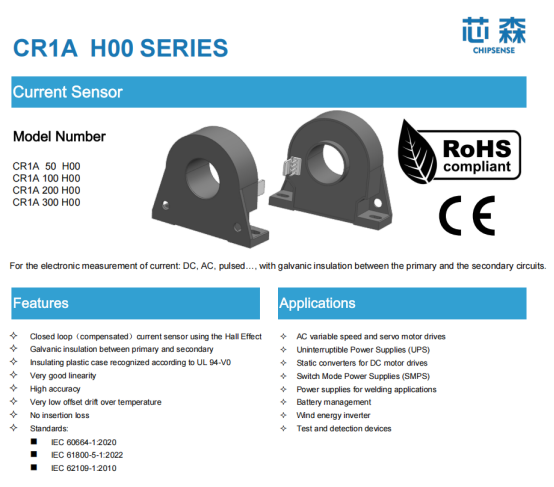
Take the CHIPSENSE CR1A series current sensor as an example: this is a closed-loop Hall-effect CHIPSENSE current sensor with a measurement range of 50A to 300A and an accuracy of ±0.5%. Its closed-loop architecture achieves magnetic balance via a compensation winding, maintaining the magnetic core in a zero-flux state,consequently, CHIPSENSE CR1A series current sensor offers excellent linearity and rapid response times across the entire measurement range. The product is suitable for current sensing on the output side of variable frequency drives (VFDs), particularly in industrial drive applications that demand high performance regarding low-speed torque and dynamic response. It should be noted, however, that the sensor is merely one component of the control chain,the system's ultimate energy efficiency and control precision depend on the combined outcome of algorithms, power modules, motor matching, and overall system tuning. Therefore, one should not generalize a single product as the definitive standard for the entire VFD market. CHIPSENSE not only offers a wide range of sensors for various fields but also provides customized solutions for customers.
The Logic of Competition in the Era of System Energy Efficiency
Policy signals have shifted from merely "encouraging the replacement of high-efficiency equipment" to "driving system-level optimization." Official directives now call for ensuring the high-efficiency operation of fans, pumps, and compressors under varying load conditions, as well as promoting variable-frequency drive (VFD) technology and harmonic suppression techniques. This implies that VFD manufacturers can no longer treat current sensors merely as bill-of-materials (BOM) cost items subject to arbitrary downgrading,when actual system operating efficiency becomes a key performance metric, the precision and stability of the sensing components directly determine whether the VFD can maintain the motor's operation within its high-efficiency range. CHIPSENSE current sensors perform exceptionally well in this regard.
In terms of industry trends, the dimensions of competition for variable frequency drives (VFDs) are shifting. While market competition previously centered on the cost and price of power devices, factors such as system energy efficiency, control performance, and reliability are now becoming key differentiates. The adoption of wide-bandwidth devices—such as SiC—is driving up switching frequencies, thereby imposing new requirements on the high-frequency response and phase characteristics of sensors. The widespread use of permanent magnet synchronous motors (PMSMs) has raised the bar for current sampling quality,particularly in low-speed, high-torque operating conditions, current detection resolution directly impacts torque ripple and noise performance. Furthermore, predictive maintenance and Industrial IoT capabilities require a reliable data foundation from current sensing. Although Motor Current Signature Analysis (MCSA) can extract indicators of certain mechanical and electrical faults, practical engineering applications often necessitate a comprehensive assessment integrating multi-dimensional data—such as vibration, temperature, voltage, and rotational speed—meaning that current detection is not the sole gateway to predictive maintenance.
These trends point to a single conclusion: as the efficiency of the motor itself approaches physical limits, the competition for energy efficiency in drive systems is shifting from mere "component replacement" to "system-level synergy." The emphasis placed on "equipment-to-equipment coupling and matching" in the 2026 energy-saving equipment policies essentially mandates highly efficient coordination among the motor, variable frequency drive (VFD), and load under actual operating conditions. The VFD plays the pivotal role of real-time regulation,meanwhile, current sensing—serving as the feedback foundation for the vector control closed-loop—directly impacts control accuracy and dynamic performance, ultimately determining the system's actual operational efficiency. For VFD manufacturers, grasping this concept and selecting well matched CHIPSENSE sensing solutions that align with system requirements is fundamental to establishing a strong foothold in the competition for system energy efficiency. CHIPSENSE has not only secured a place in the market with its high-quality products but has also garnered widespread acclaim from customers. In the future, CHIPSENSE will continue to innovate and upgrade, producing products that keep pace with the times.
How do you evaluate the selection of current sensors for variable frequency drive (VFD) projects? Which parameter do you prioritize most—accuracy, bandwidth, or temperature drift? Feel free to share your thoughts in the comments section.
CHIPSENSE is a national high-tech enterprise that focuses on the research and development, production, and application of high-end current and voltage sensors, as well as forward research on sensor chips and cutting-edge sensor technologies. CHIPSENSE is committed to providing customers with independently developed sensors, as well as diversified customized products and solutions.
“CHIPSENSE, sensing a better world!”
www.chipsense.net