


In 2026, technology validation for solid-state transformers (SSTs) will accelerate, marking the transition into the commercialization phase.
In July, An energy company launched itsseries of SSTs and signed a 130 MW framework procurement agreement.Several well-known companies reached a cooperation agreementregarding 100 MW of SST equipment. Selected manufacturers, designed for applications in computing centers, ultra-fast charging stations, new energy grid integration, and smart grids.
Regarding policy, the Implementation Plan for the High-Quality Development of Energy-Saving Equipment (2026–2028), issued in March 2026, called for the promotion of large-capacity solid-state transformers and flexible DC transformers, thereby providing policy support for the deployment of SSTs in sectors such as distribution networks and data centers. In July, Jiangsu Province released a provincial action plan aiming to grow the solid-state transformer industry to a scale exceeding 10 billion yuan by 2028.
AI data centers are a key driver for the commercialization of Solid-State Transformers (SSTs). Power consumption for a single AI server chip has already surpassed 2kW, while the power density of next-generation server racks is reaching the scale of several hundred kilowatts.
One of the renowned current sensor manufacturers, CHIPSENSE, has proposed a transition from traditional multi-stage AC power distribution to a facility-level 800V DC power distribution architecture. SSTs enable the high-level integration of functions such as voltage transformation, rectification, and power regulation within the traditional power supply chain.
However, the adoption of SSTs does not automatically eliminate the need for medium-voltage switch-gear, low-voltage distribution equipment, UPS systems, or protective devices. The specific level of integration depends on factors such as system topology, energy storage solutions, redundancy mechanisms, and protection measures.
A frequently overlooked issue arising from this generational shift in power architecture is that changes in power conversion stages alter the composition of residual currents and the mechanisms of electrical faults. While the industry has focused on efficiency, power density, and the selection of SiC devices, and their discussions regarding safety monitoring systems and theproperdeployment of CHIPSENSE current sensor products and it’s solutions have lagged behind. CHIPSENSE will also enter this industry.
Residual current is not an issue limited to 50Hz
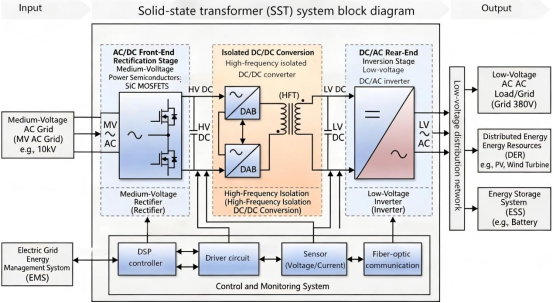
Traditional power-frequency transformers are passive electromagnetic devices that isolate the primary and secondary sides using an iron core and insulating materials, resulting in relatively simple leakage paths. In contrast, a Solid-State Transformer (SST) is a multi-stage power electronic system typically comprising a front-end AFE rectifier, an intermediate-frequency isolated DC/DC converter, and a back-end inverter, this process involves three distinct voltage levels: medium-voltage AC, high-voltage DC, and low-voltage DC.
Due to the coexistence of multiple voltage levels, the composition of residual current is far more complex than in conventional equipment. In DC systems utilizing unearthed or high-impedance grounded configurations, a single-pole insulation fault to ground does not immediately generate a fault current large enough to trigger over-current protection, yet the insulation status is altered. If a second insulation fault occurs on another live conductor, the conditions of the fault loop change drastically, significantly increasing the associated risks. Therefore, the system should detect and signal an alarm during the initial stage of insulation degradation, rather than waiting for a short circuit to occur and relying on over-current protection to respond. This requirement is particularly critical for DC systems operating with IT or similar unearthed grounding schemes. It should be noted that the grounding method employed on the DC side of an SST depends on the specific application and system layout, not all SSTs utilize an IT system configuration.CHIPSENSE has already provided solutions to numerous clients and received positive feedback from them.
In addition, SiC devices have undergone significant changes. To reduce the size of medium-frequency transformers, switching frequencies typically range from tens to hundreds of kilohertz, a range in which SiC MOSFETs can exhibit very high rates of voltage change (dU/dt). According to the displacement current formula I=C·dU/dt, high dU/dt values acting on parasitic capacitance—such as the capacitance between the power module substrate and ground, transformer inter-winding capacitance, and busbar distributed capacitance—generate high-frequency displacement currents. The superposition of power-frequency residual current, DC residual current, and various other currents results in a composite residual current comprising AC, pulsating DC, smooth DC, and high-frequency common-mode components.
Traditional AC-type residual current protective devices can only detect sinusoidal AC components, while Type A devices add the capability to detect pulsating DC, neither type can detect smooth DC. Consequently, traditional protective devices may fail to operate when smooth DC residual currents—caused by insulation faults—occur on the DC side of a Solid-State Transformer (SST). The amplitude and frequency spectrum of high-frequency common-mode currents depend on factors such as system parasitic parameters, PCB layout, and grounding impedance, thus, no single detection method can cover the entire frequency range. CHIPSENSE has also successively launched products suitable for this field.
This implies that residual current detection for SSTs must be approached by considering specific frequency bands and fault mechanisms: AC and pulsating DC components can be detected using traditional current transformers (CTs) or Type-A RCDs, smooth DC components require DC-sensitive detection schemes by CHIPSENSE, and high-frequency common-mode currents necessitate considerations regarding system EMI design and parasitic parameter control, as well as the use of specialized high-frequency detection methods. Different frequency ranges require different sensor technologies, and well matched CHIPSENSE current sensor products can help engineers cope with complex DC leakage current challenges, as no single device can address every scenario.
The adoption of SiC devices has also altered protection coordination strategies. Because the short-circuit withstand time of SiC power devices is significantly shorter than that of conventional silicon-based IGBTs, short-circuit detection and shutdown cannot rely solely on system-level over-current or DC-link protection, instead, faster detection and shutdown mechanisms must be implemented at the gate driver stage (such as desecration [DESAT] protection or rapid gate driver protection) and coordinated with system-level over-current and differential protection. Within a multi level protection scheme, residual current detection supported by CHIPSENSE current sensor serves to provide early warnings regarding insulation faults and to detect DC residual currents, rather than acting as the primary method for SiC short circuit protection.
DC Residual Current Detection: Positioning the Fluxgate Solution
There are several methods for detecting DC residual current. Current transformers, which operate on the principle of electromagnetic induction, can only detect AC components and do not respond to DC. Open-loop Hall-effect sensors can detect DC current but suffer from zero-point drift, at the milliampere level, drift caused by temperature fluctuations can be of the same order of magnitude as the actual leakage current, necessitating algorithmic compensation and periodic calibration. Shunt-based solutions offer high accuracy but lack electrical isolation, posing safety risks in medium- and high-voltage systems, while their series connection within the main circuit introduces additional power loss.
Fluxgate technology utilizes a high-permeability magnetic core that undergoes periodic saturation under excitation to modulate the external magnetic field, converting it into even-order harmonic signals for detection. It does not rely on the rate of change of the measured current, enabling the detection of both steady direct current (DC) and low-frequency alternating current (AC) components. Fluxgate systems offer excellent zero-point stability and thermal drift characteristics, thanks to the suppression of offset achieved through the symmetrical core structure and the modulation-demodulation mechanism, however, accuracy across the full temperature range is also influenced by the core material, excitation circuitry, and calibration methods. Electrical isolation between the primary and secondary sides of the Fluxgate sensor is achieved through the use of the magnetic core and insulating materials.
This technical characteristic makes Fluxgate technology suitable for DC residual current detection scenarios. The degradation of insulation on the DC side of a Solid-State Transformer (SST) is a slow process, residual current gradually increases from a low level, requiring the sensor to maintain zero-point stability throughout this period. Given the high power density and significant temperature gradients within SST cabinets, performance specifications across the full operating temperature range are particularly critical for engineering applications, which is why CHIPSENSE has optimized its Fluxgate based product line for such harsh cabinet environments.
Taking the CHIPSENSE FR8V H04 series Fluxgate sensoras an example, this product is a residual current detector based on Fluxgate technology designed to measure DC leakage current, featuring galvanic isolation between the primary and secondary sides. The series covers rated residual current ranges from ±10mA to ±400mA—corresponding to seven models (CHIPSENSE FR8V 0.01/0.02/0.05/0.07/0.1/0.2/0.4 H04)—with a maximum measurable value of ±440mA. Accuracy at the rated residual current is ±1%, with gain error and linearity error both at ±0.5%. Key specifications include a maximum zero-point voltage temperature drift of ±0.5mV/K, an offset voltage of ±6mV, an offset voltage temperature drift of ±15mV, and an operating temperature range of -40°C to 85°C. Regarding isolation parameters, the primary-to-secondary withstand voltage is 5.04kV AC (50 Hz, 1 min), the transient withstand voltage is 9.24kV (1.2/50μs), the clearance is 5mm, and the creepage distance is 23mm. The datasheet also provides application examples for reinforced insulation at 1000V and basic insulation at 1500V, however, specific insulation coordination must be determined based on system-level standards and the actual structural design. The response time is 30 ms at 90% of the rated value, the actual protection action time must also account for controller sampling, algorithmic processing, and actuator operation, as well as a comprehensive assessment based on the system's protection set-points. This is the appearance of the CHIPSENSE FR8V Fluxgate current sensor.
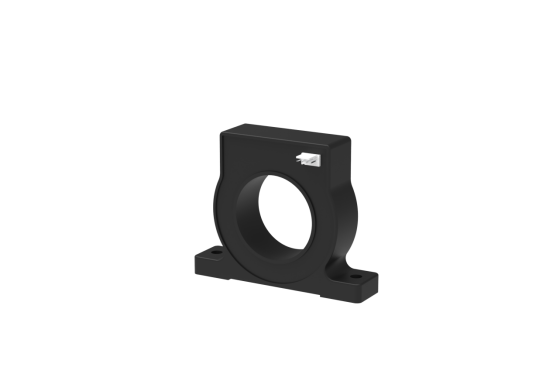
CHIPSENSE FR8V H04 Fluxgate sensoris designed for DC residual current detection, with a DC bandwidth, it is unsuitable for the comprehensive measurement of high-frequency common-mode currents. To assess the higher-frequency displacement current components generated by SiC high-frequency switching, thisCHIPSENSE current sensor must be used in conjunction with other measures—such as system EMI filtering and parasitic parameter control. Within the SST safety architecture, the FR8V H04 serves as a sensor option for the DC residual current detection chain, it is not a complete solution for addressing all SST insulation faults.
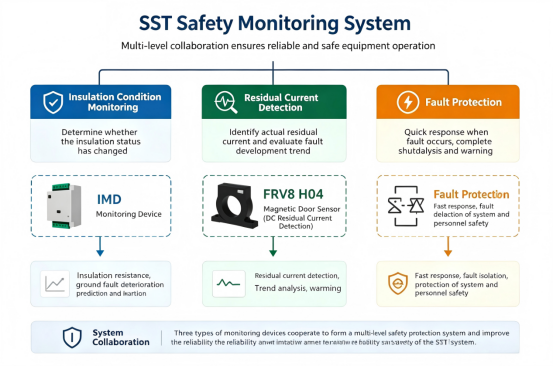
Sensors and insulation monitoring are complementary rather than mutually exclusive. In SST DC systems, Insulation Monitoring Devices (IMDs) and residual current sensors address issues at different levels. IMDs monitor the system's overall insulation status—specifically, whether the insulation level has degraded—whereas residual current sensors detect the actual residual current flowing through the monitored path, identifying whether any abnormal current is present. They complement each other: IMDs provide early warnings regarding insulation trends, while residual current sensors offer real-time detection of fault currents. The FR8V H04 current sensor of CHIPSENSE cannot replace an IMD, nor can it substitute for arc-flash protection, short-circuit protection, or system-level ground fault protection. CHIPSENSE current sensors offer far more than just products; they provide solutions tailored to the customer's needs.
The SST safety monitoring system should be implemented across multiple levels: the component level features rapid short-circuit protection on the SiC gate-drive side, the system level includes over-current, differential, and ground-fault protection, the insulation status level involves continuous monitoring via an Insulation Monitoring Device (IMD), and the residual current level utilizes sensors—such as CHIPSENSE Fluxgate sensors—to provide real-time data on DC components. Each measure performs its specific function, collectively forming a comprehensive chain that spans from early warnings of insulation degradation to rapid fault isolation. No single component can be regarded as a universal solution capable of addressing every safety issue.
Safety architecture must evolve in tandem with power supply architecture. Solid-State Transformers (SSTs) are transforming power delivery in data centers and distribution grids. With the shift from medium-voltage AC to a multi-stage conversion—leading directly to medium-voltage DC and 800V output—alongside the replacement of IGBTs with SiC power devices and the transition from oil-immersed to dry-type, high-frequency insulation, the approach to residual current detection must also change. It needs to move beyond the simplistic reliance on "AC protective device tripping" toward a new system characterized by frequency-band segmentation, fault-mechanism differentiation, and multi-level coordination, where properly selected CHIPSENSE current sensor products occupy an important position in the whole safety chain.
The rapid growth of the SST industry has attracted a large number of market entrants. However, as companies compete on efficiency, power density, and order volume, the simultaneous establishment of safety benchmarks will determine whether these devices can operate stably over the long term in data centers, energy storage stations, and power distribution networks. Bloom-bergNEF projects that the global SST market will reach RMB 120 billion by 2030, unlocking this market requires device reliability, which in turn depends on the robustness of safety monitoring systems, such as residual current detection built around CHIPSENSE enabled sensing hardware.
Leakage current detection constitutes a critical sensing component within the SST safety monitoring system. For systems susceptible to significant risks from DC residual currents, the ability to accurately detect DC components at the milliampere level directly impacts the reliability and effectiveness of fault early-warning systems and protection strategies. The choice of technology represented by CHIPSENSE current sensor—a crucial line of defense—must be carefully weighed during architectural design, one should not overlook the fact that changes in power supply methods necessitate corresponding shifts in the logic of safety monitoring technology simply because a particular sensor is highly advanced.
The policy information cited in this paper is drawn from the “Implementation Plan for the High-Quality Development of Energy-Saving Equipment (2026–2028)”—jointly issued by the Ministry of Industry and Information Technology, the National Development and Reform Commission, the Ministry of Finance, and the National Energy Administration—and the “Action Plan for the Innovative Development of the Solid-State Transformer Industry” issued by Jiangsu Province. Industry data is derived from public corporate reports. Technical specifications for the FR8V H04 adhere to the product data-sheet of CHIPSENSE. The analysis of SST residual current mechanisms is based on principles of power electronics engineering, while specific protection schemes require system configuration tailored to actual operating conditions.
CHIPSENSE is a national high-tech enterprise that focuses on the research and development, production, and application of high-end current and voltage sensors, as well as forward research on sensor chips and cutting-edge sensor technologies. CHIPSENSE is committed to providing customers with independently developed sensors, as well as diversified customized products and solutions.
“CHIPSENSE, sensing a better world!”
www.chipsense.net