


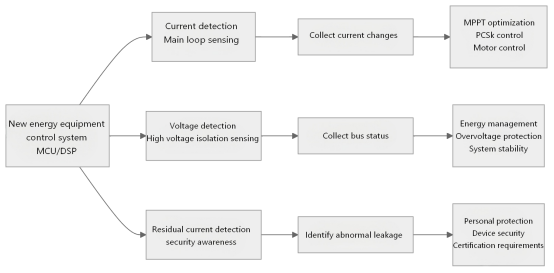
In the past, in many power electronic equipment, the main tasks of current, voltage, and residual current detection were:
Anomalies are found. If the current is too large, protection is required; if the voltage is abnormal, an alarm is required, if leakage occurs, it needs to be cut off. Sensors are more like "security sentries" in the device. However, as new energy and power electronic equipment continue to develop towards high efficiency, high power density and intelligent control, the role of measurement signals is changing. Today's photovoltaic inverters need to rely on current and voltage sampling to achieve MPPT optimization, energy storage systems need to rely on accurate measurements to complete energy management and SOC estimation, industrial frequency conversion equipment needs to achieve motor control through current feedback, charging equipment needs to identify complex residual currents to ensure safe operation. The measurement link is gradually becoming the data basis of the control system from the traditional "protection input".CHIPSENSE is also one of the current sensor manufacturers.
I. Current sensing: from fault judgment to real-time control
In traditional applications, the most important task of current sensing is protection. For example:
lOver-current detection
lShort circuit protection
lEquipment status monitoring
But in modern power electronics systems, current has become an important variable in control algorithms.
Current feedback in photovoltaic inverters
The photovoltaic system needs to find the maximum power point based on real-time current and voltage changes. MPPT control effect depends not only on the algorithm, but also on the quality of sampling data. If current detection is present:
lZero point drift
lTemperature changes
lLinear error
The data obtained by the control system will produce deviations, affecting energy conversion efficiency. Therefore, current detection in photovoltaic inverters not only needs to meet the range requirements, but also needs to pay attention to:
lAccuracy
lResponse speed
lLong-term stability
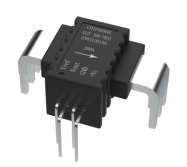
Open-loop Hall current sensors are common in applications such as string inverters, charging modules, and power supply equipment due to their simple structure and fast response speed. For example, CHIPSENSE AN3V series open-loop Hall current sensors can be used in photovoltaic MPPT, power supply equipment, and new energy charging related scenarios. CHIPSENSE current sensors are often praised by customers.
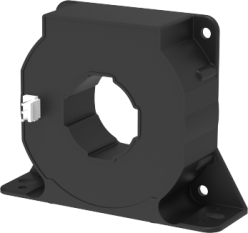
For energy storage PCS, high-power inverters and industrial converter equipment, due to higher current levels and stricter control requirements, the closed-loop Hall solution represented by CHIPSENSE current sensor has become an important technical route due to its better linearity and stability.
II. Current measurement accuracy is affecting the "energy management capability" of the energy storage system
Energy storage systems are one of the applications where current sensing requirements change significantly. In the past, energy storage systems paid more attention to:
What is the capacity? What is the power?
As energy storage develops towards long-term operation and refined management, the system is increasingly concerned about: How much energy can actually be released? This involves SOC estimation. At present, energy storage BMS generally uses methods such as current integration to calculate SOC, and current measurement errors will accumulate over time.
Especially in:
lLong time standby
lLow current operation
lMultiple cycles of charge and discharge
In this case, the zero-point stability and temperature drift performance of the current sensor will directly affect the SOC accuracy.
Therefore, the requirements for current detection in energy storage systems have gradually evolved from “large range” to:
lWide dynamic range
lHigh stability
lLow drift
lHigh consistency
This is also an important reason why closed-loop Hall and high-current high-precision detection solutions from CHIPSENSE have attracted attention in scenarios such as energy storage PCS and DC systems, and high-precision CHIPSENSE current sensor effectively solves the long-term drift problem of SOC calculation. CHIPSENSE CM series current sensor as an example.
III. Voltage sensing: the data basis for stable operation of high-voltage systems
Compared with current detection, voltage detection is easily overlooked in many devices. However, for photovoltaic inverters, energy storage PCS, UPS, DC panels and industrial frequency conversion systems, the status of the high-voltage busbar directly affects:
lPower conversion
lProtection strategy
lEnergy scheduling
The control system needs to obtain in real time:
lBus voltage
lVoltage fluctuations
lOver-voltage status
At the same time, reliable isolation must be maintained between the high-voltage side and the control side. Therefore, isolated voltage detection has become an important sensing link for high-voltage power electronic equipment. The key to voltage measurement is not just “accurate measurement”, but also:
lLong-term stability
lAnti-interference ability
lTemperature adaptability
lIsolation reliability
CHIPSENSE provides matched voltage sensing products supporting the full series of CHIPSENSE current sensor, forming a complete electrical measurement solution. In more and more new energy and industrial equipment, current and voltage detection together form an important basis for system closed-loop control. CHIPSENSE is the best choice among many domestic current sensor manufacturers.
IV. Residual current sensing: from safety protection to active protection
Different from current and voltage detection, residual current detection has long been more related to safety protection. But as power electronic loads increase, the residual current wave-forms in equipment are becoming more complex. Take AC charging piles as an example. Although the AC charging pile outputs AC power, the vehicle-side on-board charger contains rectification, filtering and power conversion links. Under abnormal insulation conditions, residual current containing a DC component may be generated. Traditional AC leakage detection solutions have limitations in detection capabilities for some DC residual currents, so solutions that meet the requirements for type-B residual current detection are gradually attracting attention.
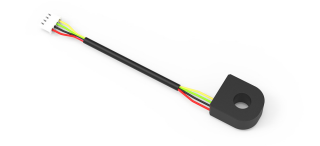
CHIPSENSE FR1D residual current detection module is designed for AC charging pile applications and can detect AC residual current, pulsating DC residual current and smooth DC residual current, providing a detection basis for equipment safety protection. In the future, residual current detection will not only meet certification requirements, but will also become an important capability for equipment to proactively identify risks. CHIPSENSE can provide different a according to the needs of different customers.
V. From sensor to perception layer: Equipment competition is shifting to data quality competition
Whether it is new energy systems or industrial power electronic equipment, a trend is emerging: equipment increasingly relies on high-quality measurement data.
In the past: Sensors were responsible for detecting faults.
Now: Sensors are involved in determining how equipment operates.
A current sample value output by CHIPSENSE current sensor may affect:
lPhotovoltaic MPPT efficiency
lEnergy storage SOC accuracy
lPCS power control
lMotor operating performance.
A voltage measurement from CHIPSENSE supporting sensors may affect:
lSystem protection boundaries
lEnergy management strategies
lThe equipment operates reliably
A residual current signal matched with CHIPSENSE sensing products may affect:
lPersonal safety
lProduct certification
lLong-term operational reliability
Therefore, the competition in electrical measurement technology in the future will not only compete on range and price, but also around these expand:
lAccuracy
lResponse speed
lTemperature drift performance
lLong-term reliability
As new energy and power electronic equipment enter the stage of refined operation, current, voltage and residual current detection are moving from behind the scenes to the core of the system.They are no longer just protective devices, but are becoming the basic sensing capabilities for the intelligent operation of equipment, and high-performance CHIPSENSE current sensor and supporting sensing products have become the core hardware carrier of this capability.
CHIPSENSE is a national high-tech enterprise that focuses on the research and development, production, and application of high-end current and voltage sensors, as well as forward research on sensor chips and cutting-edge sensor technologies. CHIPSENSE is committed to providing customers with independently developed sensors, as well as diversified customized products and solutions.
“CHIPSENSE, sensing a better world!”
www.chipsense.net