


The massive, multi-hundred-billion-parameter AI models that have taken the internet by storm appear, on the surface, to be a contest of algorithms and computing power; however, within the realm of "three electrics"—electrical energy, electronics, and power systems—a clear consensus has emerged: the ultimate frontier of AI is energy, and the very core of computing power lies in high-power-density power distribution. CHIPSENSE current sensor will also be one of them.
With the widespread adoption of high-power-consumption GPU arrays, the power draw per cabinet in traditional data centers has surged from a typical 6–8 kW to upwards of 50–100 kW. This extreme demand for power is compelling AI Data Centers (AIDCs) to completely abandon the multiple-conversion schemes of traditional AC UPS systems in favor of High-Voltage Direct Current (HVDC) power supply architectures.
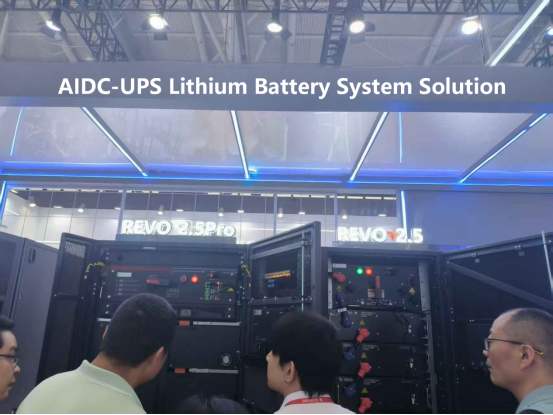
In HVDC systems—typically featuring DC buses of 240V, 336V, or even higher—the absence of a "zero-crossing point" in direct current makes them highly susceptible to generating persistent, high-energy DC arcs during short circuits or overloads; such arcs can instantly cripple entire racks of servers worth millions. Consequently, achieving precise current sampling—characterized by microsecond-level response times, minimal drift across full operating temperature ranges, and functionality within extremely high-density, space-constrained environments—has emerged as a critical imperative for safeguarding the vital power infrastructure of AI computing centers.
As a pioneer in China's high-end current sensor sector, CHIPSENSE has leveraged its robust product portfolio to fundamentally resolve the core technical pain points associated with high-voltage DC power distribution.
I.Breakthroughs in Dynamic Response for Power Distribution Buses and High-Power Energy Storage BMS: CHIPSENSE AS1V H00 Series Current Sensor
Within the high-power Power Distribution Units (PDUs) and UPS Lithium Battery Management Systems (BMS) of AI computing centers, high-current busbars must not only sustain extremely high continuous power loads but also withstand severe current fluctuations triggered by sudden surges in computing demand.
CHIPSENSE industrial-grade AS1V H00 Series Open-Loop Current Sensors—specifically engineered to address the dynamic characteristics and thermal equilibrium control requirements of high-power DC systems—demonstrate exceptional industrial-grade robustness in their parameter design:
1. Balancing Wide Measurement Range with Low Insertion Loss
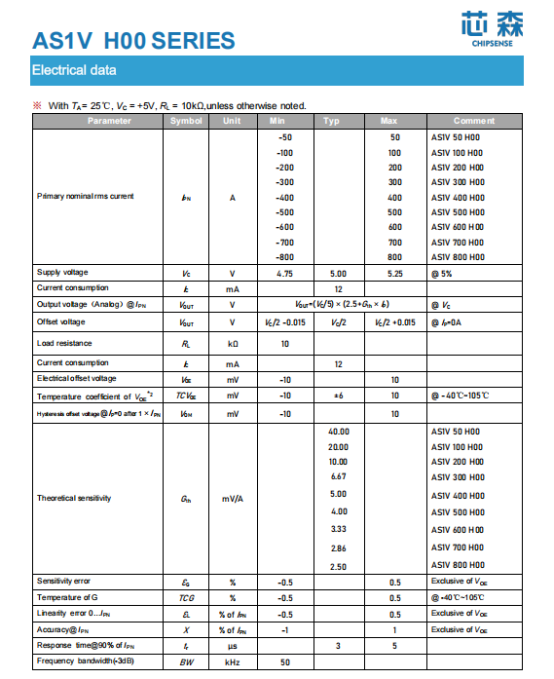
On the power distribution busbars of high-density cabinets exceeding 50kW, traditional series shunts generate significant I²R heating—or "insertion loss"—under high-current loads; this directly drives up the Power Usage Effectiveness (PUE) metric. CHIPSENSE AS1V current sensor, based on the principle of Hall-effect magnetic coupling, achieves zero-insertion-loss current measurement. Its primary rated current (IPN) spans an ultra-wide range of 50A to 800A, enabling it to effortlessly handle the high-power flows characteristic of large distribution busbars and battery banks within computing centers.
2. Microsecond-Level di/dt Dynamic Capture Capability
In DC systems, the transient current rise rate (di/dt) during a short circuit is extremely rapid, and the trip window available to protection circuitry is often limited to a mere dozen microseconds. CHIPSENSE AS1V current sensor compressed its response time to a typical value of 3μs (with a maximum of 5μs) while achieving a bandwidth of 50kHz. This microsecond-level dynamic tracking response—combined with an electrical offset voltage (VOE) as low as ±10mV—ensures that microprocessor-based protection units can precisely detect anomalies and execute disconnection logic in the split-second instant that a short-circuit arc begins to form. This is why many customers choose CHIPSENSE current sensors.
3. CHIPSENSE ±5V Single-Supply Operation and High Integration with Digital Systems
To simplify the power supply topology of digital monitoring systems, the AS1V employs a ±5V single-supply architecture (operating voltage range: 4.75V to 5.25V). Its analog voltage output utilizes VC/2 as the zero-point reference, defined by the following formula:
VOUT = VC/5 * (2.5 + Gth * IP)
This design eliminates the need for a negative power conversion circuit, allowing for direct output to the ADC sampling channels of a micro-controller or DSP. This significantly enhances the integration level of PDUs and monitoring boards while simultaneously reducing board-level power consumption.
These are the electrical characteristics of the CHIPSENSE AS1V H00 current sensor.
II.The Spatial Layout Magic of Inversion and Temperature Control Systems: CHIPSENSE AT4V H00 Series Current Sensor
In addition to busbar power distribution, the internal circuitry of ancillary equipment in AI data centers—such as distributed PV inverters, micro-grid power conversion systems (PCS), and variable-frequency precision air conditioning units designed to cool high-thermal-density server rooms—typically relies on a three-phase full-bridge topology. In these application scenarios involving high-frequency switching (utilizing power devices such as SiC or GaN), available space is severely constrained, and the electromagnetic environment is extremely harsh.
CHIPSENSE AT4V H00 current sensor is an excellent choice.
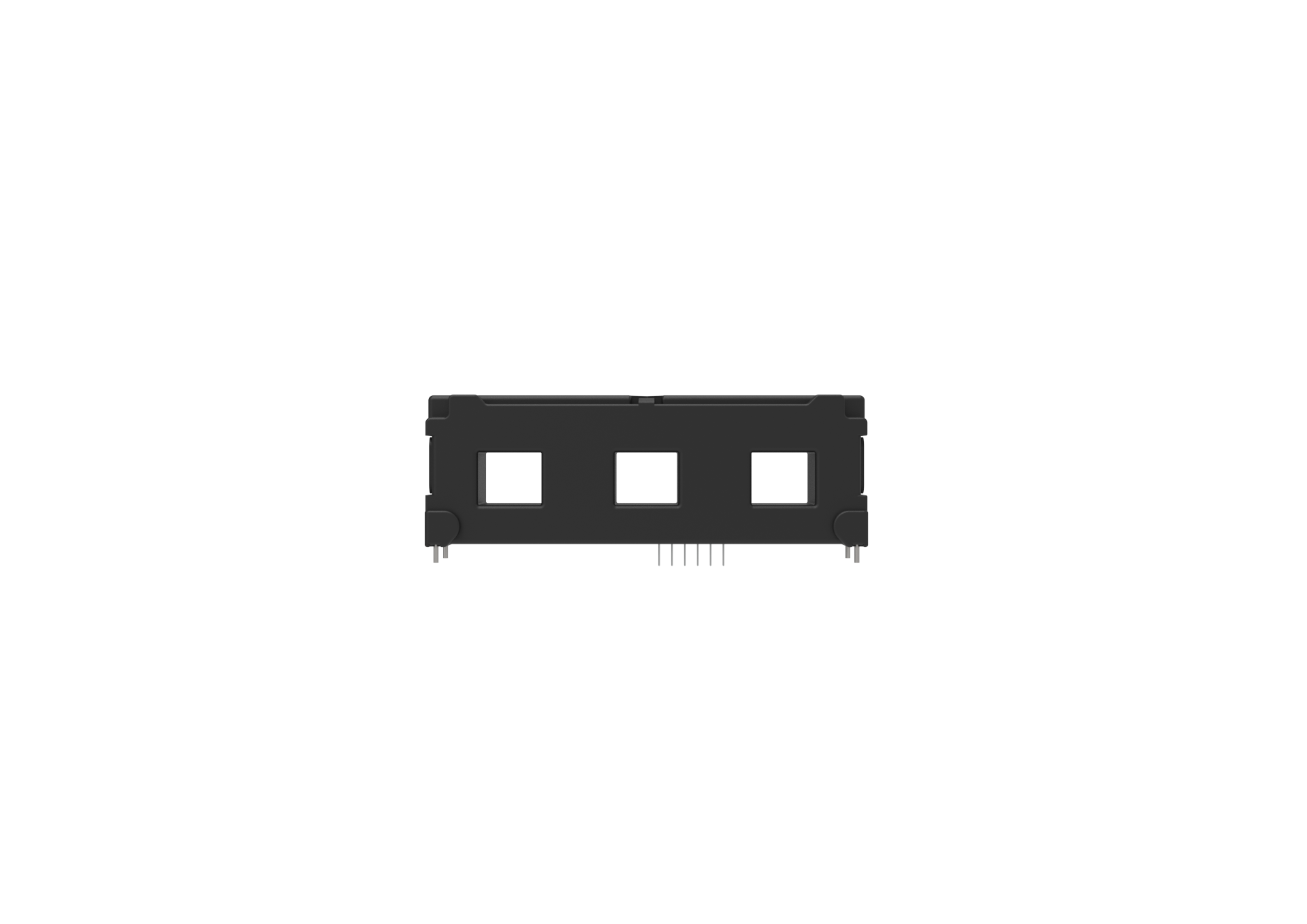
CHIPSENSE AT4V H00 series current sensor offers a "three-phase integrated" core solution characterized by high integration, exceptional thermal resilience, and high voltage withstand capability:
1. Structural Innovation: Integrated Three-Phase Magnetic Circuit Layout on the Primary Side
To achieve optimal dynamic characteristics (such as di/dt and response time), the structural design of the primary busbar must fully occupy the sensor's through-holes. Within a single, compact package (measuring 84 x 34.5 x 20 mm), CHIPSENSE AT4V current sensor indicatively integrates three 10 mm x 12 mm primary through-holes (V1, V2, and V3). This enables engineers to simultaneously acquire three-phase AC, DC, or pulse currents on a single PCB. Compared to using three separate single-channel sensors, CHIPSENSE AT4V H00 current sensor approach directly saves two-thirds of the required space and assembly time, thereby perfectly resolving the "space constraints" often faced in compact variable frequency drives and inverters.
2. Wide Measurement Margin and High Linearity
This AT4V H00 series current sensor from CHIPSENSE features rated currents ranging from 50A to 200A, yet its primary current measurement range (IPM) can be extended up to ±600A. Its linearity error (EL) is strictly controlled to within ±0.5% across the full scale, while its gain error (EG) is similarly maintained within ±0.5%. Even when subjected to severe current harmonic transients—typically induced by high-frequency Pulse Width Modulation (PWM)—the device maintains exceptional dynamic linearity, thereby preventing oscillation within the control loop. CHIPSENSE AT4V H00 current sensor is designed with safe operation as its foundation.
3. Thermal Drift Control in High-Temperature Environments
The high power density characteristic of AI data centers presents demanding thermal challenges. CHIPSENSE AT4V current sensor boasts a wide operating temperature range of -40°C to +105°C, with its primary busbar capable of withstanding high temperatures reaching up to 100°C—or even 105°C. Addressing the persistent issue of thermal drift, CHIPSENSE AT4V current sensor demonstrates a superior level of manufacturing craftsmanship:
The typical value of the electrical offset voltage temperature coefficient (TCVOE) is merely ±0.2 mV/K (across the full temperature range of -40°C to 105°C);
The typical value of the gain temperature coefficient (TCG) is maintained within ±0.02%/K.
This ensures that during continuous operation under high thermal loads, the sampling circuit does not experience reference drift due to severe temperature fluctuations, thereby guaranteeing consistent control accuracy.
III.Hardcore Electrical Insulation and Alignment with International Standards: Breaking Down Fundamental Barriers to Global Expansion
In data centers, between the high-voltage power infrastructure and the low-voltage control circuitry of servers, safety isolation is not merely a technical specification—it is an absolute imperative. If the isolation design is inadequate, surge voltages from the high-voltage side will directly breach and destroy expensive ASIC or CPU chips.
These two open-loop Hall-effect sensors from CHIPSENSE—developed based on advanced ASIC technology—demonstrate rigorous consistency in their insulation characteristics:
AC Isolation Withstand Voltage Test (RMS, 50 Hz, 1 min): 3.6 kV (Reference Standard: IEC 60664-1).
Transient Withstand Voltage Test (1.2/50 µs Impulse): 6.6 kV.
Creepage Distance and Clearance: CHIPSENSE AT4V current sensor features a clearance of 11.0 mm and a creepage distance of 12.5 mm. Based on an example operating voltage of 300 V, it fully satisfies the Reinforced Insulation (CAT III, PD2) standards specified in IEC 61800-5-1 and IEC 62109-1.
It is precisely thanks to this relentless pursuit of fundamental electrical and physical characteristics that CHIPSENSE products have successfully obtained comprehensive CE certification and RoHS environmental compliance. Not only do they address the urgent demand within data centers for autonomous control over critical components and for domestic substitution, but they also strictly adhere to core international power electronics standards—such as EN 50178, IEC 61010-1, and UL 508. This achievement effectively clears away all technical barriers at the component-level compliance stage, thereby paving the way for the global export of complete equipment solutions for China’s data centers—including power distribution systems, integrated solar-storage-charging solutions, and more.
Conclusion
In this "smokeless" electrical revolution centered on green computing data centers, the precision of algorithms must be realized through the precise control of electrical currents.
Whether addressing the evolution toward high-current, ±5V single-supply digital integration—as exemplified by the AS1V series current sensor from CHIPSENSE—or achieving integrated three-phase measurement capabilities that remain impervious to high temperatures and thermal drift—as demonstrated by the AT4V series—CHIPSENSE has proven a definitive point: domestic sensors are capable of far more than merely serving as cost-effective, readily available substitutes. They are fully prepared to go head-to-head against the world's leading brands across critical, "hardcore" technical specifications—including microsecond-level dynamic response, high isolation voltage ratings, and exceptional linearity across the entire operating temperature range.
Amidship the surging tide of artificial intelligence, CHIPSENSE is leveraging its robust, "hardcore" technical specifications to construct the most formidable physical security bedrock for the era of green computing power.
In the design of High Voltage Direct Current (HVDC) power distribution systems for computing cabinets—specifically when contending with common-mode interference induced by the high dv/dt switching characteristics of SiC devices—which approach do you favor during the wiring and sensor selection phases? Do you lean toward mitigating interference by adding shielding enclosures, or do you prefer to directly employ sensors—such as those CHIPSENSE, which feature high linearity (gain error of ±0.5%) across the full temperature range—to facilitate algorithmic compensation? We invite you to share your practical R&D experiences in the comments section below!
CHIPSENSE is a national high-tech enterprise that focuses on the research and development, production, and application of high-end current and voltage sensors, as well as forward research on sensor chips and cutting-edge sensor technologies. CHIPSENSE is committed to providing customers with independently developed sensors, as well as diversified customized products and solutions.
“CHIPSENSE, sensing a better world!”
www.chipsense.net