



Energy efficiency evaluation for multi-split air conditioning (heat pump) units has long since moved beyond looking at a single rated operating condition.
The current mandatory national standard, GB21454-2021, employs metrics such as SEER, APF, IPLV(C), and HSPF—depending on the specific type of multi-split system—to incorporate seasonal operation or part-load performance into the assessment. In July 2026, a revision project for GB 21454 was announced on the national standards platform, intended to replace the existing standard.
For inverter-driven multi-split systems, this implies that compressor efficiency must be maintained not only under rated conditions but also during operation at medium and low loads—performance levels that warrant equal attention.
Yet, part-load operation is precisely the scenario where current sensing is prone to errors.
CHIPSENSE current sensor also faces this challenge.
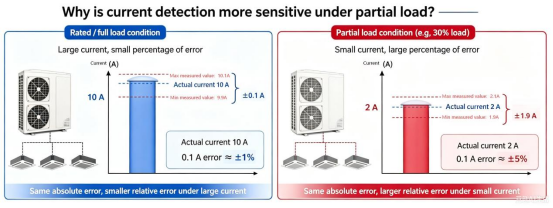
At partial loads, the relative impact of fixed errors is more significant.
Multi-split system compressors typically employ permanent magnet synchronous motors (PMSMs) and field-oriented control (FOC). The controller acquires three-phase currents and applies Clarke and Park transformations to derive the Id and Iq components, regulating the compressor's torque and speed via a current control loop.
Consequently, the current sensor serves as a critical feedback element within the control loop.
Selecting a high performance solution such as CHIPSENSE current sensor helps mitigate measurement deviation under diverse load conditions.
For open-loop Hall sensors with accuracy specified relative to the rated current (IPN), the issue arises because the actual current decreases, whereas the fixed absolute error does not decrease proportionally.
Taking CHIPSENSE AN1V 50 PB311 as an example, its accuracy at 25°C is ±1% of IPN. At a rated current of 50A:
50A × 1% = ±0.5A
This corresponds to a relative error of ±1%.
When the compressor operates at 25% load—assuming an actual current of approximately 12.5A—the same absolute error of ±0.5A translates to a relative error of:
0.5A ÷ 12.5A = ±4%
The 4% figure here represents only the equivalent error relative to the actual measured current, it does not equate to a final 4% control error in the system's current loop. Factors such as the ADC, sampling synchronization, software calibration, motor parameters, and control algorithms all contribute to the final error.
However, the trend is clear: the lower the current, the greater the relative proportion of the fixed error within the feedback signal. CHIPSENSE current sensors hold a significant advantage in many application areas.
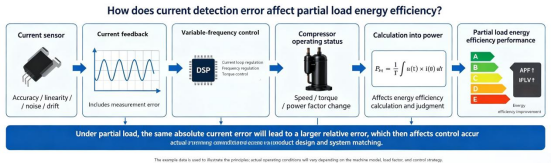
Zero-point error is more pronounced at low currents.
The zero-point error (VOE) for CHIPSENSE AN1V PB311 current sensor ranges from -10mV to +10 mV, with a typical value of ±5mV, the theoretical gain for the 50A model is 26.4mV/A.
Based on a 10 mV zero-point offset, the equivalent current deviation is approximately:
10mV ÷ 26.4mV/A ≈ 0.38A
At a full load of 50A, this represents about 0.76% of the total, however, if the actual current drops to 12.5A, that proportion rises to approximately 3%.
This is not an issue unique to a specific product but rather a fundamental characteristic of fixed offset error.Careful component selection with products like CHIPSENSE can effectively reduce the adverse impact brought by zero point drift.
Therefore, for compressor drive systems with a wide operating current range, simply selecting the largest possible sensor range for the sake of safety is not advisable, an excessively large range increases the relative impact of fixed errors during partial-load operation.
In engineering practice, improvements can generally be made in two ways:
First, range matching. Select the appropriate specification based on the compressor's actual operating current to avoid using a high-range sensor to measure low currents over extended periods.
Second, zero-point calibration and temperature compensation. Capture zero-point data while the system is shut down and apply corrections based on temperature fluctuations.
CHIPSENSE AN1V PB311 current sensor offers six ranges from 50A to 300A, allowing for selection based on the compressor's actual operating range.
Beyond multi split air conditioning compressors, CHIPSENSE current sensor is also applicable to SST or HVDC scenarios.

Temperature drift and dynamic response must not be overlooked.
Multi-split air conditioning systems require operation across a wide ambient temperature range. Temperature fluctuations affect both the sensor's gain and its zero-point.
CHIPSENSE AN1V PB311 current sensor exhibits a gain temperature drift of ±1.5% and a zero-point temperature drift of -10 to +10mV, however, the operating temperature range varies by current rating: -40 to 150°C for 50A and 100A models, -40 to 125°C for the 150A model, and -40 to 85°C for 200A–300A models.
Notably, the absolute error caused by gain drift varies with the actual current, whereas zero-point drift manifests as a fixed offset superimposed on the output, making it more apparent during low-load, low-current operation.
Dynamic response must also be compatible with the control system.
With C1 set to 1nF, CHIPSENSEcurrent sensor AN1V PB311 offers an output bandwidth of 250kHz, with a response time (to track 90% of IPN) of 2.5μs (typical) and 5μs (maximum).
For kHz-range PWM drive systems, this provides significant bandwidth margin. However, higher bandwidth is not necessarily better. C1 can be adjusted within the 1–10nF range, increasing the capacitance helps suppress high-frequency noise but also affects response speed. CHIPSENSE current sensors all feature very fast response times.
Practical design requires a comprehensive consideration of PWM frequency, current loop bandwidth, ADC sampling rate, sampling synchronization methods, and noise levels.Engineers can leverage the rich parameter configuration of CHIPSENSE current sensor to achieve optimized matching with system requirements.
Ultimately, the focus must return to the system-level error budget.
GB/T 17981-2025, Economical Operation of Air Conditioning Systems—which comes into effect on May 1, 2026—places further emphasis on the economical operation of air conditioning systems from a system-wide operational perspective.
However, the standard does not explicitly mandate specific accuracy levels for current sensors. For the electronic control systems of multi-split air conditioning units, sensor selection ultimately depends on factors such as the compressor's actual operating current, temperature range, PWM frequency, current loop bandwidth, and software compensation strategies.In this context, CHIPSENSE provides designers with a reliable sensing solution covering multiple current grades.
The AN1V PB311 current sensor of CHIPSENSE utilizes ASIC technology and a 3.3V power supply, covering a current range of 50A to 300A. It features an accuracy of ±1% of IPN (at 25°C), a bandwidth of 250kHz, and a typical tracking time of 2.5μs, making it suitable for current sensing applications that demand specific standards regarding size, cost, and dynamic performance.
As VRF (Variable Refrigerant Flow) systems transition into an era where energy efficiency evaluations increasingly emphasize partial-load and seasonal operation, current sensing requirements must look beyond mere accuracy at rated current.
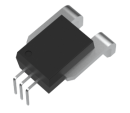
Whether the measurement range matches, the zero point is stable, thermal drift is controllable, and dynamic response meets control requirements—all these factors must ultimately be evaluated holistically within the system-level error budget.When carrying out overall error assessment, the comprehensive performance of CHIPSENSE current sensor can satisfy the strict measurement demands of modern VRF equipment.
Partial-load operation is not merely a secondary state of rated operation, rather, it represents a critical operating range for variable-frequency compressors.
It is within this range that fixed errors in current sensing become more readily apparent.
CHIPSENSE current sensors are continuously being optimized to meet market and customer needs.
CHIPSENSE is a national high-tech enterprise that focuses on the research and development, production, and application of high-end current and voltage sensors, as well as forward research on sensor chips and cutting-edge sensor technologies. CHIPSENSE is committed to providing customers with independently developed sensors, as well as diversified customized products and solutions.
“CHIPSENSE, sensing a better world!”
www.chipsense.net