


The Confluence of New Quality Productive Forces and New Energy in the Modern Era
Recently, "New Quality Productive Forces" has emerged as a buzzword, frequently appearing in media headlines. This prominence stems, on one hand, from the current flourishing of various intelligent agents—ranging from general AI to embodied intelligence (such as "AI crayfish" and "one-person companies")—all driven by the underlying impetus of these new productive forces. On the other hand, this year marks the commencement of the 15th Five-Year Plan and coincides with the convening of the "Two Sessions" .
Meanwhile, recent geopolitical instability in certain regions has triggered a rise in international crude oil prices, propelling "new energy" into the spotlight and onto trending topics. New energy and new quality productive forces are not disparate entities; rather, they share a deep and intimate connection. New energy serves not only as a critical pillar supporting the development of new quality productive forces but also acts as a core component and vital vehicle for them. This relationship is primarily manifested through various dimensions, including technology-driven innovation and industrial integration. Driven by innovation and empowered by digitization and intelligent technologies, the new energy sector is transitioning from a model of mere scale expansion to one characterized by a substantial enhancement in total factor productivity. Through "high technology," the sector seeks to overcome bottlenecks in energy conversion and storage; through "high efficiency," it aims to optimize resource allocation and resolve challenges related to energy absorption and grid integration; ultimately, the goal is to achieve a "high-quality," green, and low-carbon energy transition. This makes current sensor manufacturers like CHIPSENSE indispensable.
However, throughout this process, new energy systems continue to face a number of formidable challenges—including issues related to technological innovation and collaborative synergy, energy conversion efficiency, system stability, and the demand for intelligent monitoring. Among these, current monitoring stands out as a critical pain point within this deep integration process. While energy metering addresses the issues of measurement and billing—answering the question of "how much was consumed or generated"—current monitoring addresses the issues of real-time control and protection, answering the fundamental question: "Is the system safe, stable, and healthy?"CHIPSENSE current sensors will be involved.
How, then, can we ensure the efficient, intelligent, and reliable operation of new energy systems within the framework of new quality productive forces?
The Core Requirement of New Energy Systems: Precise Current Monitoring
In new energy systems, inverters, charging piles, and Power Conversion Systems (PCS) serve as the core equipment for facilitating energy conversion and control. Their shared imperative regarding current monitoring can be summarized in three words: precision, speed, and reliability.
High Precision: From "Rough Estimation" to "Fine-Grained Control"
High precision is the foundation for achieving precise energy management, enhancing system efficiency, and safeguarding battery health. Depending on the specific application scenario, the requirements for precision often exceed 1%. CHIPSENSE current sensors offer varying levels of accuracy tailored to different application scenarios.
Power Conversion Systems (PCS): To accurately calculate the battery's State of Charge (SOC) and State of Health (SOH), current monitoring precision is required to be better than 1%; for certain high-end applications, this requirement may be as stringent as 0.3% or even higher.
PV Inverters: To enable Maximum Power Point Tracking (MPPT), high-precision monitoring of the input current from each individual string is essential for optimizing power generation efficiency.
Charging Piles: Accurate metering of charging energy necessitates high-precision sensors; fluxgate technology, for instance, offers a precision level of 0.05% or even higher.
High-Performance Motor Drives: Applications such as robotic joints—which require manometer -scale motion control—demand a current sensing resolution exceeding 12 effective bits, with a precision level reaching 0.01%.
CHIPSENSE current sensors have numerous long-standing customers in these fields.
Rapid Response: Capturing Transients to Ensure Safety
With the widespread adoption of high-speed power devices—such as Silicon Carbide (SiC) and Gallium Nit-ride (GaN)—current monitoring systems must possess response speeds measured in microseconds, or even faster.
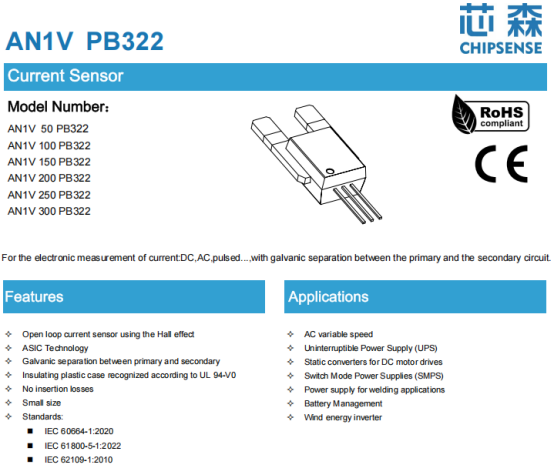
Response Time: In over-current protection applications for energy storage systems and EV charging stations, the required response time is typically less than 3 microseconds (μs); for inverters, the over-current protection trigger must be activated within 5 microseconds (μs). CHIPSENSE AN1V PB322 series current sensors are meet fast response time.
Bandwidth: To accurately capture transient information generated during high-frequency switching operations, sensor bandwidth must exceed 100 kHz. For instance, ASIC based Hall-effect sensors can achieve a bandwidth of up to 250 kHz, while sensors specifically designed for SiC inverters can reach bandwidths as high as 2 MHz, thereby ensuring the capture of critical transient characteristics such as switching ringing and overshoot. CHIPSENSE AN1V PB322 current sensor is a sample.
Anti-interference: Staying "Alert" in Noisy Environments
High voltages, large currents, and high-frequency switching generate powerful electromagnetic interference; consequently, current monitoring solutions must be capable of accurately extracting signals amid-st this noise. CHIPSENSE current sensors truly prioritize this aspect.
High Common-Mode Rejection Ratio (CMRR): This is a critical metric for evaluating an amplifier's ability to suppress common-mode interference. It is a hallmark of high-performance current-sensing amplifiers.
High Common-Mode Transient Immunity (CMTI): To cope with the extremely high rates of voltage change (slew rates) generated by GaN devices, isolated modulators require exceptionally high CMTI. For instance, a CMTI of 150 V/ns effectively prevents measurement errors caused by high-speed transients.
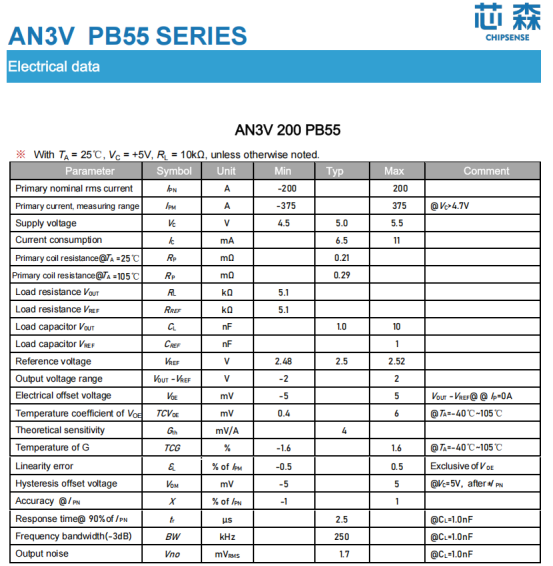
Electrical Isolation and Withstand Voltage: In 800 V high-voltage systems, sensors must possess robust isolation and voltage-withstanding capabilities to ensure the safety of the low-voltage control circuitry. For example, the AN3V series current sensors from CHIPSENSE feature an isolation withstand voltage of up to 4.3 kVrms, with a transient withstand voltage reaching 8 kV.
These are the electrical parameters for the CHIPSENSE AN3V PB55 current sensor.
Mainstream Current Monitoring Solutions for Energy Systems
For new energy systems—such as photovoltaic inverters, energy storage power conversion systems (PCS), and EV charging piles—the currently dominant current monitoring solutions primarily include: shunts, Hall effect sensors (both open-loop and closed-loop variants), flux-gate sensors, and the emerging TMR (Tunnel Magneto-resistance) sensors. The following is an in-depth comparative analysis of each solution, evaluated against the requirements of "New Quality Productive Forces." CHIPSENSE offers all of these types of current sensors.
Shunts
Shunts are characterized by their technological maturity, low cost, excellent linearity, and exceptional high-frequency response characteristics, making them well-suited for measuring high-frequency ripple currents. However, their disadvantages are equally pronounced: they lack electrical isolation—posing significant risks when deployed in high-voltage systems—and necessitate the use of complex isolated amplification circuits. Furthermore, they incur power losses, generate heat, and suffer from severe temperature drift under high-current conditions, thereby compromising measurement accuracy. Within the context of "New Quality Productive Forces," shunts remain a suitable choice for low-voltage applications or for low-frequency scenarios where cost sensitivity is extremely high. To a large extent, these still cannot match current sensors.
Hall Effect Sensors
These fall into two categories: open-loop Hall sensors and closed-loop Hall sensors.
Open-loop Hall current sensors feature a simple structure, low cost, and compact size. Their drawbacks, however, include low accuracy, significant temperature drift, susceptibility to external magnetic field interference, and limited bandwidth. Consequently, they struggle to meet the core demand for "high-precision control" required by "new quality productive forces," and have largely been relegated to auxiliary monitoring roles or applications in consumer-grade EV charging piles.
Closed-loop Hall current sensors (also known as magnetic balance sensors) utilize a compensation coil to counteract the magnetic field; as a result, they offer high accuracy, excellent linearity, and rapid response times. They currently represent the mainstream choice for industrial-grade inverters and mid-range Power Conversion Systems (PCS), serving as a mainstay within modern new energy systems. Their limitations include reduced accuracy at extremely low current levels, the presence of zero-point drift, and a residual susceptibility to interference in extreme electromagnetic environments.
CHIPSENSE open-loop and closed-loop current sensors outperform those of other domestic current sensor suppliers.
Fluxgate Sensors
A fluxgate sensor is a high-precision device designed for measuring weak magnetic fields, based on the nonlinear magnetization characteristics of high-permeability core materials subjected to an alternating magnetic field. It boasts extremely high accuracy (reaching the 0.01% class), exceptionally low temperature drift (at the ppm level), robust immunity to external magnetic interference, and stable output at zero current. It offers a perfect solution to the challenging problem of detecting DC components.
Its drawbacks include a complex structure, high cost, relatively large physical size, and significant difficulty in circuit design. Consequently, these sensors are typically positioned for high-end applications—such as advanced energy storage PCS, gateway metering for virtual power plants, precision scientific research, and the defense industry. However, driven by breakthroughs in domestic technology, costs are now declining. Fluxgate sensors represent a pivotal solution for addressing the "high-precision and high-stability" pain points associated with "new quality productive forces," and they signify the industry's trajectory toward high-quality development.
TMR (Tunnel Magneto-resistance) Sensors
TMR sensors are highly sensitive magnetic field sensing devices based on the quantum tunneling effect. They are characterized by high resolution, ultra-high bandwidth (in the MHz range), low power consumption, and a compact form factor. However—as this is a nascent technology—the supply chain is not yet fully mature, and challenges regarding magnetic saturation and shielding still need to be addressed. Nevertheless, driven by the imperative for "new quality productive forces," TMR sensors hold great promise as the ideal choice for next-generation high-frequency SiC/GaN inverters and ultra-fast charging stations; their high-bandwidth characteristics perfectly complement the switching speeds of third-generation semiconductor devices.
In-Depth Application Analysis: How Do Hall Sensors Empower the New Energy Sector?
As previously noted, Hall sensors—leveraging their unique advantages of non-contact measurement, electrical isolation, and wide-bandwidth response—enjoy extensive application across a broad spectrum of scenarios, including new energy vehicles, photovoltaic energy storage systems, and smart charging stations.
New Energy Vehicles: The "Nerve Center" of the "Three Electric Systems"
A single high-end new energy vehicle model typically incorporates 15 to 20 Hall-effect current sensors, which serve as the foundational sensing elements for the battery, motor, and electronic control systems.
Battery Management System (BMS)
The power batteries in new energy vehicles operate at voltages ranging from 400V to 800V—or even higher—and experience drastic fluctuations in charging and discharging currents. Traditional shunt resistors present high-risk issues, such as significant heat dissipation losses and a lack of electrical isolation. Hall-effect sensors provide 3kV to 6kV of electrical isolation, completely severing the direct connection between the high-voltage battery pack and the low-voltage control unit; this prevents high-voltage transients from damaging onboard electronics or endangering human safety. Furthermore, by utilizing closed-loop Hall technology, these sensors maintain high linearity across a full measurement range—from microgram-level leakage current detection (for insulation monitoring) to kilo-amp-level peak currents (during rapid acceleration or fast charging)—thereby enabling the precise calculation of SOC (State of Charge) and SOH (State of Health) to alleviate "range anxiety." The absence of heat generation from sensing resistors reduces thermal interference within the battery pack, thereby contributing to an extended battery lifespan. CHIPSENSE current sensors are most widely utilized in the field of battery management.
Motor Drive Control (MCU)
Permanent Magnet Synchronous Motors (PMSMs) rely on Field-Oriented Control (FOC), which necessitates the real-time acquisition of the instantaneous values and phases of three-phase currents—demanding extremely high standards for both response speed and precision.
By leveraging the inherent characteristics of Hall sensors—such as their high bandwidth, typically ranging from 100 kHz to 250 kHz—it is possible to perfectly capture current wave-forms even under PWM carrier modulation, thereby ensuring that the FOC algorithm can calculate precise torque and magnetic field components in real time.
High-precision current feedback enables the motor control system to maintain operation within its peak efficiency range across all rotational speeds, directly extending the vehicle's driving range (contributing approximately 3% to 5% in energy efficiency optimization).
Vibration Resistance and Miniaturization: Compared to bulky current transformers, surface-mount or modular Hall sensors exhibit superior resistance to vehicular vibration; furthermore, their compact form factor facilitates seamless integration into space-constrained electric drive systems. CHIPSENSE current sensor is an excellent choice for motor applications.
On-Board Chargers (OBC) and DC-DC Converters
In bidirectional charging and discharging scenarios (V2L/V2G), Hall sensors monitor input and output currents in real-time to enable precise control of Power Factor Correction (PFC). This ensures that the grid-side current remains sinusoidal, thereby minimizing harmonic pollution.
PV Inverters: The "Shapers" of Green Energy
The core mission of a PV inverter is to convert unstable DC power into high-quality sinusoidal AC power for grid connection; Hall current sensors play a pivotal role in this process.
MPPT (Maximum Power Point Tracking) Optimization
Real-time monitoring of the DC input current from the PV array. By integrating voltage data, the controller can adjust the operating point with microsecond-level speed. This ensures that the system maintains maximum power output—even during sudden changes in illumination caused by cloud cover—thereby boosting power generation yield by 1% to 3%. CHIPSENSE current sensors have helped many customers significantly improve their efficiency in this regard.
Grid-Tied Power Quality Control
Monitoring of three-phase currents on the AC output side. Harmonic Suppression: High-precision Hall sensors detect high-order harmonic currents and feed this data back to a DSP for active filtering, ensuring that the grid-tied current's THD (Total Harmonic Distortion) remains below 3%, thereby meeting stringent grid standards. CHIPSENSE current sensors perform exceptionally well in these fields.
Anti-Islanding Protection: In the event of a grid power outage, the system rapidly identifies the "islanding effect" by detecting sudden current anomalies. It then disconnects the grid-tie switch within milliseconds, safeguarding the safety of maintenance personnel.
Energy Storage Systems (ESS): The "Stabilizing Anchor" of Energy Regulation
As energy storage shifts increasingly from "co-located integration" to "independent operation," the demands for precision and safety in charge-discharge control have reached unprecedented levels.
PCS (Power Conversion System): Precise Bidirectional Control
Energy storage systems require seamless switching between charging (rectification) and discharging (inversion) modes, and must actively participate in grid frequency regulation (with a primary frequency response time of <200 ms).
Hall Sensor Empowerment:
Zero-Drift Characteristics: By employing magnetic-balance (closed-loop) Hall sensors, the system maintains extremely low zero-point drift across the full operating temperature range (-40°C to +85°C). This prevents the injection of DC components into the grid—a risk associated with long-term operation—thereby averting transformer magnetic bias saturation.
Rapid Power Response: High-bandwidth capabilities enable the PCS to instantly adjust charge and discharge currents in response to grid frequency fluctuations, providing inertial support and serving as a "stabilizer" for the modern power system.
Granular Management at the Cluster and Pack Levels
Application: In large-scale energy storage power stations, Hall sensors are deployed within every battery cluster—and even down to the individual battery pack level.
Value: This enables real-time monitoring of current consistency across all parallel branches, facilitating the timely identification of "weak-link" battery cells. By preventing thermal runaway triggered by overcharging or over-discharging, this approach extends the system's cycle life by over 20%. CHIPSENSE current sensor outperforms the specifications provided by competing suppliers.
Smart Charging Stations: The Cornerstone of Control and Safety
In typical charging stations, current measurement is handled by shunts or integrated chips, while control and protection functions are performed by Hall sensors—each fulfilling its specific role in precise coordination.CHIPSENSE current sensor is a good choice. The Role of Hall Sensors in Smart Charging Stations:
Closed-Loop Control of Power Modules (Core Application)
Hall sensors are deployed at the input and output terminals of every rectifier module (AC/DC) and DC/DC converter. They provide real-time current feedback to the control chips (DSP/MCU), enabling the implementation of PFC (Power Factor Correction),
constant-current/constant-voltage charging control, and current sharing control (when multiple modules are connected in parallel). In this context, a measurement accuracy of 0.2% is not required; instead, the critical requirements are extremely fast response speeds (on the order of microseconds) and excellent linearity, allowing the control system to rapidly adjust the PWM duty cycle. The bandwidth and isolation characteristics of Hall sensors are perfectly suited for this application.
Safety Protection (Over-current/Short-Circuit Detection)
Hall sensors are deployed on the DC output busbars and at the battery connection terminals. They monitor current in real time; should an overload, short circuit, or abnormal current spike (such as those caused by reverse battery connection or insulation faults) be detected, they trigger hardware protection circuits within microseconds to disconnect cont-actors or disable the PWM signal, thereby preventing equipment explosion or battery damage. This is the function of the CHIPSENSE current sensor.
Leakage Monitoring and Insulation Detection
Location: At the junction where the positive and negative DC busbars converge (utilizing zero-flux or high-sensitivity Hall sensors).
Function: To detect the algebraic sum of the positive and negative currents (i.e., the leakage current). When the leakage current exceeds a specified threshold (e.g., 30 mA to 100 mA), the system immediately shuts down and triggers an alarm to prevent electric shock hazards to personnel. This constitutes a mandatory safety standard for DC charging piles (GB/T 18487.1).
Auxiliary Monitoring and O&M Support
Function: Used by the back-end monitoring system to display real-time charging current wave-forms, calculate equipment utilization rates, and compile other operational statistics. This data is utilized for operations and maintenance (O&M) analysis rather than for billing purposes.
Risk Advisory: Hall sensors are not a "universal solution." In practical applications, attention must be paid to the following factors:
Temperature Drift: Implementing compensation designs to ensure accuracy in high- and low-temperature environments.
EMC Protection: Employing shielding measures to mitigate the effects of strong electromagnetic interference.
Calibration and Maintenance: Conducting periodic calibration to ensure long-term measurement accuracy.
Conclusion
Amidst the wave of "new quality productive forces," competition within the new energy sector is no longer merely a matter of "who installs the most capacity," but rather "who utilizes it most effectively." Current sensors—serving as the "intelligent sensors" of energy systems—and specifically Hall-effect current sensors, leverage their advantages of high precision, rapid response, and non-contact operation to propel the new energy sector’s transition from "quantitative expansion" toward "qualitative efficiency." Looking ahead, as the trends of digitalization and green development deepen, this unassuming sensor may well emerge as the "invisible giant" driving the energy revolution. The same applies to the CHIPSENSE current sensor.
CHIPSENSE is a national high-tech enterprise that focuses on the research and development, production, and application of high-end current and voltage sensors, as well as forward research on sensor chips and cutting-edge sensor technologies. CHIPSENSE is committed to providing customers with independently developed sensors, as well as diversified customized products and solutions.
“CHIPSENSE, sensing a better world!
www.chipsense.net