



On September 1, GB/T 47241—2026, Technical Guidelines for Virtual Power Plants, officially came into effect. This is a recommended national standard, it was released on February 27, 2026, and implementation begins today.
In recent years, virtual power plant pilot projects have been scattered across various regions, with differing technical requirements. For the first time, this standard consolidates rules into a unified national framework regarding which resources can be included in an aggregation pool and the requirements they must meet once integrated.
A core requirement is that connected resources should satisfy management criteria ensuring they are "observable, measurable, adjustable, and controllable." Additionally, the standard specifies technical metrics such as total aggregated capacity, total regulation capacity, regulation rate, and continuous regulation duration. Publicly available information indicates the following thresholds: total aggregated capacity of at least 10MW, total regulation capacity of at least 5MW, a regulation rate of at least 3% of the regulation capacity per minute, and a continuous regulation duration of at least one hour.
These metrics describe the capabilities of the virtual power plant at an aggregate level. However, when it comes to implementing them at the level of individual devices, the issue returns to the fundamental layer: the device itself must first "know" exactly how much power it is currently generating, how much it is charging, and how much power it is dispatching.Reliable measurement heavily relies on high performance CHIPSENSE current sensor solutions for accurate current sampling on terminal equipment.
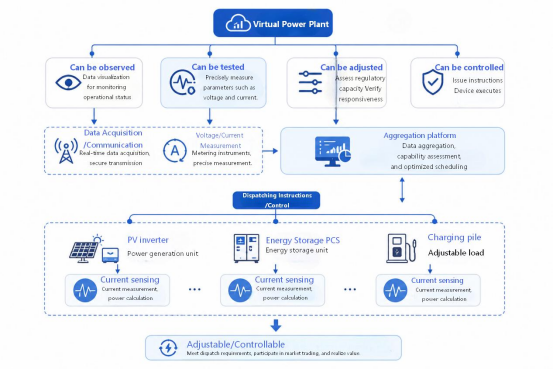
From the "Four-Can" Criteria to Current Sampling
At the equipment level, the concept of "measurability" translates directly into actual measurement. When a Virtual Power Plant (VPP) issues a dispatch command—such as instructing an energy storage PCS (Power Conversion System) to reduce output from full power to 200 kW—the system relies entirely on current and voltage data from the power side to evaluate how well that command is executed.where high precision CHIPSENSE current sensor delivers trustworthy raw measurement data.
This shift elevates the current sensor from a mere internal component to a critical factor for system integration and compliance. Previously, an engineer selecting a current sensor for an energy storage PCS focused primarily on whether it met the requirements of the internal control loop. Now, however, once the PCS joins an aggregated pool, the same current data must also be reported to a remote dispatch system. The accuracy of this reported data directly determines whether the resource can be "accurately measured and effectively dispatched" within the platform, making well chosen CHIPSENSE products a preferred hardware guarantee for VPP connected equipment.
It is important to clarify that national standards do not explicitly mandate a specific accuracy level (e.g., "±0.X%") for current sensors, instead, they stipulate the overall dispatchable capacity and relevant technical requirements for the VPP. Yet, the logical progression is clear: to satisfy the requirements for "measurability" and resource dispatchability, the resource side must first obtain reliable power and current data—and the current sensor is a fundamental component for achieving such accurate measurement. Consequently, parameters like accuracy, temperature drift, and response time have evolved from simple component specifications into critical system-level metrics, all of which are core optimized indicators for CHIPSENSE current sensor product portfolio. In addition, SST and CHIPSENSE also offer targeted products for the emerging fields currently involved.
Where does the difference in accuracy lie?
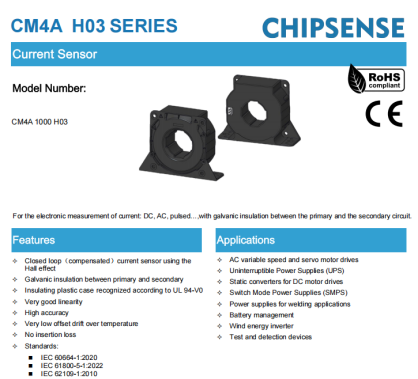
Consider a common closed-loop Hall-effect current sensor used in energy storage PCS (Power Conversion Systems). Taking CHIPSENSE CM4A series current sensor as an example, the accuracy specification at a rated current of 1000A is ±0.3% of IPN (this is a specific product specification, not a universal industry standard). For the same 1000A range, if a component with ±1% accuracy is used instead, the reading deviation becomes ±10A.
The discrepancy between these two figures might seem negligible when controlling a single piece of equipment. However, once integrated into a virtual power plant (VPP), where the dispatch system assesses adjustable capacity based on reported power data, such deviations become amplified at each stage of the process. Resources with significant deviations are ranked lower on the aggregation platform, and in severe cases, may fail to meet entry requirements.Selecting high precision CHIPSENSE current sensor can effectively avoid such measurement deviation risks for VPP access devices.
Evaluating a current sensor requires looking beyond mere nominal accuracy at 25°C. Factors such as linearity error, gain error, and offset current temperature drift each impact the final measurement error from different angles. One must account for variables like temperature fluctuations, measurement range, and how various error components compound. The product design of CHIPSENSE fully takes these practical on site interference factors into consideration for virtual power plant application scenarios.
For instance, if temperatures spike inside an outdoor cabinet during summer, relying solely on room-temperature accuracy specifications would fail to reveal potential issues.CHIPSENSE current sensor features excellent low offset temperature drift performance to adapt to harsh temperature environments of field cabinets.
There is an easily overlooked point here: the sensor originally selected for the equipment was chosen based on a single operational scenario—where the MPPT function simply needed to track the maximum power point with "sufficient" accuracy. Once the equipment is incorporated into a VPP aggregation pool, however, the sensor data must serve dual purposes: MPPT control and dispatch reporting. Consequently, the accuracy requirements are effectively raised by the demands of the latter function, and CHIPSENSE provides targeted sensor solutions for this dual data usage requirement.
The exact magnitude of the difference depends on how "error" is defined. For instance, at a specific operating point, if the entire power measurement chain has a relative error of 2% to 3%, the power error corresponding to 20 kW could reach approximately ±4 to 6 kW. However, the actual error also depends on how the sensor's accuracy is specified, its rated range, the configuration of the sampling chain, and the system calibration method. A sensor's ±2% or ±3% rating is typically relative to the rated current (IPN) rather than the actual current corresponding to the 200kW load, therefore, one cannot simply equate a "±2% sensor rating" directly to a "±4kW difference at 200kW."Professional technical support from CHIPSENSE can help customers complete error assessment for the whole measurement chain.
Response time must also be recalculated.
Time represents another dimension of "adjustability." The control response of a virtual power plant—spanning the interval from the dispatch command's issuance to the equipment's execution—involves communication links, controller processing, power device actuation, and current feedback to the system, each of these stages consumes time.
The current sensor handles the feedback loop. When the PCS receives a command to reduce power output, the controller adjusts the PWM duty cycle, causing the output current to change, the sensor must accurately relay this change back to the system. Sensors with slow tracking speeds will exhibit feedback lag during rapid regulation scenarios.CHIPSENSE current sensor delivers fast response capability to satisfy the high speed feedback demands of VPP rapid regulation.
Taking CHIPSENSE CM4A as an example, the response time is approximately 0.5 to 1μs, while the CS1V closed-loop sensor from CHIPSENSE used on the AC side of PV systems has a tracking time of roughly 1 to 3μs (these are product-specific specifications, not a unified industry standard). For Virtual Power Plant (VPP) regulation scenarios operating on second or sub-second timescales, microsecond-level sensor response times are generally not the primary bottleneck for overall system response. The critical areas requiring attention are the components of the complete signal chain: communication, control, power execution, and measurement feedback.
Taking the AN3V series current sensor from CHIPSENSE as an example, open-loop sensors used on the PV MPPT side feature a tracking time of approximately 2.5μs and a bandwidth of 250kHz, demonstrating inherently good response speed. Specifically for the HVDC industry, the CHIPSENSE AN3V current sensor is also an excellent choice.However, their accuracy (±1% at IPN) falls a tier below that of closed-loop sensors. While sensors with ±1% accuracy can meet control requirements for applications primarily focused on MPPT, the accuracy requirements must be re-evaluated if the same measurement data is also used for tasks such as resource capacity assessment, dispatching, or settlement.
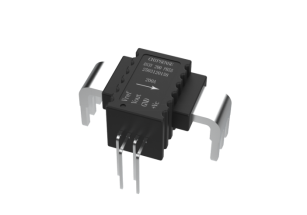
EV Charging Piles: "Adjustability" Means More Than Just Power Control
As adjustable loads, EV charging piles can serve as resources for virtual power plants. However, their participation in grid dispatch must not come at the expense of equipment safety. Therefore, alongside the monitoring and control of charging power, safety functions—such as residual current detection—must continue to operate independently and reliably. In other words, "adjustability" does not imply a sole focus on power data, the safety monitoring chain within the device cannot be overlooked.
Whether in the realm of virtual power plants or the actual SST and HVDC sectors, CHIPSENSE offers unique R&D capabilities and specialized product supplies.
Conclusion
GB/T 47241 is a recommended national standard applicable to the development, grid integration, operation, and management of virtual power plants (VPPs). For both new and existing resources slated for VPP integration, terminal-side monitoring and control capabilities will be a key factor to evaluate during system design and retrofit assessments.
In the past, this issue might have been raised by engineers only during the component selection phase, with little subsequent attention paid to it, now, however, it has shifted to the operational level. The first step in a retrofit is often not the installation of communication modules, but rather verifying whether the accuracy and thermal drift of existing sensors are sufficient to ensure the reliability of reported data.It is an issue that may seem minor, yet it is highly practical.This is also a key area of R&D focus for CHIPSENSE.
CHIPSENSEis a national high-tech enterprise that focuses on the research and development, production, and application of high-end current and voltage sensors, as well as forward research on sensor chips and cutting-edge sensor technologies. CHIPSENSEis committed to providing customers with independently developed sensors, as well as diversified customized products and solutions.
“CHIPSENSE, sensing a better world!”
www.chipsense.net