



Starting with a charging station "tripping"
Last winter, a public charging station in southern China experienced a strange charging interruption. The system indicated the cause was a leakage protection trip. Maintenance personnel inspected the site and found the charging station's insulation to be normal; replacing the car restored normal charging. The problem was ultimately discovered: the issue stemmed from the ride-hailing vehicles-after long-term operation, a capacitor inside the onboard charger had aged, generating a DC leakage current exceeding 6mA. This particular charging station happened to be equipped with only a standard Type A leakage protection device, unable to detect this DC component leakage, hence the strange phenomenon of "replacing the car fixed the problem." CHIPSENSE had already discovered this problem and began developing a corresponding current sensor.

The "Transformation" of Leakage Current
Traditionally, leakage current is considered to be 50Hz alternating current, with a sine wave waveform observed when a person is electrocuted. However, the power electronic conversion inside a charging station transforms the current into a variety of forms.
After rectification, if the insulation is damaged, the resulting leakage current may be a pulsating waveform with missing positive half-cycles (what we call "pulsating DC"); if the power factor correction circuit malfunctions, it may produce a continuous, smooth DC leakage current; if the switching transistor breaks down, the leakage current may also contain high-frequency components. Therefore, leakage current sensors are very important.
These different forms of leakage current attack the magnetic core material in completely different ways. AC leakage current allows the core to magnetize normally, while the DC component causes it to become biased, gradually approaching saturation. Once the core is saturated, the transmission characteristics of the current transformer become distorted, and the AC leakage current that could normally be detected may be missed.
This is why standards such as IEC62752 and GB/T22794 require charging piles to have the ability to detect pulsating DC and smoothed DC, and specifically emphasize a 6mA DC leakage current threshold—exceeding this value, the magnetic core may enter the saturation region, rendering the protection function ineffective.These CHIPSENSE leakage current sensors all take into account.
The Wisdom of Split Design
Faced with these complex leakage current wave-forms, the engineering community has offered a solution: B Type leakage current detection. It can cover all wave-forms from DC to above 1kHz, truly achieving comprehensive coverage.
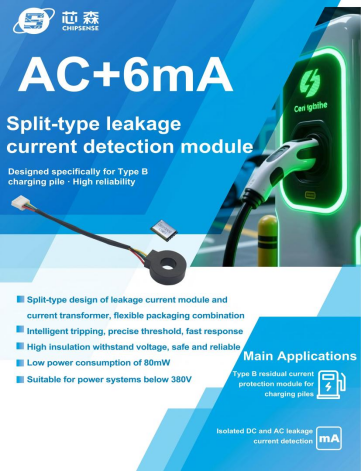
However, implementing B Type detection is not simple. It requires special magnetic core materials (usually permalloy or nanocrystalline) and complex signal processing circuitry. Integrating the current transformer and processing circuitry into a single housing, as with traditional leakage protection devices, presents a dilemma: the current transformer is large, requiring a very large module; moreover, the current transformer needs to be close to the main circuit, while the processing circuitry must be kept away from heat sources and interference sources—a difficult balance to achieve.
The CSMD1&TR3A 6 C00 module, launched by CHIPSENSE, a professional sensor manufacturer in China, is designed to solve this contradiction. It separates the current transformer (TR3A) from the detection module (CHIPSENSE CSMD1), connecting them with a wire. This allows the current transformer to be flexibly mounted on the main circuit copper busbar, while the detection module can be mounted on the control board, away from heat sources. This "separate" structure may seem simple, but it gives the overall layout of the machine a great deal of freedom, reduces temperature rise interference inside the module, and improves detection accuracy. CHIPSENSE CSMD1 & TR3A 6 C00 modules have attracted a lot of attention from customers. The following is an introduction to the key features and technical highlights of CHIPSENSE CSMD1 & TR3A 6 C00 modules.
Zero Calibration and Self-Test: The Invisible "Checkup"
Two details in the module's technical specifications are particularly noteworthy: Zero Calibration and Self-Test.
Any magnetic core device has residual magnetism, and temperature changes can cause zero-point drift. If this error is not eliminated, the detection threshold may deviate from the design value. The CSMD1 module is designed with a short connection to GND on the calibration pin (C1). As long as the main controller pulls this pin low for more than 50ms after power-on, the module will automatically complete zero-point correction. This action must be completed before the main circuit is closed—because once the main circuit is powered on, the magnetic field generated by the primary current will contaminate the zero-point calibration.
The self-test logic is even more ingenious. An internal test coil (ZCT_01/02), in conjunction with an external resistor Rtest, can simulate a leakage current without main power. The main controller triggers the self-test via the C2 pin (or directly controls the test circuit) and then waits for the TRIP pin to flip. If the TRIP does not activate within the specified time, it indicates that the module itself may be damaged, requiring an alarm or disabling of charging. This "self-test before charging" mechanism transforms protection into a verifiable behavior, rather than a hypothesis. CHIPSENSE this leakage current sensor is very well made.
From the timing diagram, the self-test process includes a series of steps: T1 (power-on stabilization), T2 (zeroing enable), T3 (zeroing wait), and T4 (self-test enable), each with clearly defined time requirements. These details represent the determinism brought about by the solidified hardware logic—you don't need to worry about how the internal algorithm runs; you only need to control the pin levels according to the timing sequence to obtain the expected protection action. This is the advantage of CHIPSENSE CSMD1&TR3A 6 C00 module leakage current sensor.
The Role of Software: Not Control, But Coordination
Some might ask: Since the module is internally an ASIC, what's the point of the software?
The answer is: the software is responsible for "timing" and "coordination."
The main control MCU doesn't need to know how to identify the leakage current waveform; that's the ASIC's job. However, the main control must know when to calibrate, when to perform a self-test, when to read the TRIP status, and what to do after reading it (e.g., disconnect the relay, report a fault). In a sense, this module is a "smart sensor" that outputs a high/low level to indicate "safety" or "danger." The software's job is to ensure that this sensor always operates at the correct operating point and to execute the correct protective action when it issues a danger signal. This is why CHIPSENSE SMD1&TR3A 6 C00 module leakage current sensor exists.
This division of labor is very clear: hardware ensures "accurate sensing," and software ensures "timely response." Only the combination of both constitutes a complete leakage current protection system.
CHIPSENSE CSMD1&TR3A 6 C00 module leakage current sensor serves precisely this purpose.
Conclusion
Returning to the initial case, if that charging station had used a B Type leakage current module capable of detecting 6mA DC, it wouldn't have been fooled by the aging capacitors in the ride-hailing vehicle. Tripping might still occur, but it would be a proper response to a real danger, not a malfunction. CHIPSENSE CSMD1&TR3A 6 C00 module leakage current sensor will be a good choice.
Leakage current detection may not be the most cutting-edge technology in charging stations, but it concerns the safety of every vehicle and every person. When we talk about charging power, charging speed, and intelligent interaction, let's not forget those tiny modules hidden in the corners of the circuit board—they have no screens, no sounds, yet they silently perform tens of thousands of current sampling and judgments with every charge.
This silence itself is a form of power.
CHIPSENSE SMD1 & TR3A 6 C00 module leakage current sensor will be well received by customers in the market.
CHIPSENSE is a national high-tech enterprise that focuses on the research and development, production, and application of high-end current and voltage sensors, as well as forward research on sensor chips and cutting-edge sensor technologies. CHIPSENSE is committed to providing customers with independently developed sensors, as well as diversified customized products and solutions.
“CHIPSENSE, sensing a better world!
www.chipsense.net