


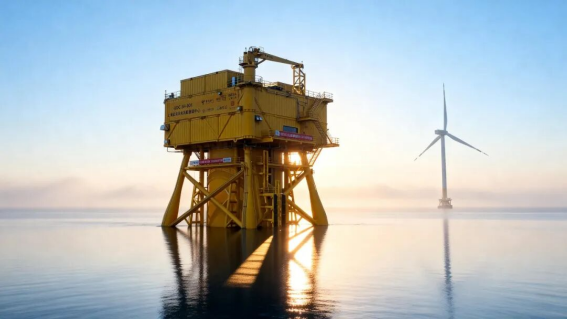
Ten kilometers offshore from Shanghai Lingang, the wind turbine blades slowly rotate in the sea breeze. The generated electricity travels along the dedicated cables directly to a cylindrical container deep beneath the sea floor. Inside this container, thousands of servers are providing computing power for the AI large-scale model.
In early February 2026, the world's first "sea wind direct connection" submarine data center was officially launched in Shanghai. This project is not only a breakthrough in the field of marine engineering, but also indicates that a profound revolution in the integration of energy and computing power has quietly begun.
01 The Underwater Computing Heart, Shaping a New Era of Green Data
Under the global AI wave, the demand for computing power is growing exponentially, and energy supply and carbon emissions restrictions have become constraints. The Shanghai Lingang Underwater Data Center is an innovative solution proposed to address this contradiction.
This project with a total investment of 1.6 billion yuan combines two core technologies: "offshore wind power direct connection" and "seawater natural cooling", creating the world's first such data center.
The project's planned total scale is 24 megawatts, and the first-phase demonstration project, which has been put into operation, is 2.3 megawatts. Compared with traditional data centers, its designed PUE is no higher than 1.15, and the green power supply rate exceeds 95%.
The uniqueness of this project lies in its distinctive structural design. The data cabinets adopt a cylindrical vertical structure, which not only effectively withstands wave impacts but also expands the internal usable area.
02 Energy challenges: The contradiction between computing power and electricity is becoming increasingly prominent.
The International Energy Agency predicts that by 2030,global data center electricity consumption will increase by more than double,reaching approximately 945 TWh. In China, this demand may reach 300-700 billion kilowatt-hours,accounting for 2.3%-5.3% of the total social electricity consumption.
In traditional data centers, the electricity cost usually accounts for more than 50% of the total operating cost. What is more worrying is that approximately 40% of the electricity is used for cooling and heat dissipation.
This energy consumption structure is clearly unsustainable, especially in the context of global efforts to achieve the "carbon neutrality" goal.
For traditional land-based data centers, for every 1 yuan spent on electricity, 40 cents are used for cooling and heat dissipation, while the underwater data centers can reduce this cost to below 10 cents.
03 Maritime-land alliance, a win-win combination of wind power and computing power
The technological breakthrough of the Lingang Underwater Data Center lies in achieving a dual green model of "direct supply of green electricity from the sea + natural cooling under the sea".
This project directly connects to the nearby Lingang Offshore Wind Farm and realizes direct connection of wind power through photovoltaic composite cables, significantly reducing transmission losses. Using seawater as a natural cooling source, no traditional air conditioning systems are required.
According to calculations, the underwater data center can save 22.8% of electricity, 100% of water, and more than 90% of land compared to traditional data centers.
"Direct connection of sea wind" is the core pioneering breakthrough of this project. The data cabinets are directly laid out in the wind farm to achieve direct supply of green electricity, and through flexible adaptation technology, the problem of stability in power supply from new energy sources is solved.
04 CHIPSENSE Current sensing, the invisible guardian of the synergy between new energy and computing power
The current sensor, as the core component for monitoring and controlling the flow of electrical energy, plays a crucial role in the integrated system of new energy and computing power.
In the underwater data center, the current sensor is applied in multiple aspects such as wind power generation systems, transmission lines, and server power management.
According to global growth insights, the global market size of current sensors is approximately 4.32 billion US dollars in 2025 and is expected to reach 11.49 billion US dollars by 2035. Electric vehicles and renewable energy systems are the main growth drivers.
In the global current sensor market for electric vehicles, the revenue in 2025 is approximately 1.097 billion US dollars.
The current sensor is crucial for optimizing power quality and energy efficiency, especially when using fluctuating offshore wind power. Precise current monitoring becomes the foundation for maintaining the stable operation of the data center.
05 Blue Ocean Strategy, China's Green Computing Power Path
The submarine data center project is just a microcosm of China's promotion of the computing and electricity integration strategy. Enterprises such as Chinese Well-known large company have globally promoted the "optical wind storage coordinated constant power + grid-forming technology" to help data centers achieve full green power supply.
Hailan Cloud has initiated a 500-megawatt offshore wind direct connection submarine data center scheme research, integrating the data cabin with deep-sea wind turbine units for further cost reduction and efficiency improvement.
This "computing-electricity synergy" model aligns with China's policy directions of "East-to-West computing allocation" and "accelerating the construction of a national integrated computing power network".
Similar to the Lingang project, in the micro-grid project of the Red Sea New City in Saudi Arabia, Well-known large company supported a 1.3GWh energy storage system and 400MW photovoltaic power generation through grid-forming energy storage technology, achieving 100% independent power supply from renewable energy.
06 Global linkage, the future vision of green computing power
The significance of the Lingang undersea data center goes far beyond the success of a single project. It provides an innovative solution for the contradiction between computing power and energy for China and the world, marking the beginning of humanity's integration of energy and information technology at a deeper level.
Since 2025, domestic computing power demand has grown rapidly, and the rack availability rate of third-party data centers has significantly increased. With the emergence of more AI applications, the demand for green computing power will continue to increase.
Chinese enterprises plan to rely on the advantages of the offshore wind power industry to export the "Chinese solution" for undersea data centers to countries participating in the "Belt and Road Initiative".

The market for current sensors will also grow in this trend. The Asia-Pacific region already accounts for 40% of the global current sensor market, making it the largest regional market in the world.
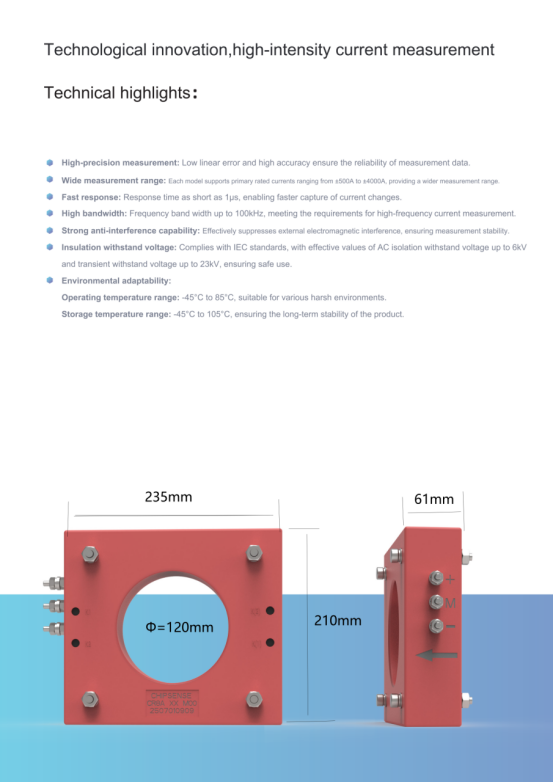
As technology advances, many excellent Hall current sensors are providing higher precision, faster response, and stronger anti-interference capabilities to meet the needs of new application scenarios such as 800V high-voltage systems.
The cylindrical container of the data center lies quietly at the shore of the East Sea. The seawater gently absorbs the heat, while wind power continuously supplies green energy to the computing facilities inside. This project not only provides a green computing power foundation for the construction of the Shanghai International Data Hub in the New Pudong Area, but also becomes a new brand for connecting international data services.
The microgrid in the Red Sea city of Saudi Arabia has achieved 100% independent power supply using renewable energy for over two years, with a cumulative power supply volume exceeding 1.5 billion kilowatt-hours. From the banks of the Huangpu River to the shores of the Red Sea, a green computing power revolution powered by CHIPSENSE current sensors is accelerating its spread globally.
On the coast of the East China Sea, a "green computing power circulation" scene is unfolding gradually. And in every corner of this scene, CHIPSENSE current sensor, this "invisible guardian", is working silently to ensure that every ampere of current is precisely controlled and utilized.
CHIPSENSE is a national high-tech enterprise that focuses on the research and development, production, and application of high-end current and voltage sensors, as well as forward research on sensor chips and cutting-edge sensor technologies. CHIPSENSE is committed to providing customers with independently developed sensors, as well as diversified customized products and solutions.
“CHIPSENSE, sensing a better world!
www.chipsense.net