


If 2025 was a transitional period for the high-quality development of China's energy storage industry, then 2026, the first year of the 15th Five-Year Plan, will accelerate the departure from the extensive, scale-expansion development model and usher in a high-quality development stage where "value is king." From the mass production of 500Ah cells to the cost per kilowatt-hour approaching the "1 cent era," coupled with the explosive growth in demand for AI computing power infrastructure, competition in the energy storage industry is shifting from capacity expansion to scenario-based solutions and the construction of a global ecosystem. Energy storage power stations are moving from "passive supporting facilities" to "independent market players." CHIPSENSE current sensor will also be an important participant.
In this transformation, the Battery Management System (BMS), as the "brain" of energy storage, directly determines the safety baseline and economic ceiling of a power station through its current monitoring capabilities. This article will deeply analyze the three key "safety secrets" that must be cracked in BMS current monitoring. This is inseparable from current sensor manufacturers, including CHIPSENSE.
Definition and Main Functions
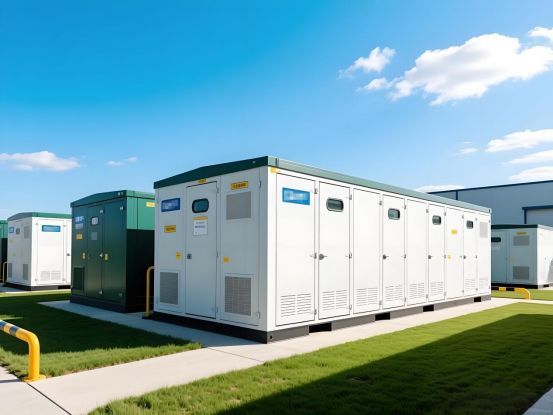
The Battery Management System (BMS) is the "brain" and "nerve center" of an energy storage system. It is responsible for real-time monitoring, management, and protection of the battery pack, ensuring its safe, efficient, and long-life operation. In the energy storage field (such as photovoltaic energy storage, industrial and commercial energy storage, and grid-side energy storage), the role of the BMS is particularly critical, directly affecting the system's power generation efficiency, operating revenue, and safety. Therefore, the CHIPSENSE current sensor will also play an important role.
The main functions of an energy storage BMS
(Battery Management System) go far beyond simple battery protection. It is a complex hardware and software system, and its main functions mainly include the following modules:
• Battery Status Monitoring: Real-time acquisition of data such as voltage, current, temperature, SOC (State of Charge), and SOH (State of Health).
• Safety Protection: Overcharge/over-discharge protection, short circuit protection, abnormal temperature protection, and insulation fault monitoring.
• Balancing Management: Active or passive balancing to address differences in individual cells and extend battery life.
• Communication and Control: Interfaces with PCS (Power Conversion System) and EMS (Energy Management System) for intelligent scheduling.
• Fault Diagnosis and Early Warning: Through data analysis, potential risks (such as insulation degradation and leakage) are detected in advance.
To ensure the safe and reliable operation of battery systems, based on the latest national standards and industry practices, the three key safety measures for energy storage BMS current monitoring can be summarized as follows:
Key 1: High-Precision Current Sampling (Accuracy) – The Cornerstone of SOC Estimation and System Control
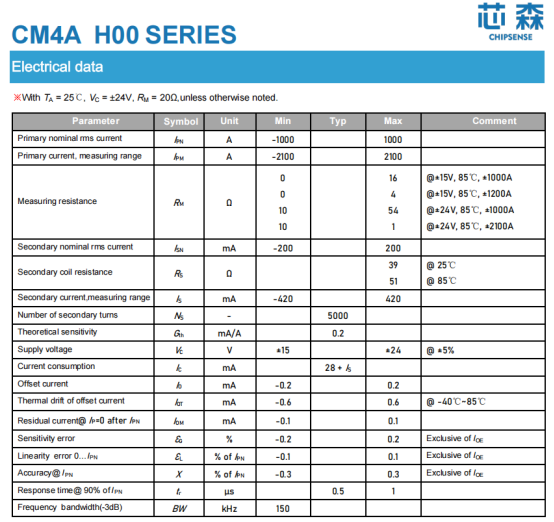
Current data is a crucial input for BMS to estimate remaining charge (SOC), assess state of health (SOH), and control charge and discharge. The accuracy of current sampling directly affects the accuracy of system judgments. According to GB/T 34131-2023 "Battery Management System for Power Storage" standard, the current acquisition error should be ≤0.2% F.S. (full scale). If a current sensor has a total accuracy of ±0.3% of IPN (maximum value), it is equivalent to 0.15% (calculated as follows: upper limit of error = 1000A × 0.3% = ±3A, the proportion calculated in F.S. (2000A) = 3A / 2000A = 0.15%), which is better than the national standard requirements.
All CHIPSENSE current sensors meet national standards. CHIPSENE CM4A H00 is just one example.
The mainstream measurement methods include shunts, Hall current sensors, and fluxgate sensors, each with its own advantages and disadvantages. Shunts are low-cost and fast-responding, but suffer from energy loss and temperature drift, requiring temperature compensation algorithms. Hall current sensors use non-contact measurement, have good isolation, and are suitable for high-current scenarios. However, because Hall current sensors are based on magnetic principles, they are susceptible to interference from external magnetic fields. But if a closed-loop Hall current sensor is used, its compensation coil can effectively counteract changes in the external magnetic field, thereby improving interference resistance. Fluxgate sensors have the highest accuracy among the three and strong anti-interference capabilities, but they are also relatively expensive, making them suitable for high-end, high-reliability energy storage systems. CHIPSENSE current sensors are all fast-responding.
Key 2: Response Speed-The "Quick Knife" of Over-current Protection
Energy storage systems experience large instantaneous current surges. When anomalies such as over-current, short circuit, overcharge, or over-temperature occur, the BMS must react within an extremely short time to prevent the fault from escalating into thermal runaway or fire. Level 1 alarms must trigger within ≤300ms, supporting audible and visual alarms and fault code display; protective actions (such as circuit disconnection) must be completed within 2 seconds. Hall effect sensors typically possess high bandwidth characteristics (e.g., above 100kHz) and fast response times (≤1μs), enabling rapid capture of transient current changes, achieving millisecond-level hardware protection, and cutting off faulty circuits. This is the most basic requirement for CHIPSENSE current sensor. CHIPSENSE current sensors are all designed with safety in mind.
Key 3: Isolation – A "protective shield" for high-voltage systems.
Energy storage systems operate at high voltage levels (1500V+ or even higher), and non-isolated measurements can easily lead to grounding interference and even electric shock risks. Especially in high-voltage cascaded and string architectures, electrical isolation is the bottom line for ensuring personal and equipment safety. In this context, Hall effect current sensors in non-contact measurement solutions offer natural electrical isolation between the primary and secondary sides. These products must possess high AC isolation withstand voltage (e.g., 3.8-6kV) and transient withstand voltage (e.g., 16-23kV) insulation performance, eliminating the need for additional isolation circuits and significantly improving the system's EMC (electromagnetic compatibility) performance. CHIPSENSE current sensor is far superior to its competitors in these aspects.
How to Develop a "Sharp Eye" for Energy Storage?
Closed-Loop Hall Effect Technology: Counteracting External Interference
The core principle of closed-loop Hall effect technology is to use the magnetic field generated by the secondary coil to counteract the magnetic field generated by the primary current, keeping the magnetic core in a "zero flux" state. This design not only significantly improves linearity but also effectively suppresses interference from external stray magnetic fields, ensuring stable and reliable measurement data even in complex energy storage container environments.
Wide Temperature Range and High Reliability: Energy storage power stations are often deployed in outdoor environments with extreme temperature variations. Sensors need to support a wide operating temperature range of -40℃ to 85℃, employing highly stable magnetic core materials and a secondary injection molding process to ensure long-term stable operation under harsh conditions such as vibration and humidity, thus facilitating efficient management of the energy storage power station throughout its entire life-cycle.
These are the characteristics of the CHIPSENSE CM4A H00 current sensor.
Adaptable to large battery cells and high dynamic range scenarios
For the mainstream 587Ah+ large battery cells expected in 2026, the sensor needs to provide a wide measurement range of 500A to 5000A. High bandwidth characteristics (such as 150kHz) can accurately capture high-frequency harmonics during high-current charging and discharging processes, providing detailed data for BMS equalization algorithms and fault diagnosis. CHIPSENSE current sensors offer a wide range of measurement ranges and can even be customized to meet customer needs.
In 2026, the energy storage industry is bidding farewell to the "price war" of unchecked growth and entering a high-quality development stage focused on safety, efficiency, and lifespan. Current monitoring, as the "eyes" of the BMS (Battery Management System), is undeniably crucial. CHIPSENSE current sensor is also one of many current sensor manufacturers.
In the opening year of the 15th Five-Year Plan, high-precision, fast-response, and strong-isolation current monitoring technology builds a solid safety defense for energy storage BMS, helping China's energy storage industry achieve steady and sustainable growth in this new cycle of value enhancement. We believe that CHIPSENSE current sensor will become one of the leading domestic current sensor manufacturers.
Q1: Why is the "temperature compensation" function of Hall sensors particularly emphasized in 2026?
A: With the large-scale deployment of energy storage power stations in the cold northwest and hot, humid south, the environmental temperature differences are extreme. Traditional current sensors have a large temperature drift coefficient, resulting in SOC estimation deviations of over 5% in summer and winter. The industry's pursuit of full life-cycle benefits in 2026 requires sensors to maintain an accuracy within ±0.5% over a wide temperature range of -40℃ to 85℃, which necessitates advanced ASIC chips for real-time temperature compensation.CHIPSENSE current sensors can all achieve this.
Q2: I've heard that shunts are cheaper, so why do high-end energy storage systems still use closed-loop Hall effect sensors?
A: This is a typical "cost-effectiveness" misconception. While shunts have lower initial costs, they suffer from insertion losses (heat generation), require complex isolation circuits, and experience significant accuracy degradation under high-frequency, high-current conditions. In mainstream 1500V high-voltage systems, Hall effect sensors offer advantages such as non-contact measurement, high isolation withstand voltage, and no heat loss, making them more advantageous in terms of system-level cost and long-term reliability, especially suitable for high-power, high-safety-requirement scenarios. Current sensors still play an important role in necessary situations.
Q3: What new requirements does grid-forming energy storage place on current sensors?
A: Grid-forming technology is currently a hot topic. It requires energy storage systems to actively support grid frequency and voltage. This places extremely high demands on the response speed (bandwidth) of current sensors—they must be able to capture millisecond-level grid disturbance signals. Ordinary sensors have slow responses and cannot meet the real-time requirements of grid-forming control. Therefore, the selection of the current sensor is very important.
Q4: When selecting a current sensor, besides accuracy, what other "hidden parameters" should be considered?
A: In addition to the nominal accuracy, we recommend focusing on the following three points:
1. EMC performance: Can it operate stably in complex electromagnetic environments and avoid false alarms?
2. Long-term drift: After one year of use, is the accuracy still within the nominal range?
3.Overload capacity: Can it withstand instantaneous current surges several times greater than normal without damage?
CHIPSENSE current sensors assist with selection and provide excellent after-sales service, striving to meet all customer needs.
CHIPSENSE is a national high-tech enterprise that focuses on the research and development, production, and application of high-end current and voltage sensors, as well as forward research on sensor chips and cutting-edge sensor technologies. CHIPSENSE is committed to providing customers with independently developed sensors, as well as diversified customized products and solutions.
“CHIPSENSE, sensing a better world!
www.chipsense.net