


Introduction: When "HALO" Meets the Power System
In March 2026, the global capital market was swept up in "HALO transactions." Goldman Sachs, in its latest report, proposed an investment framework of "heavy assets + low attrition rate," focusing on sectors with high barriers to entry in physical assets and low risks of technological substitution—especially energy infrastructure. In China, with the continuous increase in installed capacity of new energy sources such as photovoltaic, wind power, and energy storage, the demand for intelligent and efficient power systems is unprecedented. In this energy revolution, current sensors, especially Hall effect current sensors, are quietly becoming a key bridge connecting "HALO assets" and the smart grid. Especially current sensor manufacturers such as CHIPSENSE
I. New Energy Opportunities Under HALO Trading
1. What is HALO Trading? HALO stands for Heavy Assets + Low Obsolescence. In the context of rapid AI iteration and frequent geopolitical conflicts, tangible assets—such as power equipment, energy storage systems, and charging piles—become safe havens for capital due to their scarcity and irreplaceability. The significant gains in sectors like non-ferrous metals, power equipment, and energy storage since 2026 reflect this logic. Therefore, the role of the CHIPSENSE current sensor is even more important.
2. Challenges Behind the "Better-than-Expected" New Energy Installations The China Photovoltaic Industry Association predicts that China will add 180GW–240GW of photovoltaic capacity and no less than 120 million kilowatts of wind power capacity in 2026. However, with the expansion of installed capacity, the stability, security, and intelligence of the power system are becoming increasingly prominent:
Difficulty in grid connection of distributed photovoltaic systems: How to monitor current fluctuations in real time to avoid inverter tripping?
Safety risks of energy storage systems: How to accurately monitor charging and discharging current to prevent thermal runaway?
Charging pile efficiency optimization: How to achieve dynamic load management and reduce energy consumption?
The core of these questions points to a key technology: high-precision, high-reliability current monitoring. CHIPSENSE current sensors are characterized by high precision, high linearity, and high reliability.
II. Hall Current Sensor: The "Intelligent Nerve" of the Power System
1. Working Principle and Advantages Hall current sensors are based on the Hall effect, indirectly measuring current by measuring changes in the magnetic field around a conductor. CHIPSESEN also like this. They have the following characteristics:
Non-contact measurement: No need to disconnect the circuit, high safety, suitable for high-voltage and high-current scenarios.
Wide-band response: Can monitor DC, AC, and complex waveform currents in real time, suitable for photovoltaic inverters, energy storage PCS, and other equipment.
High precision and stability: Strong anti-interference capability, small long-term drift, meeting the needs of industrial applications.
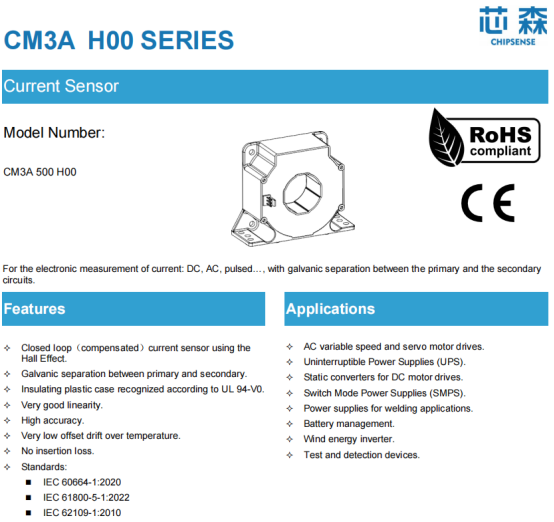
CHIPSENSE current sensor also includes all of these. CHIPSENSE CM3A H00 series current sensor can be used as a reference.
2.Application Scenario Analysis
| Application Areas | Specific scenarios | Functions of Hall effect sensors |
| Photovoltaic Inverters | DC-side current monitoring, | Real-time feedback of MPPT (Maximum Power Point Tracking) algorithm to improve power generation efficiency |
| Energy Storage Systems (PACK/BMS) | charge/discharge current monitoring, | Prevent over-current and short circuits, extending battery life; support accurate SOC (State of Charge) calculation |
| Charging Piles | dynamic load management, | Optimize power allocation, reducing peak demand costs; support V2G (Vehicle-to-Grid) interaction |
| Inverters/Uninterruptible Power Supplies | output current feedback, | Improve control accuracy and reduce harmonic interference |
| DC Transmission Panels | multi-channel current monitoring. | Enable energy flow visualization and rapid fault location |
3. Case Study: The Safety Guardian in Energy Storage Systems Taking a large-scale energy storage power station as an example, Hall effect current sensors are integrated into the Battery Management System (BMS) and Energy Management System (EMS):
Charging Phase: Monitors the current distribution of each battery cluster, balances charging, and avoids the risk of overcharging.
Discharging Phase: Provides real-time feedback on the output current, coordinating with the inverter to adjust power and ensure grid stability.
Fault Warning: Triggers emergency circuit breaking through abnormal current fluctuations (such as short circuits or leakage) to prevent fires.
Data shows that energy storage systems equipped with Hall effect sensors have a failure rate reduced by more than 30% and a lifespan extended by 20% [industry report].
III. Technological Trends and Risk Warnings
1. Technological Upgrade Directions
Integration: Integrating Hall sensors with MCUs (Micro-controller Units) to achieve "edge computing" and reduce data transmission latency.
High Temperature Adaptability: Developing sensors resistant to temperatures above 150℃ for high-temperature environments such as new energy vehicles and industrial frequency converters.
Digital Interface: Transitioning from analog output to digital buses such as CAN and Mod-bus for easier Industry 4.0 integration.
2. Risks and Challenges
Cost Pressure: High-precision Hall sensors are expensive, requiring a balance between performance and cost.
Lack of Standards: Measurement standards vary across different application scenarios, necessitating unified industry standards.
Interference Suppression: Optimizing magnetic shielding design is necessary in strong magnetic field environments (such as motor drives).
CHIPSENSE current sensors are designed to save costs for customers and provide high-quality products.
Experts recommend:
"When selecting a Hall current sensor, priority should be given to three key indicators: bandwidth, accuracy, and response time, and calibration should be performed in conjunction with the actual application scenario.For example, photovoltaic inverters require a focus on low drift characteristics, while energy storage systems place greater emphasis on overload protection capabilities." —A new energy power electronics expert.
CHIPSENSE current sensor is a good choice among many current sensor manufacturers.
IV. Conclusion: From "HALO" to "Smart Power"
The "HALO trading" model has made the world re-evaluate the value of "heavy assets," while Hall current sensors, as the "intelligent nerves" of the power system, are helping new energy equipment leap from "usable" to "easy to use." CHIPSENSE current sensors are also constantly striving to develop. In trillion-dollar sectors such as photovoltaic, energy storage, and charging piles, whoever masters accurate, efficient, and safe current monitoring technology first will gain a competitive edge in the energy revolution. CHIPSENSE current sensor has made efforts to perform well in this field.
A Promising Future:
As carbon neutrality goals advance, the Hall sensor market is projected to grow at an annual rate exceeding 15%.
Combined with AI algorithms, sensor data will further empower predictive maintenance and energy efficiency optimization, creating a "self-healing" power system.
It believes that CHIPSENSE current sensors will become the preferred supplier of current sensors.
CHIPSENSE is a national high-tech enterprise that focuses on the research and development, production, and application of high-end current and voltage sensors, as well as forward research on sensor chips and cutting-edge sensor technologies. CHIPSENSE is committed to providing customers with independently developed sensors, as well as diversified customized products and solutions.
“CHIPSENSE, sensing a better world!
www.chipsense.net