


In 2025, the penetration rate of new energy vehicles in my country exceeded 50% for the first time (data source: China New Energy Network), even reaching 59.5% in November 2025, meaning that nearly 60 out of every 100 cars sold were new energy vehicles. With the popularization of electric vehicles, the related charging infrastructure has also been continuously improved. Major gas stations have added charging piles, and the coverage rate of charging piles in national highway service areas has exceeded 98%. As of November 2025, the total number of electric vehicle charging infrastructure (charging points) nationwide reached 19.322 million. Against this backdrop, charging pile safety is a major concern in the industry. DC leakage cannot be detected by traditional leakage protection devices; therefore, adopting Type B leakage detection technology is an important means of ensuring the safe operation of charging piles. Therefore, CHIPSENSE current sensor also plays an important role in this.

What is DC leakage in charging piles?
DC leakage in charging piles, simply put, means that direct current appears in places where it shouldn't be (such as the vehicle frame or the ground), which is a fault condition. Unlike common AC leakage, it is unique to DC systems and mainly occurs in the rectification and conversion stages within the charging pile. There are three main sources:
1. Capacitor characteristics: The capacitor dielectric generates leakage current when a DC voltage is applied; this is a natural characteristic of capacitors;
2. Leakage in the rectifier section: Problems in AC-DC conversion can cause pulsating DC leakage;
3. Leakage in the DC converter: Faults in the DC voltage conversion stage can cause smooth DC leakage.
DC Leakage Current Types:
In the DC system of charging piles, leakage current mainly manifests in the following two forms:
Smooth DC leakage refers to a DC leakage current whose magnitude and direction do not change with time, such as leakage caused by insulation failure between the battery system and ground. This leakage current is small (usually in the mA range) but persistent, easily accumulating into a safety hazard. Traditional RCDs are ineffective against this type of leakage, requiring specialized sensors. CHIPSENSE current sensor is one such option.
New National Standard Requirements: GB 39752-2024, which will be fully implemented on August 1, 2025, requires DC charging piles to monitor leakage current in real time, with an action threshold of ≤6mA.
Pulsating DC leakage refers to a DC leakage current whose direction remains unchanged but whose magnitude pulsates with time, such as leakage caused by insulation failure in the charging circuit. This leakage current exhibits pulsating characteristics. Type A residual current devices (RCDs) can provide protection against this type of leakage.
Type B Residual Current Devices: These can detect AC, pulsating DC, and smooth DC leakage currents, providing a comprehensive protection solution. CHIPSENSE current sensors are among the excellent products offered by numerous manufacturers.
The new national standard GB 39752-2024 mandates that DC charging piles be equipped with protection devices capable of detecting both types of leakage current (usually Type B or Type A + DC 6mA), to ensure charging safety.
Why is DC leakage more dangerous?
High concealment:Traditional AC residual current devices (RCDs) are largely ineffective against smooth DC leakage, making it difficult to detect in a timely manner.
High persistence:DC current tends to flow continuously, potentially accumulating into a safety hazard over time.
High risk:Once it occurs, it can damage equipment or even cause fires; furthermore, it poses a threat to personal safety. The harm of DC current to the human body is no less than that of AC current, and may even be more dangerous (e.g., more difficult to break free from).
B-type Residual Current Detection Technology Principle
Type B residual current detection technology is an advanced leakage protection technology used to detect residual currents of AC, DC, and composite wave-forms (such as pulse and high-frequency currents). It is mainly used in complex leakage scenarios brought about by the increasing prevalence of modern power electronic equipment. Its core principle is based on the comprehensive sensing and response to various types of fault currents. In electric vehicle charging pile applications, type B residual current detection technology is central to safety. It can simultaneously identify AC, pulsating DC, and smooth DC leakage. It monitors the current vector sum in real time through a zero-sequence current transformer. Once the imbalance exceeds a threshold (e.g., 30mA), it cuts off the power within 0.1 seconds, which is much faster than traditional protection. CHIPSENSE current sensors demonstrate expertise in this area.
Implementation methods for Type B residual current protection in charging stations:
Common hardware solutions include:
Broadband current transformer + fluxgate sensor
The broadband CT detects AC and high-frequency components (15 Hz to 1 kHz+)
The fluxgate sensor specifically detects the 0 Hz (i.e., DC) component.
Dual-channel signal processing: AC and DC signals are processed separately, and a comprehensive judgment is made to determine if the limits are exceeded.
Zero-Sequence Current Transformer + Electronic Trip Unit
The zero-sequence current transformer is based on Kirchhoff's current law, monitoring the difference between the incoming and outgoing currents in the charging circuit to determine if there is a leakage current. When the detected leakage current exceeds the threshold (6mA for DC, 30mA for AC), the module outputs a trip signal, and the electronic trip unit drives a mechanical mechanism to disconnect the circuit. It has a fast response speed, with an action time of ≤30ms, which is much faster than traditional protection.
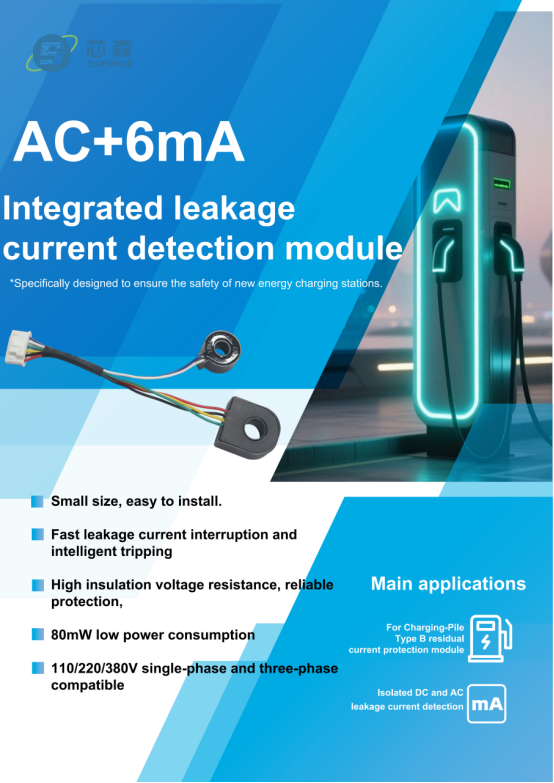
The A+DC6mA type sensor is an integrated product combining a residual current sensor and a current transformer: specifically designed for the new national standard, it can detect pulsating DC leakage current and smooth DC leakage current of 6mA and above, with a short response time (≤0.1 seconds). CHIPSENSE TR6A 32 C00 & FR1D 6 C00 current sensor is a good example.
A comparison of common technical solutions is shown in the table below.
| Solution | Zero-sequence current transformer solution | Fluxgate sensor | Traditional Type A Residual Current Device (RCD) |
| Detection Range | DC/AC leakage current | DC/AC leakage current | For AC leakage current only |
| Accuracy | 6mA | Less than 1mA | 30mA |
| Cost | Medium | High | Low sensitivity |
| Applicable Standards | IEC 62955 | IEC 62752 | GB 16917 |
As can be seen from the table, in the field of electric vehicle charging stations, Type B residual current detection technology is an important measure to ensure personal safety and meet regulatory compliance. Zero-sequence current transformers, due to their high sensitivity, fast response, non-contact operation, and relatively low cost, have become the preferred solution for most DC fast charging applications. This is why customers choose CHIPSENSE leakage current sensors.
Conclusion
Type B residual current detection technology is one of the key technologies for the safe operation of charging piles. It can provide accurate leakage current monitoring data and effectively reduce safety risks through a rapid power-off protection mechanism. However, in practical applications, attention must still be paid to details such as installation, calibration, and maintenance to ensure the stability and reliability of the system. It believes that in the near future, CHIPSENSE leakage current sensors will become one of the most popular suppliers among many sensor manufacturers.
CHIPSENSE is a national high-tech enterprise that focuses on the research and development, production, and application of high-end current and voltage sensors, as well as forward research on sensor chips and cutting-edge sensor technologies. CHIPSENSE is committed to providing customers with independently developed sensors, as well as diversified customized products and solutions.
“CHIPSENSE, sensing a better world!
www.chipsense.net