


Energy—particularly non-renewable energy—has historically been a fiercely contested resource; indeed, a review of history across different eras and regions reveals that a great many wars have been waged primarily over energy. Amidst the current volatile international landscape, geopolitical tensions—particularly in the Middle East—are exacerbating uncertainties within global energy supply chains. For the average citizen, the most tangible manifestation of this instability is the price of gasoline: in less than a month, the cost of fueling a car has surged from the "6-yuan era" to the "9-yuan era." Against this backdrop, new energy technologies have been propelled to unprecedented heights, compelling nations to pursue energy autonomy and vigorously develop renewable sources such as photovoltaic and wind power. Consequently, energy storage has ushered in an era of unparalleled growth opportunities, with the safety and autonomous contractility of energy storage systems emerging as key focal points for the industry. Drawing upon CHIPSENSE latest FR-series fluxgate sensor technology, this article explores how to construct a layered defense architecture—utilizing high-sensitivity analog sensors (CHIPSENSE FR7V/FR5V/FR2V series fluxgate sensor) alongside digital battery sensors (CHIPSENSE FR1C series)—to achieve comprehensive and precise coverage of energy storage systems, ranging from insulation monitoring to energy management.
I. Energy Storage Challenges in the Global Context: Safety and Autonomy as Core Imperatives
As the global energy landscape undergoes a fundamental reshaping, energy storage—serving as critical infrastructure for balancing energy supply and ensuring power security—is assuming ever-greater importance. However, fluctuations in energy supply chains triggered by geopolitical conflicts—compounded by risks such as extreme weather events and counterattacks—are subjecting the safety and autonomous contractility of energy storage systems to severe tests. Through technological breakthroughs involving fully localized, end-to-end solutions, CHIPSENSE Sensors provides the industry with safe, reliable, and stable current monitoring solutions, thereby empowering clients to effectively navigate the challenges of complex operating environments.
II. Technical Foundation: Fluxgate Principles and CHIPSENSE FR Series Product Matrix
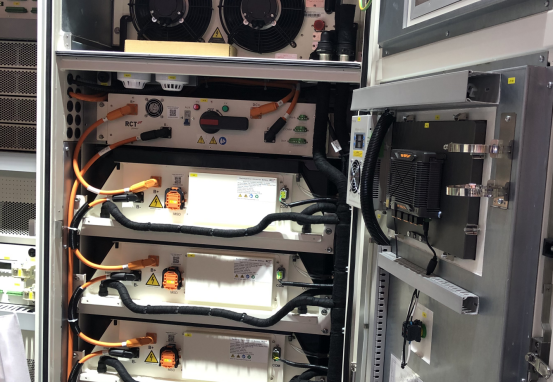
Energy storage systems operate in complex environments characterized by severe electrical transients and electromagnetic interference. All products within the CHIPSENSE FR series utilize Fluxgate technology, leveraging the nonlinear characteristics of a magnetic core in its saturation state to perform detection. Compared to traditional Hall-effect sensors, Fluxgate technology offers key advantages: exceptional zero-point stability, extremely low temperature drift (typically ±1.5 mV/K), and robust anti-interference capabilities (characterized by a high Common Mode Rejection Ratio). These attributes ensure reliable performance—free from both "false alarms" and "missed defections"—across a wide operating temperature range of -40°C to +85°C.
According to CHIPSENSE latest product specifications, the FR series is broadly categorized into two primary application groups:
1. Insulation and Leakage Monitoring Group (Voltage Output): This category includes CHIPSENSE FR7V H00, FR5V H00, and FR2V H00 series leakage current sensors. All three models feature voltage outputs and are specifically designed for the detection of DC residual currents (leakage currents), covering a wide measurement range spanning from 5mA to 30mA.
2. Battery Main Circuit Monitoring Group (Digital Output): This category comprises CHIPSENSE FR1C H00 series leakage current sensors. This current sensor is specifically engineered for use with power batteries and energy storage converters; it features a CAN 2.0B digital communication interface, covers a measurement range of ±300A to ±500A, and connects directly to the Battery Management System (BMS) to facilitate energy management.
III. The First Line of Defense: Tiered Early Warning for Insulation Monitoring (Based on CHIPSENSE FR7V/FR5V/FR2V Leakage Current Sensors)
On the DC side of energy storage systems—specifically between PV panels, battery packs, and inverters—there often exist distributed capacitance and inherent risks associated with insulation aging. Traditional mechanical Residual Current Devices (RCDs) typically feature a response threshold of 30mA; consequently, they often only trigger after a fault has already resulted in significant thermal accumulation. CHIPSENSE voltage-output sensor series, by virtue of their high, milliard-level sensitivity, enable true "early warning" capabilities.
1. The "Microscope" for Micro-Leakage: CHIPSENSE FR7V H00 Series leakage current sensors
For residential energy storage systems or precision PV inverters, leakage currents often begin as a gradual rise at the micro ampere level.
Key Parameters: According to CHIPSENSE datasheet (DS-FR7V H00-CN-V3), this series leakage current sensors offers two specific models: ±5mA (FR7V 0.005) and ±10mA (FR7V 0.01).
Application Scenarios: Serving as the highest-sensitivity detection node, CHIPSENSE FR7V leakage current sensor is typically installed at the battery pack output or internally within string inverters. When a decline in insulation resistance causes the leakage current to exceed 5mA, the sensor immediately outputs an alarm signal. At this stage, the system is still in its "incubation period," providing O&M personnel with ample time to conduct troubleshooting and thereby prevent unplanned system downtime.
2. The "Gatekeeper" for Medium-to-High Currents:CHIPSENSE FR5V H00 and FR2V H00 Series
In commercial and industrial energy storage containers or large-scale ground-mounted power stations, system voltages are significantly higher (1000Vdc/1500Vdc), and background leakage currents are more substantial; consequently, sensors with a wider measurement range are required.
Key Parameters:
CHIPSENSE FR5V H00 (DS-FR5V H00-CN-V2.1): The measurement range covers ±10mA to ±100mA, making it suitable for monitoring medium-power DC power supplies and combiner boxes.
CHIPSENSE FR2V H00 (DS-FR2V H00-CN-V3.1): Covering a measurement range of ±10mA to ±300mA, this model features a larger aperture size (φ20 mm to φ40.5 mm), making it suitable for leakage current detection on large-cross-section busbars.
Application Scenarios: These two sensor models are typically deployed within DC combiner cabinets or on the DC side of PCS (Power Conversion Systems). In addition to offering an isolation withstand voltage of 3.0kV to 3.6kV—enabling them to withstand system-level surge transients—they also provide real-time feedback on the magnitude of leakage currents via voltage signals. When the leakage current rapidly escalates within the 10mA to 100mA range, the system can identify this as a "developing fault"; it then triggers a debating mode or a soft shutdown—rather than an immediate hard trip—thereby safeguarding the equipment hardware.
IV. The Second Line of Defense: The Digital Nerves of Battery Management (Based on CHIPSENSE FR1C Leakage Sensor )
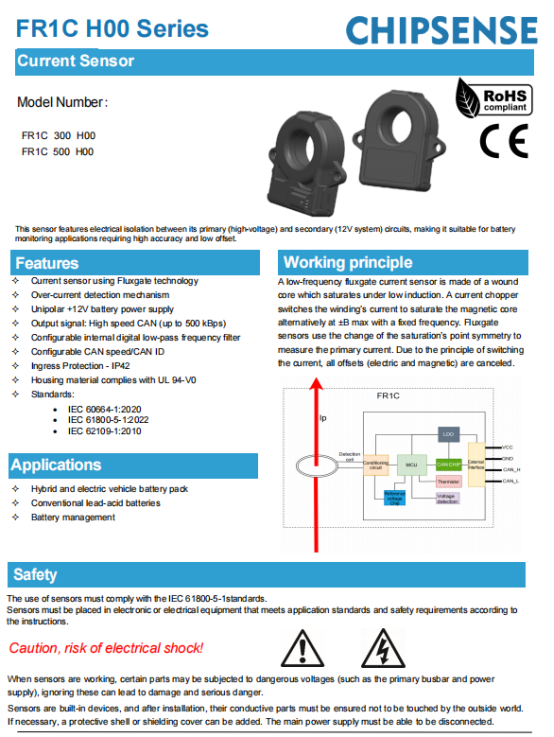
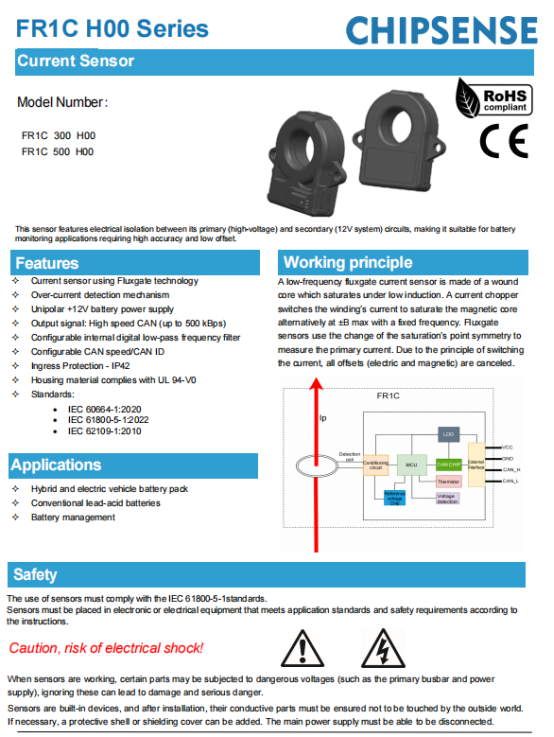
If the leakage sensor serves as the immune system, then the battery current sensor acts as the nervous system. CHIPSENSE FR1C H00 series (DS-FR1C H00-CN-V2) leakage sensor fills the gaps inherent in traditional analog sensors regarding communication and diagnostics.
1. Fully Digital Communication
CHIPSENSE FR1C series leakage sensor is available in two specifications—±300A and ±500A—and is specifically designed for the main circuits of energy storage battery systems. Unlike CHIPSENSE FR7V/5V/2V series, which outputs analog voltage signals, the FR1C directly outputs signals via the CAN 2.0B protocol (500 Kbps).
Technical Advantages: In the complex electromagnetic environments typical of containerized energy storage systems, digital signal transmission offers superior immunity to interference compared to analog voltage signals (0–5V), thereby preventing signal attenuation and noise coupling during long-distance transmission.
Data Integration: It directly transmits the battery's charging and discharging current data (with an accuracy of ±0.5%) to the BMS, facilitating precise calculations of SOC (State of Charge) and SOH (State of Health).
2. Built-in Safety Diagnostic Mechanism
The FR1C series features comprehensive self-diagnostic capabilities for faults, complying with the IEC 61800-5-1 functional safety standard.
Fault Reporting: When internal sensor anomalies occur—such as FLASH checksum errors, fluxgate oscillation irregularities, or over-temperature conditions—CHIPSENSE FR1C leakage sensor transmits specific error codes (e.g., 0x41, 0x42, etc.) via the CAN bus, rather than simply driving the signal to zero. This "articulate" fault mode enables the BMS to clearly distinguish between a genuine "zero-current" state and a "sensor failure," thereby facilitating the execution of SIL-level safety shutdown strategies.
V. Full-Stack Autonomous Control: Solving "Bottleneck" Challenges
Achieving 100% localization—from magnetic core materials to signal processing chips—the product holds numerous patents covering critical components, thereby breaking the Western technological monopoly. The product has been deployed in mass production for key projects at leading enterprises and has successfully expanded into overseas markets in the Middle East and Southeast Asia; notably, it has replaced international brands in a GW-scale photovoltaic energy storage power station, serving as a testament to the strength of Chinese technology.
VI. Customer Value: Multi-Dimensional Empowerment—Safety, Cost Reduction, and Efficiency Gains
Safety & Efficiency:Millisecond-level response times prevent accidents such as fires and explosions, while reducing operations and maintenance (O&M) costs by over 30%.
Intelligent O&M:Facilitates AI-driven fault prediction models to enable proactive maintenance, thereby extending system lifespan by 20%.
Global Adaptability:A wide-range, multi-protocol design meets the diverse requirements of various scenarios, supporting customers in their global expansion strategies.
Conclusion: Wielding the Shield of Technology to Safeguard Energy Security
At this critical juncture of energy security and industrial transformation, CHIPSENSE remains committed to empowering the energy storage sector through innovative breakthroughs. Leveraging precise, reliable, and proprietary current sensing technologies, we assist our customers in building safer and more efficient energy ecosystems. To choose CHIPSENSE is to choose mastery over risk and a guarantee for the future.
CHIPSENSE is a national high-tech enterprise that focuses on the research and development, production, and application of high-end current and voltage sensors, as well as forward research on sensor chips and cutting-edge sensor technologies. CHIPSENSE is committed to providing customers with independently developed sensors, as well as diversified customized products and solutions.
“CHIPSENSE, sensing a better world!
www.chipsense.net