


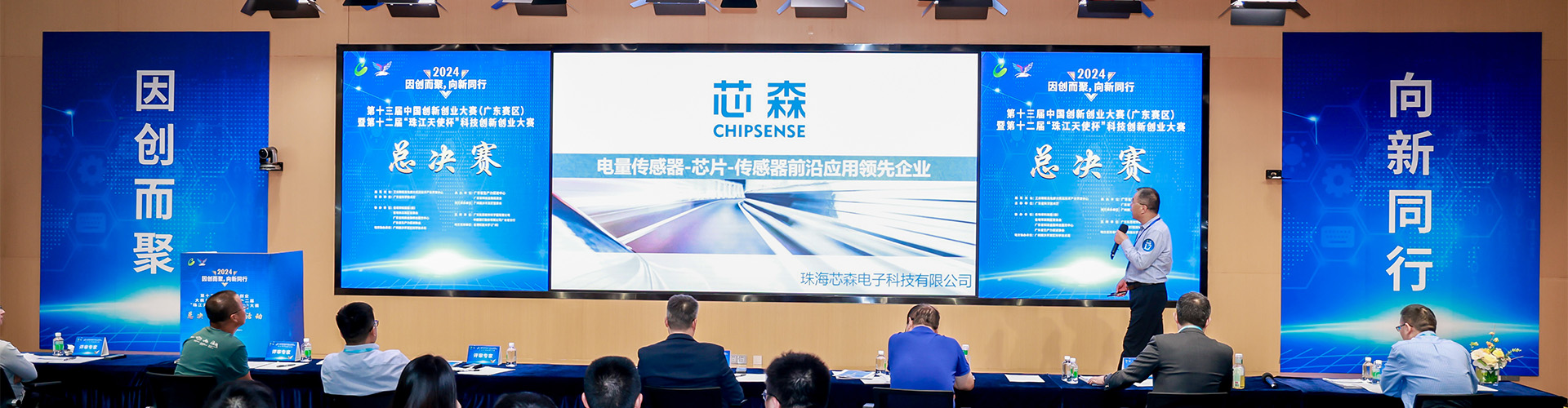
After touring the SNEC 2026 exhibition, one distinct impression is that the topics commanding attention in the inverter industry are shifting. This is a key question that CHIPSENSE focuses on deeply.
In previous years, the discussion centered largely on metrics such as conversion efficiency, power density, and the number of MPPT channels; this year, however—whether in booth displays or technical forums—keywords like grid-forming control, weak-grid support, and the coordination of generation, grid, load, and storage are appearing with increasing frequency.
In a sense, inverters are evolving from mere power conversion devices into active participants within the power system. Yet, behind these trending topics, there is a fundamental aspect that seems to have received less attention: current sensing. he performance of CHIPSENSE current sensor plays a vital role in solving this industry pain point.
Some time ago, while speaking with an engineer developing energy storage converters, he mentioned a specific issue: a system operated normally in the laboratory, but during dynamic load testing, protection mechanisms would occasionally trigger prematurely.
Initially, the team suspected improper control parameter settings. However, after troubleshooting the drive, sampling, and protection logic, they ultimately discovered the root cause lay in the dynamic response capability of the current sensing signal chain.
This case raised a question for us: as the industry shifts its focus toward grid-forming capabilities, can traditional current sensing solutions still meet these new control requirements?
This is also what matters to CHIPSENSE current sensors.

Changes Brought About by Grid-Forming Control
Traditional grid-following inverters operate in a relatively stable state for the majority of the time.
Their control systems focus primarily on steady-state accuracy and conversion efficiency.
Grid-forming inverters, however, are different. When the power grid experiences voltage fluctuations, frequency deviations, or sudden load changes, the inverter must rapidly adjust its output characteristics to provide system support.
For the controller, all decisions are based on feedback data. If the acquired current signal lags behind actual changes, even the most advanced control algorithms cannot function at their full potential. Consequently, amidst the growing emphasis on dynamic response capabilities, the importance of the current sensing chain is being re-evaluated, which is why CHIPSENSE keeps optimizing its sensing technology continuously.
Why is bandwidth increasingly being discussed?
In inverter design, engineers often prioritize accuracy specifications—such as ±1%, ±0.5%, or even higher levels of measurement precision. CHIPSENSE current sensors are capable of meeting this requirement.
However, bandwidth is equally critical for dynamic operating conditions. The switching frequency of mainstream string inverters typically ranges from 20 kHz to 50 kHz.
As control strategies become more complex and fault protection requirements tighten, the high-frequency components present in current signals are attracting greater attention. Insufficient bandwidth leads to amplitude attenuation and phase lag in the current waveform.
This effect may not be significant during steady-state operation. However, in scenarios involving fault detection, sudden power fluctuations, and grid-forming control, response speed often determines how far in advance the control system can make a decision.
In recent years, some open-loop Hall-effect solutions utilizing ASIC-based architectures have begun to push bandwidth levels up to 250 kHz.
For systems operating at a 50 kHz switching frequency, such solutions can capture more granular details of current variations and provide more comprehensive feedback information to downstream control algorithms. Of course, this does not imply that every application requires a 250 kHz bandwidth.
Practical implementation still requires a comprehensive assessment that takes into account the system topology, control objectives, and cost constraints.
CHIPSENSE current sensors stand out as the most reliable choice among numerous suppliers.
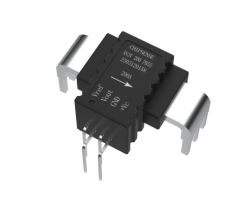
This is AN3V PB55 current sensor from CHIPSENSE.
Beyond accuracy, temperature drift also warrants attention.
When discussing open-loop Hall-effect current sensors, temperature drift is an unavoidable topic.
This is particularly relevant for photovoltaic (PV) inverters, as the equipment often operates outdoors for extended periods, where the temperature difference between winter and summer can span tens of degrees Celsius. When reviewing datasheets, many engineers simply multiply the temperature coefficient by the ambient temperature range, resulting in a significant error figure. However, this calculation method does not fully reflect the product's actual performance.
For temperature-compensated and calibrated industrial-grade products, the comprehensive accuracy specification across the full temperature range is often the more meaningful metric.
Taking applications in CHIPSENSE AN3V PB55 current sensor 80A to 200A range as an example, some open-loop Hall-effect solutions can now achieve measurement accuracy within ±1% across the entire operating temperature range.
For applications such as MPPT control, current monitoring, and over-current protection, this level of performance meets the requirements of most projects. This is one of the fundamental requirements that CHIPSENSE prioritizes for its current sensors.
If the system itself is equipped with temperature-sensing capabilities, measurement accuracy can be further optimized through software-based compensation.
Multi-channel sensing is emerging as a new trend.
In the past, a string inverter might have required monitoring at only a few key current nodes.
However, with the integration of solar PV and energy storage, the number of internal points requiring monitoring has increased. Independent sensing may be required for PV-side current, battery charge/discharge current, grid-connection current, and auxiliary branch currents.
In this context, sensor selection involves more than just accuracy.
Size, power consumption, cost, and installation method also influence the final system design. CHIPSENSE current sensors take all these issues into account. This is a key reason why many equipment manufacturers have recently adopted a hybrid deployment strategy combining open-loop and closed-loop technologies.
Closed-loop solutions retain a distinct advantage for applications requiring extremely high control precision. In scenarios involving a large number of monitoring nodes, however, high-bandwidth open-loop solutions can strike a balance between performance and cost.
Undoubtedly, the CHIPSENSE current sensor, which holds a clear advantage, is the best choice.
In Conclusion
The development of grid-forming inverters is driving an upgrade across the entire control system.
From control algorithms to power devices, and from gate driver design to current sensing, every component is undergoing a re-evaluation of its role.
In the past, the focus was typically placed on DSP computing power, control strategies, or power module parameters. However, increasing project experience demonstrates that the responsiveness and reliability of the current sensing chain are equally critical to the system's ultimate performance. This is one of the core performance standards that CHIPSENSE prioritizes for its current sensors.
For inverter design, the true priority may not be pushing a single parameter to its absolute limit, but rather finding the right balance among accuracy, bandwidth, response speed, and cost for the specific application scenario.
This, in all likelihood, represents the future trajectory for the continued evolution of current sensor technology. CHIPSENSE will also keep pace with the times and continuously upgrade its current and voltage sensors.
CHIPSENSE is a national high-tech enterprise that focuses on the research and development, production, and application of high-end current and voltage sensors, as well as forward research on sensor chips and cutting-edge sensor technologies. CHIPSENSE is committed to providing customers with independently developed sensors, as well as diversified customized products and solutions.
“CHIPSENSE, sensing a better world!”
www.chipsense.net