


The transition period for CCC certification of charging piles officially ended on August 1, 2026. For manufacturers, this means that products lacking certification can no longer be sold or used.
As a professional supplier of high-performance sensing components for the new energy industry, CHIPSENSE has been closely tracking the policy updates and technical difficulties of EV charging pile 3C certification, and our professional CHIPSENSE current sensor series has become a core solution to address the pain points of residual current detection in the certification process.
Recent discussions with industry clients reveal that, compared to traditional aspects such as communication protocols, metering accuracy, and environmental testing, an increasing number of R&D engineers are focusing on a previously overlooked area: residual current protection.
In particular, the detection of smooth DC residual currents (specifically the 6mA DC threshold) has become a critical focus during the product rectification process required for certification.
At this stage, selecting a high-precision and stable CHIPSENSE current sensor is the key to helping R&D teams smoothly complete product rectification and pass certification.
On the surface, this appears to be merely a standard testing requirement; however, from an engineering perspective, it actually reflects the fundamental differences between new energy vehicle charging systems and traditional power distribution systems. CHIPSENSE has long conducted in-depth research on the residual current detection characteristics of charging pile systems, and our customized CHIPSENSE current sensor products are designed to adapt to the complex working conditions of new energy charging equipment.
Why must charging piles address 6mA DC leakage?
Traditional residual current protection devices were originally designed for power-frequency AC systems.
In residential, commercial, and industrial power distribution systems, most leakage current manifests as AC; consequently, Type AC and Type A RCDs have been sufficient to meet the vast majority of application requirements.

However, charging systems for new energy vehicles are different.
Whether it is the On-Board Charger (OBC), the PFC (Power Factor Correction) circuit, or the DC/DC converter, each involves rectification and energy storage stages. If insulation performance degrades or a component malfunctions, a continuous, smooth DC leakage current may occur.
This type of leakage current is neither AC nor pulsating DC; rather, it is a steady, unidirectional current.
This is precisely where the problem lies.
Type AC RCDs can only detect AC residual current; while Type A RCDs can detect pulsating DC, their operation still relies on the AC component within the current.
When a continuous DC bias is present in the circuit, the detection core gradually enters a state of saturation, resulting in reduced AC detection capability.
Engineers typically refer to this phenomenon as "magnetic saturation" or "magnetic neutralization."
Simply put, the leakage current has not disappeared; rather, the protection device is no longer able to accurately detect it.
This is also a key reason why current charging station standards require the addition of 6mA smooth DC detection capabilities. To solve this industry-wide technical problem, CHIPSENSE has optimized the internal structure and detection algorithm of CHIPSENSE current sensor, effectively avoiding magnetic saturation and ensuring stable detection of smooth DC leakage current.
The two most common solutions during the certification rectification process
Currently, there are two mainstream approaches in the industry.
The first involves adding a DC 6mA detection module to a Type A RCD.
This solution is relatively low-cost, so it remains the architecture of choice for a large number of AC charging piles and mass-market commercial charging units.
When a smooth DC leakage current of 6 mA is detected, the detection module issues a protection signal, triggering an upstream Type A RCD to cut off the power.
However, this approach places high demands on system coordination.
The detection response time, MCU processing logic, relay actuation time, and RCD tripping time must all be precisely matched; otherwise, the system risks exceeding the allowable operation time limits during certification testing. Many manufacturers choose to equip this solution with CHIPSENSE current sensor to improve the overall coordination and response efficiency of the detection system.
The second solution employs B Type residual current detection technology.
Compared to the Type A approach, B Type detection covers AC, pulsating DC, smooth DC, and various complex wave-forms without requiring additional coordination logic; consequently, it is increasingly adopted in supercharging stations, bidirectional charging units (V2G), and overseas market projects.
As 800V high-voltage platforms become more widespread, market demand for B Type detection solutions continues to grow. CHIPSENSE has launched a full range of B Type sensing products based on mature technology, and the high-performance CHIPSENSE current sensor has become the preferred core component for B Type residual current detection schemes.
Why is B Type residual current detection gaining increasing attention?
For many R&D engineers, the greatest challenge in detecting 6mA smooth DC leakage currents lies not in the detection itself, but in maintaining reliability under complex operating conditions.
New energy vehicle charging systems involve not only power-frequency AC components but also pulsating DC, smooth DC, and various composite wave-forms. With the advent of 800V high-voltage architectures, supercharging technologies, and V2G applications, residual current wave-forms have become increasingly complex, placing higher demands on traditional detection solutions.
Consequently, B Type residual current detection solutions—capable of handling a wide range of leakage wave-forms—are attracting growing interest.
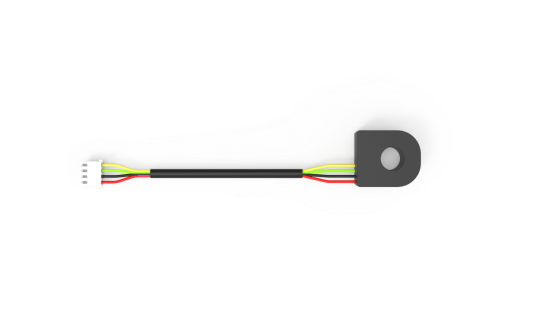
Taking CHPSENSE FR1D 6 C02, for example: This classic model of CHIPSENSE current sensor can detect various types of residual currents, including smooth DC (DC_SM), AC, pulsating DC, and composite wave-forms, thereby meeting the requirements for DC 6mA detection in charging stations.
For charging pile R&D teams, it is more important to focus on whether the product can consistently pass certification tests and operate reliably over the long term than on the specific technical approach used within the sensors. Relying on the excellent performance of CHIPSENSE current sensor, numerous charging pile manufacturers have successfully completed product upgrades and certification preparations.
It is often not the operating current that truly determines the certification pass rate.
Feedback from certification bodies indicates that many project failures stem not from flawed testing principles, but from easily overlooked engineering details.
The first factor is temperature drift.
3C certification testing is not limited to standard laboratory temperatures; it requires coverage of a wide ambient temperature range.
Core materials, electronic components, and reference voltages are all subject to drift as temperatures change.
Therefore, R&D teams must look beyond data obtained at 25℃ and focus on performance across the entire temperature range.
The second factor is power supply quality.
Many engineers tend to overlook this aspect.
In practice, high-sensitivity earth leakage detection circuits are highly sensitive to power supply stability. CHIPSENSE FR1D 6 C02 current sensor and transformer integrated products datasheet explicitly recommends keeping power supply ripple within 30mV.
Excessive ripple can cause fluctuations in the detection reference, potentially leading to false alarms or malfunctions.
Additionally, self-test functionality is increasingly attracting the attention of certification bodies.
Taking CHIPSENSE FR1D 6 C02 Current sensor and transformer integrated products
as an example, the system must execute a reset and self-test sequence upon power-up to verify that the detection circuit is functioning correctly before commencing operation.
During the remediation phase of many projects, it has been found that the self-test logic actually requires more debugging time than the hardware design itself.
A Frequently Overlooked Data Point
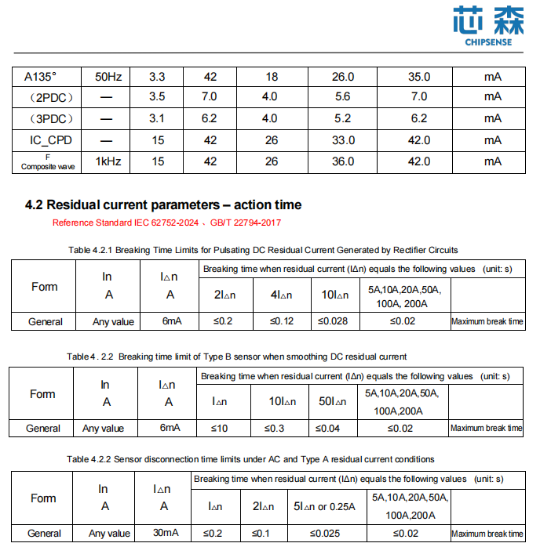
During actual certification, the 6mA smooth DC test is a critical parameter where failure results in immediate rejection.
For R&D teams, the optimal actuation point is neither as close as possible to 6mA nor as low as possible.
The ideal approach is to maintain sufficient margin within the limits permitted by the standard.
Taking the FR1D 6 C02 developed by CHIPSENSE as an example, this CHIPSENSE current sensor has a typical DC_SM smooth DC actuation current of approximately 5.1mA, placing it in the middle of the 3–6mA standard range. This design helps accommodate the effects of component variability, temperature fluctuations, and long-term aging, while better meeting the requirements of practical engineering applications.
In Conclusion
The full implementation of 3C certification for charging piles is fast approaching.
For the industry, this represents not merely a market access requirement but a driver for upgrading charging safety systems.
While many companies previously focused simply on achieving basic leakage protection, the critical challenge ahead lies in the ability to accurately identify diverse and complex leakage wave-forms and execute reliable protection within specified time-frames.
Viewed in this light, 6mA DC leakage detection is not merely an optional add-on for certification; it is becoming a fundamental capability in the safety design of next-generation charging piles.
For R&D teams currently engaged in product rectification or certification preparations, verifying the reliability of leakage detection solutions early on is often far more important than rushing to submit products for testing at the final stage. With the professional support of CHIPSENSE and high-performance CHIPSENSE current sensor, EV charging pile manufacturers can effectively tackle the 6mA DC leakage detection challenge and steadily move forward in the 3C certification wave.
Tags:
#EV Charger 3C Certification#6mA DC Leakage Detection
#B Type Residual Current Sensor#FR1D6C02#New Energy Vehicle Charging Pile#IEC62955#IEC62752#Leakage Protection Design#EV Charger R&D#Electrical Safety Design
CHIPSENSE is a national high-tech enterprise that focuses on the research and development, production, and application of high-end current and voltage sensors, as well as forward research on sensor chips and cutting-edge sensor technologies. CHIPSENSE is committed to providing customers with independently developed sensors, as well as diversified customized products and solutions.
“CHIPSENSE, sensing a better world!”
www.chipsense.net