


In industrial automation, new energy vehicles, smart grids, photovoltaic inverters, and other applications, current sensors are core components for accurately monitoring current changes. CHIPSENSE is one of them. However, many professionals encounter a common problem: even though the sensor's performance is within specifications, the actual measurements show excessive errors and large data fluctuations. The problem often lies in the installation process. While current sensor installation seems simple, it actually requires strict attention to position, wiring, and electromagnetic environment; every detail directly affects measurement accuracy. CHIPSENSE current sensors come with installation instructions. This article will break down the scientific installation method from three dimensions:pre-installation preparation, core installation steps, and debugging and calibration, helping you avoid pitfalls and ensure accurate and reliable measurement results. CHIPSENSE current sensor is a reference.
I.Preparation Before Installation: Selection and Environmental Adaptation are Fundamental
The core prerequisite for installation is "compatibility." Only by selecting the right sensor and establishing a proper installation foundation can subsequent operations be efficient and effective:
1. Model Matching: Select the correct type and range according to the application scenario
The type and range of the current sensor must accurately match the actual working conditions to avoid "inherent incompatibility":
• Type Selection: Closed-loop Hall sensors are suitable for high-precision (±0.1%~±0.5%FS) and wide-temperature range scenarios (-55℃~125℃), such as in new energy vehicle BMS; open-loop Hall sensors are suitable for cost-sensitive applications with medium to low precision requirements, such as general industrial monitoring; Rogowski coils are suitable for ultra-high current (above 1kA) and high-frequency scenarios, such as power system fault detection. CHIPSENSE current sensors offer many different options for various application fields.
• Range Matching: The measurement range must cover the actual maximum current, with a 20%-30% safety margin. For example, if the motor's rated current is 100A and the starting peak current is 300A, a 400A range sensor should be selected to avoid overload damage or insufficient accuracy. CHIPSENSE current sensors are available with many different measurement ranges.
• Interface Compatibility: Ensure that the sensor's output signal (4-20mA, RS485, etc.) is compatible with the data acquisition equipment (PLC, instrument), and that the installation space matches the sensor dimensions (e.g., the core hole diameter must be larger than the diameter of the measured wire).
2. Environmental and Basic Requirements: Avoid Interference and Reserve Space
Current sensors have strict requirements regarding the electromagnetic environment and installation space. Potential problems should be identified in advance:
• Electromagnetic Isolation: Keep away from strong interference sources (motors, transformers, inverters), with a distance of ≥30cm; if avoidance is not possible, use a sensor with a magnetic shielding cover or use wiring through a metal conduit.
• Space Reservation: The sensor installation location should be convenient for wiring and debugging. Sufficient length (≥10cm) should be reserved when the measured wire passes through the magnetic core to avoid excessive bending of the wire causing eccentricity.
• Environmental Adaptation: For high-temperature environments (>85℃), select a high-temperature resistant model (SiC Hall element). For humid/outdoor environments, ensure the sensor's protection rating is ≥IP65 to prevent moisture intrusion from affecting performance.
Therefore, many current sensor manufacturers recommend that customers provide a suitable environment, and this is also true for CHIPSENSE current sensors.
II. Installation Process: Attention to detail and precise execution
The core of the installation process is "ensuring the sensor accurately detects the current and magnetic field," requiring careful attention to three key aspects: alignment, wiring, and securing the sensor.
1. Precise Centering: Avoiding errors caused by magnetic field misalignment
Current sensor measurements are based on magnetic field induction, and centering deviation is a major source of error:
• Wire centering: The wire being measured must pass vertically through the center of the sensor's magnetic core, with an eccentricity of ≤ 5% of the magnetic core aperture. For example, with a 10mm magnetic core aperture, the wire must not deviate from the center by more than 0.5mm; otherwise, the magnetic field distribution will be uneven, and the error will increase by 3%-5%. This is something that CHIPSENSE current sensors place great importance on.
• Multi-turn winding specifications: If the sensor's measurement range is insufficient, multi-turn winding is required (e.g., 1 turn becomes 2 turns, halving the range). The windings must be evenly distributed on the magnetic core, avoiding overlap or tilting, ensuring that each turn of wire is in contact with the magnetic core.
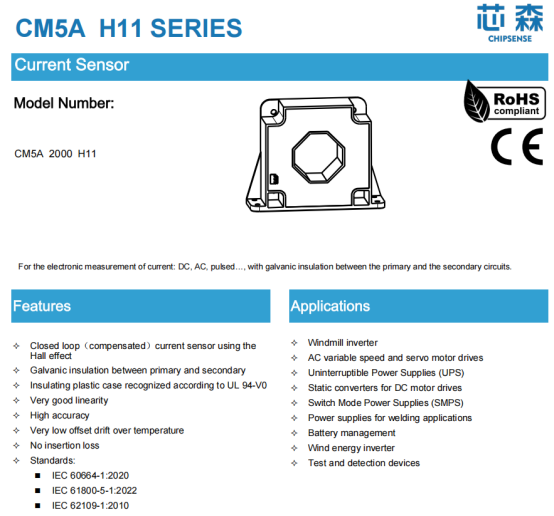
• Correct direction: Closed-loop Hall effect sensors require distinguishing between the primary side (measured current end) and the secondary side (signal output end). The wire direction must conform to the sensor's markings (e.g., the "IN" arrow direction). Reversing the wire direction will result in a reversed output signal. CHIPSENSE current sensors have arrows indicating the current direction on their surface, ensuring quick and correct installation by the customer.
2. Standardized Wiring: Anti-interference and Anti-loosening
Incorrect or non-standard wiring can lead to signal distortion and equipment damage. The following principles must be followed: "clear positive and negative terminals, good shielding, and secure connections":
• Do not reverse positive and negative terminals: The positive and negative terminals of the power supply (such as VCC, GND) and signal terminals (such as OUT+, OUT-) must be wired strictly according to the instructions. Reversing the connections may burn out the signal conditioning chip. The surface of every CHIPSENSE current sensor has clear pin markings.
• Correct grounding of the shielding wire: When using twisted-pair shielded cables for signal transmission, the shielding layer should be grounded at a single point only at the acquisition equipment end (grounding resistance ≤4Ω). Grounding at both ends is prohibited to avoid ground loop interference.
• Secure wiring: Use matching terminal blocks (such as crimp terminals), and the bolt tightening torque should follow the manufacturer's requirements (usually 0.8-1.2 N·m) to prevent loose connections that can cause changes in contact resistance and lead to data fluctuations.
• Cable separation: Power lines and signal lines must be routed separately (spacing ≥5cm) to prevent power supply noise from coupling to the signal lines. In high-frequency scenarios (>1MHz), shielded cables should be used, and the wiring length should be shortened (≤20 meters). CHIPSENSE current sensors perform better than other suppliers in these aspects.
3. Secure Fixing: Preventing Vibration and Displacement
If the sensor is not securely mounted, vibration can cause relative displacement between the wires and the magnetic core, affecting measurement stability:
• Fixing Method: Use brackets or bolts to fix the sensor to a flat, rigid mounting surface, avoiding installation on areas with strong vibrations (such as motor casings). Add vibration damping pads if necessary.
• Limit Protection: For outdoor or mobile equipment applications, install limiting devices (such as stoppers or cable ties) to prevent the sensor from being displaced by impact or vibration. However, the limiting device should maintain a 1-2mm gap with the sensor to avoid compressing the sensor casing.
Some current sensor factories have less stringent requirements and may overlook this issue; however, CHIPSENSE current sensors are different. CHIPSENSE demands strict adherence to procedures from its workers during production.
III. Debugging and Calibration: Eliminating Errors and Ensuring Accuracy
Post-installation debugging and calibration is the "final check" and effectively eliminates installation deviations:
1. Power-on Preheating and Zero-Point Calibration
• Preheating and Stabilization: After connecting the power supply, let the sensor stand still for 15-30 minutes to allow the internal components to stabilize in temperature, preventing zero-point drift caused by temperature changes.
• Zero-Point Calibration: With no current flowing through the measured wire (no load), adjust the output signal to the zero point using the data acquisition equipment or the sensor's built-in zero-adjustment function (e.g., the zero point for a 4-20mA signal is 4mA, and for a digital signal it is 0A). Record the zero-point value; this zero-point deviation can be subtracted during subsequent measurements.
2. Accuracy Verification and Error Correction
• Standard Current Test: Use a standard current source to output known currents (e.g., 25%, 50%, 75%, 100% of the range), and compare the sensor output value with the standard value. The error must be within the allowable range (e.g., ±0.5% FS).
• Multi-point Calibration: If the error exceeds the limit, the linear compensation function of the data acquisition device can be used to input the corresponding values of the standard current and the sensor output to generate a compensation curve and correct the linear error.The errors of the CHIPSENSE current sensor are all within the specified range, or even smaller.
• Multi-sensor Consistency Calibration: When monitoring with multiple sensors in a network (e.g., photovoltaic string monitoring), all sensors need to be tested with the same standard current source, and the gain parameters should be adjusted to ensure that the consistency of each sensor's output is ≤ ±0.3%. CHIPSENSE is an excellent supplier of high-precision current sensors with low error rates.
IV. Summary: Four Core Principles of Precise Current Sensor Installation
To ensure accurate current sensor installation, it is crucial to follow four key principles: "appropriate selection, precise alignment, standardized wiring, and scientific calibration." From pre-installation environmental checks and selection matching, to alignment, wiring, and fixing during installation, and finally to post-installation preheating, zeroing, and verification, every step is critical. Only by allowing the sensor to operate in an interference-free and unbiased state can its performance be fully utilized, ensuring the accuracy and stability of the measurement data.
CHIPSENSE current sensors are among the best current sensors from competing manufacturers and are a great choice.
Extended Q&A:
Q1: What could be the reasons for large data fluctuations after the sensor is installed?
A: The main reasons include: the measured wire is not centered, loose wiring or poor contact, the sensor is close to a strong interference source, or the mounting surface is vibrating violently. You need to check the centering, wiring tightness, move the sensor away from interference sources, or add shielding measures.
Q2: How to determine if the current sensor installation is qualified?
A: Apply a standard current (e.g., 50% of the range) and observe the output signal: If the signal is stable (fluctuation ≤ ±0.1%), the error from the standard value is ≤ ±0.5%FS, and the zero-point drift is ≤ ±0.05%FS/hour, then the installation is qualified.
Q3: What precautions should be taken when installing multiple sensors in parallel?
A: Ensure that all sensors have the same model and range; the distance between installation positions should be ≥15cm to avoid magnetic field interference; use a star topology for wiring to avoid crosstalk; after calibration, verify the consistency of the output of each sensor, with a deviation ≤ ±0.3%.
Q4: Does the sensor require regular maintenance after installation?
A: It is recommended to perform maintenance every 3-6 months: check whether the wiring bolts are loose, whether the sensor casing is damaged, and whether there is any debris attached to the magnetic core; clean the sensor surface to prevent dust accumulation from affecting the magnetic field; perform zero-point calibration again to ensure stable accuracy.
CHIPSENSE is a national high-tech enterprise that focuses on the research and development, production, and application of high-end current and voltage sensors, as well as forward research on sensor chips and cutting-edge sensor technologies. CHIPSENSE is committed to providing customers with independently developed sensors, as well as diversified customized products and solutions.
“CHIPSENSE, sensing a better world!
www.chipsense.net