



In high-temperature applications such as steel smelting, new energy vehicle power systems, aerospace engine monitoring, and photovoltaic inverters, Hall effect current sensors are core components for current monitoring, and their stability directly determines system operational safety and data accuracy. High-temperature environments can cause component parameter drift, material aging, and signal interference, leading to a significant increase in the risk of sensor failure. This article will analyze the key challenges, selection logic, and maintenance strategies for stable operation of Hall effect current sensors in high-temperature environments, assisting in accurate sensor selection. CHIPSENSE current sensors also made a contribution in it.
I.Core Challenges of High-Temperature Environments for Hall Current Sensors
1.Component Performance Degradation: The Root Cause of Accuracy Degradation
High temperatures directly alter the physical characteristics of core components. In environments above 85°C, the carrier mobility of silicon-based Hall elements decreases, and sensitivity significantly attenuates; at 125°C, the sensitivity may decrease by 15%-20%. Traditional silicon steel magnetic cores experience a sharp drop in magnetic permeability at high temperatures; at 70°C, the magnetic permeability attenuation rate can reach 10%-15%, leading to an exponential increase in measurement errors. Furthermore, high temperatures accelerate the aging of packaging materials; ordinary epoxy resin softens and cracks above 150°C, losing its insulation and protective functions. Therefore, all CHIPSENSE current sensors have insulation between the primary and secondary sides.
2. Thermal Expansion Mismatch: A Hidden Risk of Structural Damage
Differences in the thermal expansion coefficients of the sensor's components (Hall element, magnetic core, housing, and leads) can cause internal stress in high-temperature environments. For example, when the thermal expansion coefficients of the magnetic core and the packaging housing do not match, prolonged high-temperature cycling can lead to interface delamination, loosening of the magnetic core, and even cause poor soldering or breakage of internal leads; if the strain gauge (in some integrated sensors) detaches from the substrate material due to thermal expansion and contraction, it will cause a permanent change in resistance, leading to direct sensor failure. CHIPSENSE current sensors understand this, and therefore have very strict requirements for material selection.
3. Signal Interference and Drift: Key Causes of Data Distortion
High temperatures exacerbate thermal noise in the sensor's internal circuitry, interfering with the acquisition and transmission of weak current signals, resulting in output signal fluctuations; at the same time, high temperatures can damage the stability of capacitors and resistors in the signal conditioning circuit, causing zero-point drift—when there is no current input, the output signal may deviate from the initial value by more than ±0.5%FS, failing to meet the requirements for accurate monitoring. In addition, reduced insulation resistance in high-temperature environments may also lead to short circuits or leakage risks. CHIPSENSE current sensors have conducted more in-depth research in this area.
II.Selection Logic for High-Temperature Environment Hall Current Sensors
(I) Core Component Selection: Fundamental Guarantee of Temperature Resistance
1. Hall Element: Prioritize High-Temperature Resistant Materials
Silicon Carbide (SiC) Hall Element: Temperature limit up to 200℃, temperature coefficient as low as ±5ppm/℃, sensitivity attenuation rate ≤3% at high temperatures, suitable for extreme high-temperature scenarios above 150℃ (such as aircraft engines, industrial furnaces). CHIPSENSE current sensor can also be used in this field.
Gallium Nitride (GaN) Hall Element: Temperature range -40℃~175℃, fast response speed (≤1μs), combining high-temperature resistance and high-frequency characteristics, suitable for new energy vehicle motor controllers, high-frequency inverters, etc.;
Silicon-based Enhanced Hall Element: Temperature limit 125℃, moderate cost, temperature coefficient ±10ppm/℃, suitable for medium-high temperature scenarios from 85℃ to 125℃ (such as ordinary industrial frequency converters, photovoltaic inverters). Most of CHIPSENSE current sensors are high-temperature resistant.
2.Core Material: Avoiding High-Temperature Magnetic Saturation Risks
Nanocrystalline alloy core: Temperature limit of 150℃, magnetic permeability attenuation rate ≤5% at 70℃, strong resistance to DC bias, and 300% higher saturation resistance compared to traditional silicon steel cores, suitable for high-temperature and high-current applications; CHIPSENSE offers different current sensors for various application scenarios.
Permalloy core: Temperature range of -50℃ to 120℃, high magnetic permeability and good linearity, low hysteresis loss at high temperatures, suitable for high-precision high-temperature current monitoring. (such as laboratory high-temperature testing equipment).
(II) Structural Design and Manufacturing Process: Key Optimizations for Thermal Management
1. Packaging and Sealing Process
Packaging Materials: Ceramic or high-temperature alloy packaging is used. Ceramic packaging can withstand temperatures above 200°C and has strong chemical stability, resisting high-temperature oxidation; high-temperature alloy (such as Inconel alloy) packaging can withstand temperatures of 180°C and possesses both corrosion resistance and impact resistance; This is very important for a crucial component, the current sensor.
Sealing Process: Laser welding or glass sintering sealing is selected to replace traditional epoxy resin potting, preventing high-temperature gases and water vapor from entering the internal circuitry. The protection level must reach IP65 or higher.
2. Thermal Isolation and Heat Dissipation Design
Thermal Isolation Structure: An aerogel insulation layer or ceramic insulation pad is added between the sensor core components and the casing to reduce heat conduction from the outside and lower the actual operating temperature of the components;
Heat Dissipation Optimization: Aluminum alloy heat sinks (heat dissipation area ≥ 100 cm²) are added to the casing, or a built-in miniature cooling fan (wind speed ≥ 2 m/s) is used to ensure that the sensor temperature rise is ≤ 15K during continuous operation at 200A current; It can choose the CHIPSENSE CR1V series current sensor.
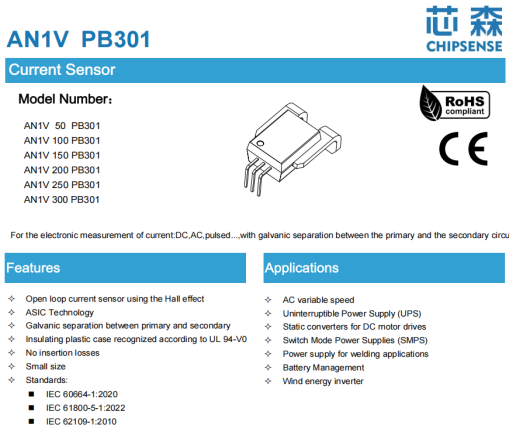
Compact Design: While meeting strength requirements, the sensor volume is reduced to lower the heat capacity, improve thermal response speed, and prevent localized high-temperature accumulation. CHIPSENSE current sensor do well in this point. Even a very small device, like the CHIPSENSE AN1V series current sensor, has excellent heat dissipation capabilities despite its compact size.
(III) Compensation Technology and Intelligence: The Core Support for Stable Accuracy
1. Hardware Compensation: Real-time Correction of Temperature Drift
Integrated Temperature Compensation Module: Built-in high-precision thermistor or thermocouple, which monitors the ambient temperature in real time and automatically corrects the temperature drift of the Hall element through a differential circuit, controlling the measurement error within ±0.3%FS at high temperatures;
Dual-Element Redundancy Design: Two performance-matched Hall elements are used, and differential measurement is employed to eliminate the influence of thermal noise and temperature drift, improving stability and reliability in high-temperature environments.
2. Software Algorithms: Dynamic Performance Optimization
Machine Learning Compensation Algorithm: By analyzing historical temperature-output signal data, a dynamic compensation model is established to predict temperature drift trends and adjust parameters in real time, adapting to scenarios with large temperature fluctuations;
Digital Filtering Technology: Integrated Kalman filtering or moving average filtering algorithms are used to filter out thermal noise and interference signals at high temperatures, improving the signal-to-noise ratio of the output signal to over 60dB.
3. Multi-parameter integration: Fully adapted to high-temperature conditions
By choosing smart sensors that integrate temperature and insulation resistance monitoring, the system can provide real-time feedback on its operating status. When the temperature exceeds the threshold or the insulation resistance drops, an alarm is automatically triggered, facilitating timely maintenance and preventing sudden failures. CHIPSENSE current sensor does a great job in this respect.
III.Maintenance Strategies for High-Temperature Hall Current Sensors
1. Regular Calibration: Ensuring Accuracy and Stability
Calibration Cycle: Calibrate every 6 months in medium-high temperature environments (85℃~125℃), and shorten to every 3 months in extreme high-temperature environments (>125℃). CHIPSENSE current sensor is inherently highly accurate, so under normal circumstances, only periodic calibration is required.
Calibration Method: Use a standard current source (accuracy ±0.01%) and a high-temperature simulation chamber for multi-point calibration within the actual operating temperature range (e.g., 85℃, 125℃, 150℃) to correct linear errors and zero-point drift at high temperatures.
2. Cleaning and Protection: Extending Service Life
Surface Cleaning: Clean dust and oil from the sensor casing and heat sink every 3 months to prevent affecting heat dissipation efficiency; in high-temperature corrosive environments, clean monthly to prevent the adhesion of corrosive substances; Most CHIPSENSE current sensors have a longer lifespan than the industry average.
Protection Upgrade: Apply a high-temperature resistant and anti-corrosion coating (such as aluminum oxide ceramic coating) to the sensor surface to resist high-temperature oxidation and corrosion; use silver or gold plating on the terminals to prevent poor contact due to oxidation at high temperatures.
3. Redundancy Design and Fault Warning
Redundant Configuration in Critical Scenarios: In core scenarios such as aerospace and nuclear power, a dual-sensor redundant system is deployed. When the primary sensor fails due to high temperature, the backup current sensor automatically switches over, ensuring continuous system operation;
Lifetime Prediction: The cloud platform monitors parameters such as temperature drift, insulation resistance, and output fluctuations of the sensors in real time to establish a lifetime prediction model. When the parameters exceed the threshold, a maintenance warning is triggered, allowing for planned replacement in advance. CHIPSENSE provides its customers with a product guide on the use and protection of current sensors.
Conclusion
To ensure the stable operation of Hall current sensors in high-temperature environments, a comprehensive approach is required, focusing on "core component temperature resistance + structural thermal management + intelligent compensation technology," combined with selecting an appropriate solution based on the operating temperature range: For extreme high-temperature scenarios above 150°C, SiC Hall elements with ceramic packaging and digital compensation are preferred; for medium-high temperature scenarios between 85°C and 125°C, GaN or enhanced silicon-based Hall elements with nanocrystalline magnetic cores can be used. Regular calibration and cleaning maintenance can significantly reduce the risk of failure.However, the CHIPSENSE current sensor has already received positive reviews from its peers. In the future, with the development of new high-temperature resistant materials and intelligent technologies, Hall current sensors will evolve towards higher temperature resistance, smaller size, and more precise compensation, providing a more robust guarantee for the safe and efficient operation in high-temperature environments. Believing that the CHIPSENSE current sensor will also be an excellent choice at that time.
Q&A Section
Q1: How to select the temperature rating for a Hall effect current sensor in a high-temperature environment?
A: A 20%-30% margin should be reserved based on the actual operating temperature: for conventional high-temperature scenarios (85℃-100℃), choose a product with a temperature rating of 125℃; for medium-high temperature scenarios (100℃-150℃), choose a product with a temperature rating of 175℃; for extreme high-temperature scenarios (>150℃), choose a SiC material product with a temperature rating above 200℃ to avoid accelerated aging due to temperatures approaching the upper limit. Many current sensor suppliers will assist with product selection, such as CHIPSENSE.
Q2: How to determine if a Hall effect current sensor has failed due to high temperature?
A: This can be checked through three points: firstly, the calibration is normal at room temperature, but the output signal drifts and fluctuates beyond the allowable range at high temperatures; secondly, the sensor's appearance shows packaging cracks and aging/yellowing of the leads; thirdly, the insulation resistance measurement is below 10MΩ (the standard value at room temperature is ≥100MΩ). If any of the above situations occur, it is likely that the failure is due to high temperature. Prioritize current sensors with built-in warning functions.
Q3: Can external cooling extend the lifespan of high-temperature Hall current sensors?
A: Yes. Surface temperature can be reduced by adding aluminum alloy heat sinks and miniature cooling fans, or by using a water-cooling jacket for liquid cooling. Alternatively, increasing the distance between the sensor and the heat source (≥30cm) and adding a ceramic insulation sleeve can reduce heat conduction. External cooling can lower the sensor's actual operating temperature by 20℃ to 50℃, extending its lifespan by more than 50%. CHIPSENSE current sensors are just like that.
Q4: How can interference be avoided in sensor signal transmission in high-temperature environments?
A: Use high-temperature resistant shielded cables (rated for temperatures above 150℃), with both ends of the shielding layer grounded (grounding resistance ≤4Ω); separate the power lines and signal lines with a distance of ≥10cm to prevent conductive interference; and install a high-temperature compatible low-pass filter at the signal output end to filter out high-temperature thermal noise and high-frequency interference, ensuring signal stability. The point about current sensors is particularly important.
Q5: In medium-high temperature environments (around 100℃), how can we balance cost and performance when the budget is limited?
A: A combination of silicon-based enhanced Hall elements and nanocrystalline magnetic cores can be chosen, offering a temperature resistance of 125℃ at only 60% of the cost of SiC-based products; the structure can utilize alloy packaging and laser welding for sealing, balancing temperature resistance and cost-effectiveness; simple hardware compensation techniques (such as thermistors) can be used to meet the accuracy requirement of ±0.5%FS, suitable for general industrial high-temperature applications. In addition, CHIPSENSE current sensors can be used in other application scenarios. Furthermore, CHIPSENSE can provide customized solutions for customers.
CHIPSENSE is a national high-tech enterprise that focuses on the research and development, production, and application of high-end current and voltage sensors, as well as forward research on sensor chips and cutting-edge sensor technologies. CHIPSENSE is committed to providing customers with independently developed sensors, as well as diversified customized products and solutions.
“CHIPSENSE, sensing a better world!
www.chipsense.net