


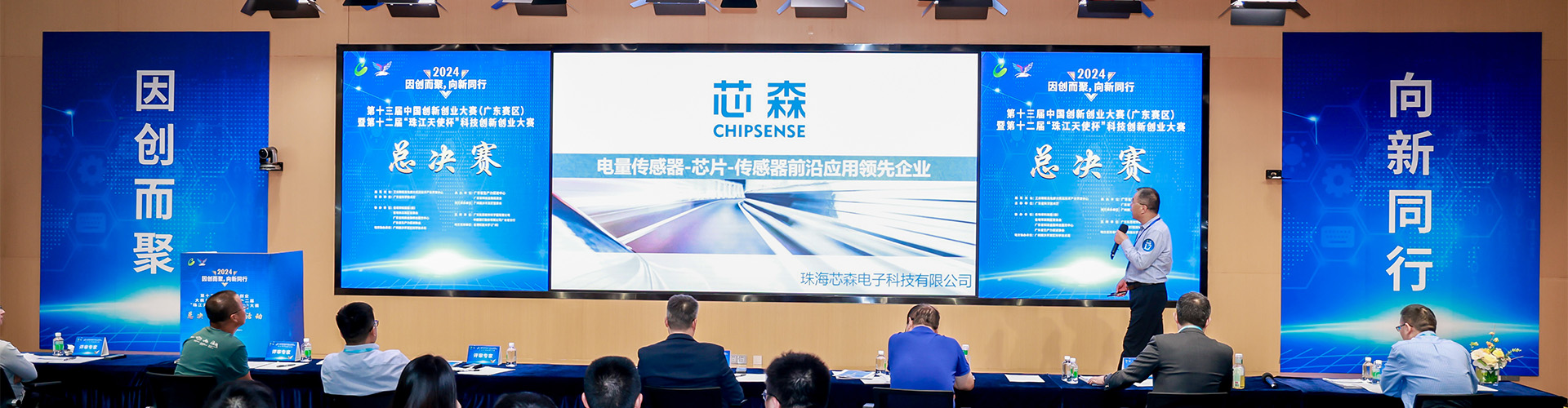
Since the National Development and Reform Commission and the National Energy Administration jointly issued the Notice on Improving the Capacity Price Mechanism on the Generation Side earlier this year, discussions regarding "capacity pricing" within the energy storage industry have intensified significantly. As a core supporting enterprise for the energy storage sector, CHIPSENSE has also closely tracked this policy change, recognizing its profound impact on the entire industrial chain and the vital role of CHIPSENSE current sensor in the industry transformation.
To many outside the power sector, this may appear to be merely a new market mechanism. However, for investors and operators of energy storage projects, the resulting changes represent not just an adjustment to revenue models, but a fundamental shift in how the value of energy storage is assessed.
In this critical transformation stage, high-precision sensing equipment represented by CHIPSENSE current sensor has become an indispensable technical guarantee for energy storage projects to realize their true value.
In the past, industry discussions on energy storage projects typically focused on installed capacity, storage duration, and revenue from peak-valley arbitrage.
Yet, as the capacity price mechanism is gradually implemented, another concept is beginning to garner attention:Usable capacity. Accurate identification and monitoring of usable capacity cannot be achieved without professional sensing devices, and CHIPSENSE has long focused on tackling related technical difficulties.
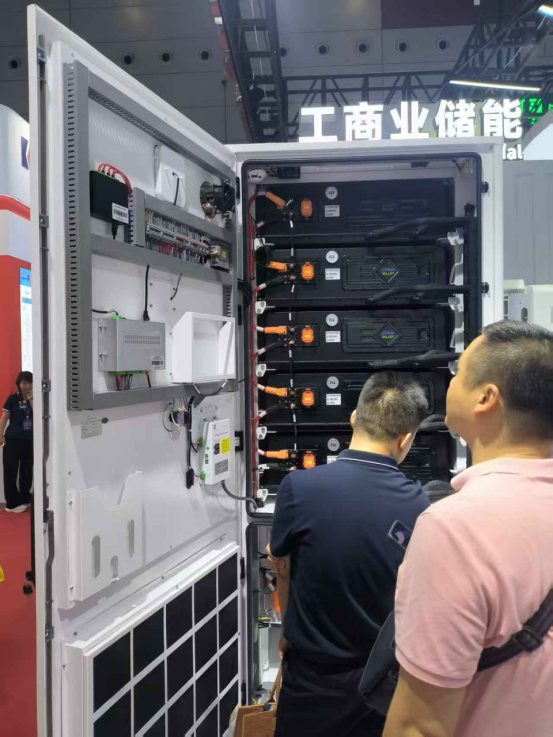
Usable capacity.
Simply put, an energy storage system must not only have sufficient storage capacity but also be able to deliver that energy when the grid needs it.
While this may seem like a mere change in phrasing, it actually reflects a shift in the logic behind the design and operation of energy storage systems.In this new operational logic, the data collected by CHIPSENSE current sensor runs through every link of system operation.
Theoretical capacity is not the same as actual usable capacity.
For energy storage systems, rated capacity is typically a design parameter.
For instance, a 100 MWh energy storage station can theoretically store 100 MWh of electrical energy.
However, in actual operation, the dispatch-able capacity is often influenced by various factors.
For example:
Battery temperature fluctuations;
Battery aging and degradation;
Variations in cell consistency;
PCS operating status;
Constraints imposed by charging and discharging strategies.
Capture real-time changes caused by the above problems, stable and high-precision current monitoring is required, and this is exactly where the strengths of CHIPSENSE current sensor lie.
Consequently, for operations personnel, the primary concern is often not the station's designed capacity, but rather the amount of capacity that can actually be delivered under current conditions.This is a key reason why the energy storage industry has increasingly prioritized condition monitoring and operational data management in recent years, and it also creates a broad application space for CHIPSENSE series sensors.This is a key reason why the energy storage industry has increasingly prioritized condition monitoring and operational data management in recent years.
From the BMS level on up, an energy storage system is constantly "calculating itself."
The system does not inherently know how much charge remains;
precisely speaking, it must continuously perform calculations and assessments based on various data.
Take SOC (State of Charge), for example.
Regardless of the algorithm employed, the core objective is to estimate the battery's current remaining charge.
In practical engineering applications, SOC estimation typically requires integrating information such as current, voltage, temperature, and battery models.
Current data is a key input parameter in this process.
A lack of reliable current data can compromise the accuracy of SOC estimation, thereby affecting the system's assessment of available capacity.
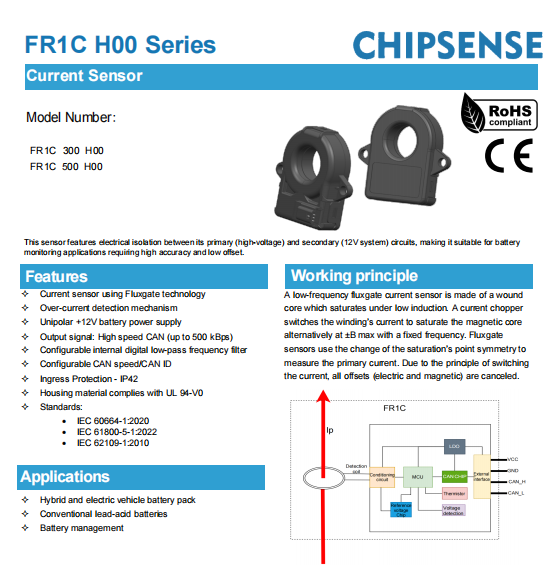
Therefore, within an energy storage system, current sensing serves not only a protective function but also acts as a crucial foundation for state estimation. CHIPSENSE current sensor features high precision, low temperature drift and strong anti-interference capability.
The implementation of these control functions relies on stable and reliable current feedback.
From this perspective, current data effectively permeates the entire energy flow process of the energy storage system. As a professional sensor manufacturer, CHIPSENSE has launched multiple series of current sensors tailored to energy storage scenarios to meet the diverse current collection needs of different links in energy storage systems. CHIPSENSE FR1C H00 fluxgate current sensor has received positive feedback from customers.
What measurement challenges do large-scale energy storage projects face?
As the scale of energy storage projects continues to expand, the operating conditions for current sensing are becoming increasingly complex.
Taking the currently mainstream 1500V energy storage system as an example, engineering design focuses not only on measurement accuracy but also on:
High-voltage isolation;
Electromagnetic compatibility (EMC);
Long-term stability;
Temperature drift performance;
Safety and reliability.
Different sensing solutions may be employed depending on the specific application point, such as battery cluster management, PCS control, or high-current busbar monitoring.
For instance, in battery management systems, the focus is on long-term, stable data acquisition capabilities;
in PCS control, the emphasis is on dynamic response performance;
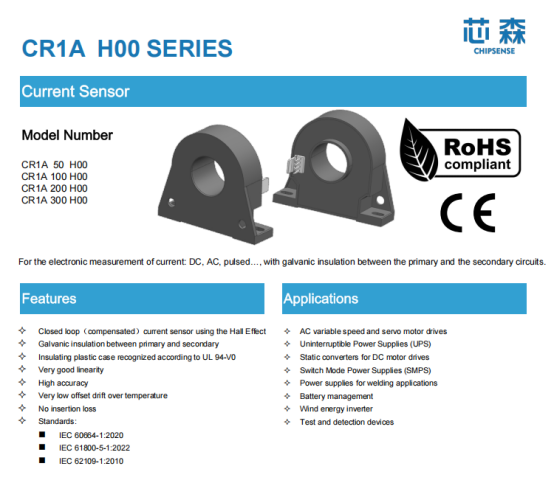
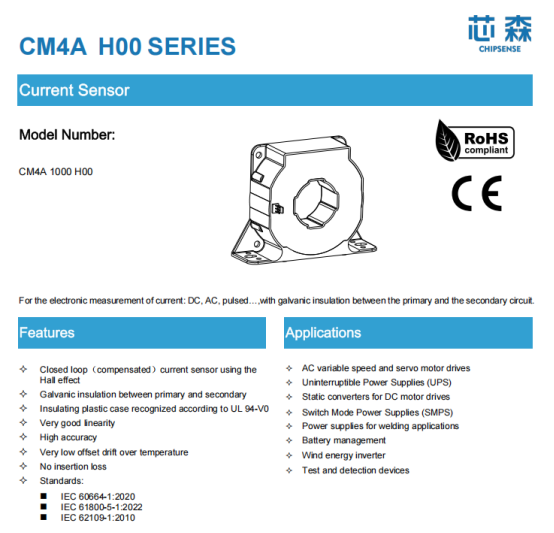
whereas in high-current busbar applications, a balance must be struck between accuracy, isolation, and long-term reliability. Facing the complex measurement challenges of large-scale energy storage, CHIPSENSE has targeted its product layout in a targeted manner. CHIPSENSE FR1C H00 series fluxgate sensor, CHIPSENSE CR1A H00 series and CHIPSENSE CM4A H00 series current sensors are developed for different application scenarios of energy storage systems.
Therefore, in engineering practice, the appropriate current sensing solution is typically selected based on the specific application scenario. CHIPSENSE current sensor products according to specific application scenarios to solve measurement pain points.
Transitioning from the Construction Era to the Operational Era
Over the past few years, the energy storage industry has undergone a phase of rapid expansion.
The industry’s focus has been on whether installed capacity is sufficiently large and costs are sufficiently low.
However, as the market gradually matures, operational capabilities are becoming increasingly important.
Whether in capacity markets, ancillary service markets, or the increasingly complex power trading models of the future, energy storage systems ultimately rely on accurate data and reliable equipment performance to realize their value.
For engineers, this means that beyond the batteries and power conversion systems (PCS), the seemingly fundamental aspects of measurement deserve equal attention.
After all, the ability of an energy storage system to operate stably, accurately assess its status, and formulate sound control strategies hinges on the support of this underlying data.
In this sense, the shifts driven by capacity pricing mechanisms may represent more than just a change in revenue models; they epitomize the energy storage industry's transition from a "construction-oriented" approach to an "operations-oriented" one. and CHIPSENSE current sensor is the core hardware source of this underlying data.
In this industry transformation, high-quality sensing equipment represented by CHIPSENSE will continue to empower the stable and efficient operation of energy storage systems across the whole life-cycle.
CHIPSENSE is a national high-tech enterprise that focuses on the research and development, production, and application of high-end current and voltage sensors, as well as forward research on sensor chips and cutting-edge sensor technologies. CHIPSENSE is committed to providing customers with independently developed sensors, as well as diversified customized products and solutions.
“CHIPSENSE, sensing a better world!”
www.chipsense.net