



Global wind power installations are projected to reach 150 GW by 2025, with my country accounting for over 50%. Wind energy is poised to become another growth driver following the explosive growth of solar power. However, failures in wind turbine blades, gearboxes, and inverters result in significant annual power generation losses. Power generation efficiency losses are increasingly becoming a focus of industry attention. Simultaneously, issues such as the MPPT efficiency, grid connection stability, and fault diagnosis of wind turbine converters also impact wind power development. This paper attempts to discuss how to improve the efficiency of wind power systems using a high-precision sensor. It will taking CHIPSENSE current sensor as an example.

Maximum Power Point Tracking (MPPT) in Wind Power Converters
Not only solar power but also wind power has MPPT. According to statistics, insufficient MPPT accuracy in wind turbines can lead to energy losses of 2-5%. To maximize the utilization of wind energy resources, maximum power point tracking (MPPT) control technology has emerged, specifically for wind power converters. This technology dynamically adjusts the turbine's speed or pitch angle to ensure the unit consistently outputs maximum power under varying wind speeds. Its core principle is matching the impedance of the wind energy conversion system with the load impedance to maximize energy capture efficiency. CHIPSENSE's current sensor was specifically developed for this purpose.
Traditional MPPT control methods
Traditional MPPT control methods are mainly divided into two categories: indirect control methods based on wind speed measurement and direct control methods that do not rely on wind speed measurement. These mainly include: tip speed ratio method, power signal feedback method, and hill-climbing search method. Due to the difficulty and high cost of accurately measuring wind speed, direct control methods are more widely used in practice. However, CHIPSENSE current sensors are well-received by customers in the same application field because the products from CHIPSENSE are designed to save customers costs. Due to space limitations, this article only discusses the power signal feedback method based on the power curve within the direct control method. This method directly detects the generator's output power and uses an optimization algorithm to locate the maximum operating point on the power-speed characteristic curve. The core task is to adjust the load on the generator side in real time so that the wind turbine always operates on the optimal power-speed curve at its current wind speed, thereby capturing maximum wind energy. This process requires accurate power calculation, i.e., power = voltage×current. Since wind in nature is constantly changing, the converter's control loop must be fast enough to keep up with the changes in wind energy; therefore, a sufficiently fast current monitoring scheme is required.
a). Power Signal Feedback Control Method
This is a direct method that does not rely on wind speed measurement and is one of the most classic and commonly used MPPT strategies. It includes two main variations:
Basic principle:
Given the aerodynamic characteristics of the wind turbine, at the optimal tip speed ratio λ_opt, the mechanical power Pm of the turbine is proportional to the cube of the generator speed ω, i.e., Pm_opt = K_opt * ω³.
Simultaneously, the electromagnetic torque Tg of the generator is proportional to the power Pm (Pm = Tg * ω). Therefore, the optimal torque command T_ref = K_opt * ω² can be derived.
The controller (usually the converter) rapidly adjusts the generator torque to ensure it precisely tracks this optimal torque curve.
Working Process:
1. Measure the current generator speed ω.
2. Calculate the optimal torque reference value T_ref at the current speed based on the preset K_opt.
3. Through the converter's torque control loop, make the generator output torque track T_ref.
Advantages:
No anemometer required, simple structure, strong robustness.
Fast control response, good stability.
It is currently the most widely used traditional MPPT method in wind power converters.
Disadvantages:
Its performance depends on the preset K_opt parameter, which can change due to factors such as wind turbine blade contamination and changes in air density, causing deviations from the true maximum power point.
b). Lookup Table Method
Basic Principle:
Through preliminary wind turbine characteristic testing, an optimal power curve P_opt = f(ω) at different speeds is pre-obtained and stored in the controller.
The system measures the current speed ω and obtains the target output power P_ref at that speed by looking up a table.
The controller adjusts the system to make the output power track P_ref.
Advantages and Disadvantages:
Similar to the optimal torque method, but it directly controls power. Its performance also heavily depends on the accuracy of the pre-stored power-speed curve.
In practical wind energy systems, the optimal torque control method is considered the most classic and mainstream traditional MPPT method due to its excellent overall performance.
The Role of Hall Current Sensors in Wind Power MPPT
The Role in Optimal Torque Control and Lookup Table Methods
Both optimal torque control and lookup table methods rely on current sensors for current data acquisition and feedback. The specific roles of current sensors in MPPT are as follows:
Achieving Precise Torque Control
Basic Principle: The electromagnetic torque Tg of the generator is proportional to the current Iq that generates that torque (called the torque current component in vector control),Tg=Kt⋅Iq
Workflow:
The MPPT controller calculates the optimal torque command Tref based on the measured speed ω.
The torque command Tref is converted into a current command Iqref.
The converter's inner current loop begins operation, requiring real-time measurement of the generator's actual phase current.
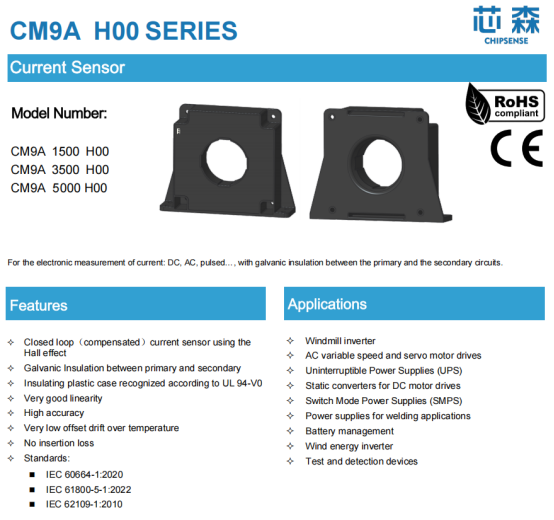
A Hall current sensor (such as CHIPSENSE CM9A closed loop current sensor) provides a high-precision, isolated phase current feedback value Iqfb at this moment. This is why CHIPSENSE current sensors are so popular with customers.
The controller compares Iqrefand Iqfb, and through a PID controller, drives the converter's power switching devices (such as IGBTs) to ensure that the actual torque current Iq quickly and accurately tracks the command value.
Core Value:
Accuracy: CHIPSENSE CM9A current sensor’s high accuracy (±0.3%) ensures precise torque control. A 1% error in current measurement will result in approximately a 1% error in the actual torque, causing the fan to deviate from its maximum power point and resulting in energy loss. CHIPSENSE current sensor does not allow this situation to occur.
Dynamic Response: CHIPSENSE CM9A current sensor’s fast response (≤1μs) and wide bandwidth (100kHz) ensure that the inner current loop—the innermost and fastest closed loop in this control system—responds stably and quickly. This is essential for the entire MPPT system to keep up with wind speed changes. CHIPSENSE current sensors do well in it.
Role in Hill Climbing Search Method
Role: Provides key input for power calculation
Basic Principle: The hill climbing method determines its action by observing changes in output power P.
Power Calculation: Power P = V×I. Here, both voltage V and current I need to be accurately measured.
Workflow: The system applies a small disturbance to the rotational speed.
A Hall current sensor measures the current I after the disturbance, while a voltage sensor measures the voltage V.
The controller calculates the power P = V×I.
The power difference ΔP before and after the disturbance is compared to determine the direction of the next disturbance.
Core Value Propositions:
Measurement Accuracy: Inaccurate current measurements will result in incorrect calculated power P and power change ΔP. The algorithm might make completely opposite decisions based on erroneous information, causing the system to deviate from its maximum power point (MPP) or generate larger oscillations near the MPP, leading to significant efficiency losses.
Interference Immunity: Electromagnetic interference is severe in wind power environments. CHIPSENSE CM9A current sensor’s high interference immunity and excellent linearity ensure clean and accurate current signal output even in complex noisy environments, preventing the algorithm from being "deceived" by noise.
Advantages of Hall Current Sensors
In MPPT applications, Hall current sensors are the preferred choice due to the following characteristics:
Non-contact measurement: No circuit disconnection required, convenient installation and maintenance.
Wideband response: Adapts to the high-speed sampling requirements of MPPT (response time down to the microsecond level).
High insulation: Suitable for high-voltage converters, improving system safety.
Strong anti-interference capability: Maintains data stability in the complex electromagnetic environment of wind farms.
Conclusion
Although the indirect control method based on wind speed measurement does not directly rely on current sensors, generator control still requires a current loop. Furthermore, over-current protection and system monitoring also utilize current sensors. In conclusion, Hall current plays a crucial role in the MPPT method for control feedback, power calculation, and ensuring system safety. If the MPPT algorithm is the brain of the wind turbine, responsible for thinking and formulating strategies; and the converter is the muscle, responsible for execution; then the current sensor is the nerve ending of this muscle, providing real-time and accurate feedback of the actual execution to the brain, ensuring the perfect execution of the brain's strategy and allowing for fine-tuning based on the feedback. If a Hall sensor is an essential component, then CHIPSENSE current sensors would be the preferred choice.
CHIPSENSE is a national high-tech enterprise that focuses on the research and development, production, and application of high-end current and voltage sensors, as well as forward research on sensor chips and cutting-edge sensor technologies. CHIPSENSE is committed to providing customers with independently developed sensors, as well as diversified customized products and solutions.
“CHIPSENSE, sensing a better world!
www.chipsense.net