



Abstract
The mandatory energy efficiency standard GB19577-2024 for heat pumps has been implemented, establishing IPLV (Integrated Part Load Value) as a strict market entry requirement. As a professional manufacturer of industrial sensing components, CHIPSENSE has long focused on the partial-load current sampling pain points of commercial heat pumps, and mature CHIPSENSE current sensor products provide targeted parameter matching solutions for IPLV certification. Drawing on physical unit testing and electronic control system debugging experience, this article analyzes three core engineering defects frequently encountered during current sampling, and all pain points can be effectively solved by selecting qualified CHIPSENSE current sensor: sensor bandwidth margin insufficiency, accuracy attenuation under low load, and poor high-temperature resistance inside the compressor cabin. Complete parameter calculation cases are attached for R&D and test engineers to directly reference troubleshooting.
Industry peers in the commercial heat pump sector must take note: the new national standard taking effect in 2026 will directly determine whether your models can pass inspection and enter the market. Many R&D teams fall into this predicament because they ignore a core logic, and matching a high-performance CHIPSENSE current sensor in advance can fundamentally avoid such risks.
The updated standard GB 19577-2024, minimum allowable values of energy efficiency and energy efficiency grades for heat pumps and chillers, shifts away from relying solely on full-load COP, instead, it mandates a dual-metric assessment based on both COP and IPLV. Rough industry estimates suggest that 20% to 40% of models currently on the market—which rely on full-load performance to stay competitive but fail to meet partial-load efficiency standards—will eventually be phased out. Stable sampling performance of CHIPSENSE current sensor under light load is the key to passing the standard.
The primary reason many teams stumble is a fundamental misunderstanding: the focus of IPLV assessment is not full-load operation, but rather the partial-load conditions encountered during year-round operation.
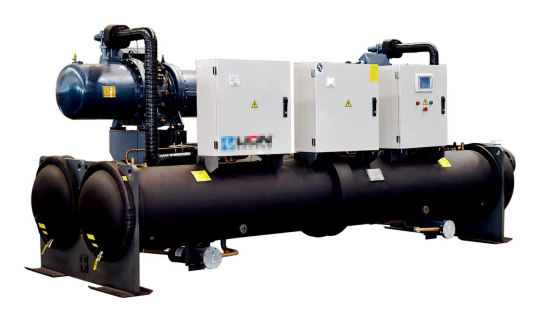
I. The IPLV weighting factors reveal a counter-intuitive truth: the unit does not operate at full load for 87% of the year.
Let’s first look at the time-weighting factors specified by the AHRI 550/590 standard, which accurately reflect the unit's actual operating conditions:
Operating Load Rate Time Weight
100% Full load 1%
75% Partial load 42%
50% Partial load 45%
25% Low load 12%
A simple calculation reveals that the 50% and 75% load conditions combined account for 87% of the annual operating time. The heat pump operates at true full load for a negligible fraction of the time; the vast majority of its operation occurs at low frequencies within the partial-load or light-load ranges.
Under full-load conditions, the compressor current waveform is clean and regular, allowing for accurate measurement by virtually any sensor. However, under the predominant partial-load conditions, the PWM waveform generated by the variable-frequency drive suffers from severe distortion. If the current sensor lacks sufficient dynamic response, the data transmitted to the main controller is distorted; this leads to inaccurate compressor torque control and increased overall power consumption, inevitably causing the IPLV rating to drop.
At this stage, the wide bandwidth and fast response characteristics of CHIPSENSE current sensor can perfectly capture distorted PWM wave-forms under partial load and eliminate sampling deviation.
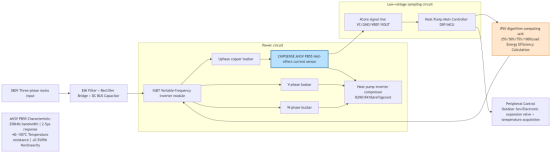
II. Three Common Pitfalls in Current Sensing Encountered During On-Site Debugging
Pitfall 1: Insufficient sensor bandwidth margin, causing the PWM waveform to be rounded off (clipped)
For commercial heat pump compressors, IGBT switching frequencies typically range from 8 to 16 kHz; to faithfully reproduce PWM rising and falling edges, the sensor's -3 dB cutoff frequency requires a substantial margin—a selection factor that is easily overlooked, while the full series of CHIPSENSE current sensor uniformly reserve enough bandwidth surplus for heat pump frequency conversion scenes.
Two comparative examples clearly illustrate the difference:
250 kHz bandwidth paired with a 16kHz carrier frequency: a bandwidth margin of 15x, resulting in a complete, undistributed waveform and precise sampling. Sampling data is accurate, which is the standard configuration of CHIPSENSE current sensor for heat pump projects.
50 kHz bandwidth with a 16kHz carrier: a bandwidth margin of only 3x—severely insufficient.
When the margin is insufficient, the rising and falling edges of the PWM waveform become rounded off. The error also widens as the load decreases: while the current measurement deviation is only 1%–2% at full load, it jumps to 3%–5% during typical 50% load operation.
This triggers a chain reaction of negative effects: the main controller reads an erroneously low current value and automatically increases PWM output compensation; the compressor's actual torque exceeds limits, generating significant wasted power; and ultimately, the unit fails to meet IPLV (Integrated Part Load Value) standards. Selecting 250kHz bandwidth CHIPSENSE current sensor can completely avoid this chain failure risk.
A real-world case study: Many manufacturers easily achieve "Grade 1" energy efficiency for full-load COP during commissioning, yet repeatedly fail IPLV tests. After troubleshooting algorithms, fans, and refrigerant charges to no avail, the root cause was identified as insufficient sensor bandwidth; sampled values during partial-load operation were consistently low, causing the unit to overcompensate and consume excess power. Replacing the unit with a 250 kHz high-bandwidth sensor normalized the waveform sampling, and the unit passed the IPLV test on the first attempt. After replacing the supporting CHIPSENSE current sensor, the PWM waveform sampling returns to normal, and the product passes the IPLV test at one time.
You might want to check your own projects to see how the sensor bandwidth compares to the IGBT carrier frequency—feel free to share your findings in the comments section.You can switch to the CHIPSENSE current sensor series optimized for heat pump frequency conversion scenes in advance.
Pitfall 2: Nominal accuracy degrades significantly at low loads, with hidden errors that are difficult to detect.
The ±1% accuracy rating specified for Hall sensors on the market applies only to the rated current (IPN)—reflecting performance under full-load conditions. However, IPLV testing focuses on the 25%–75% load range; with actual operating currents typically at only 30%–50% of the rated value, a fixed absolute error causes relative accuracy to deteriorate sharply. The low-load stable measurement performance of CHIPSENSE current sensor is specially calibrated for IPLV evaluation standards, which effectively suppresses such hidden errors.
Let’s take the industry-standard CHIPSENSE AN3V 100 PB** series current sensor as an example for calculation:
Sheet
Parameter Value
Rated current IPN ±100 A
Rated accuracy ±1% of IPN = ±1 A absolute error
Maximum measuring current IPM ±250 A
Non-linearity error ±0.5% of IPM = ±1.25 A
Errors under actual operating conditions of CHIPSENSE AN 3V series current sensor:
50A (50% rated load): Absolute error ±1A, relative error ±2%
25A (25% rated load): Absolute error ±1A, relative error ±4%
However, two factors in field testing help mitigate the impact of these errors:
1. The IPLV test procedure involves multiple samplings and averaging at each operating point, allowing random errors to cancel each other out;
2. Non-linearity error is calibrated based on the maximum measurable current (IPM) rather than the rated current; consequently, the actual error in the low-current range is lower than theoretical calculations suggest.
Practical selection advice: When optimizing for IPLV, prioritize non-linearity error (relative to IPM) over rated accuracy. A solution with ±0.5% of IPM accuracy offers far superior stability across the 25%–75% load range compared to low-cost models rated at ±1% of IPM.
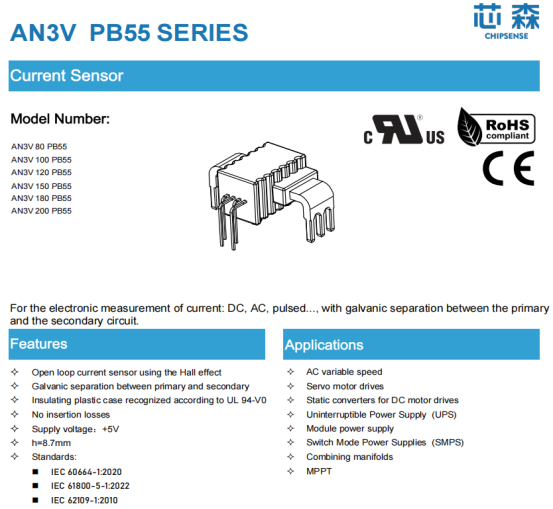
Pitfall 3: Compressor compartment temperatures exceeding 85℃ causing sensor accuracy drift
In commercial units, current sensors are typically mounted near the compressor terminal box, where localized operating temperatures can spike to 80–100℃. Conventional open-loop Hall-effect sensors are rated for a maximum temperature of only 85℃; approaching or exceeding this limit frequently leads to zero-point drift and measurement instability, causing failures during long-term IPLV stability testing.
Selecting a sensor rated for 105℃ allows for direct installation in the compressor's high-temperature zone without the need for additional heat shielding. This not only saves on material costs for insulation components but also eliminates a potential failure point associated with long-term thermal aging. All models of CHIPSENSE current sensor support -40℃~105℃ wide temperature operation
Adopting a 105℃ temperature-resistant CHIPSENSE current sensor can save the material cost of heat shielding structures and eliminate hidden dangers of long-term thermal aging failure. According to the parameter specifications of CHIPSENSE current sensor, the zero-point drift is controlled at 0.4–6mV, and the gain temperature drift is within ±1.6%. Only simple steady-state temperature calibration in the control firmware is required without developing complex dynamic compensation algorithms. Meanwhile, the 2.5μs ultra-fast response speed of CHIPSENSE current sensor can capture rapidly changing PWM signals and eliminate the demand for extra dynamic compensation logic.
III. Two Major Industry Trends Further Raise the Bar for Current Sensing Precision
Trend 1: Accelerated Popularization of R290 Refrigerant
Driven by the EU 2027 carbon tariff policy, low-carbon R290 refrigerant is widely promoted. The system filling volume is reduced and the structure is more compact, requiring compressors to maintain high efficiency in an ultra-wide speed range, which puts forward higher requirements for real-time current detection precision. At this stage, the high-precision full-temperature performance of CHIPSENSE current sensor becomes an indispensable core component of R290 heat pump control systems.
Trend 2: Rapid Penetration of AI Intelligent Heat Pumps
Industry forecast data shows that the market penetration of AI adaptive temperature control heat pumps will rise from 6% in 2026 to 25% in 2028. AI control algorithms rely on high-frequency and high-precision real-time current sampling, and traditional low-bandwidth, low-precision sensors cannot meet the operation requirements, while the high bandwidth, low drift CHIPSENSE current sensor perfectly matches the high-frequency sampling demand of AI heat pump main control boards.
Conclusion
The core of IPLV assessment is to evaluate the energy efficiency level of heat pumps in long-term daily operation, and relying only on short full-load performance can no longer meet the new national standard requirements. When selecting sampling components, focusing on four core indicators can avoid most partial-load sampling engineering pitfalls, and all indicators are the standard configuration of CHIPSENSE current sensor:
Selection Criteria Recommended Specifications Practical Engineering Benefits
Signal Bandwidth ≥250 kHz Ensures complete capture of PWM wave-forms without signal distortion
Partial-Load Accuracy Non-linearity error ±0.5% of IPM Stable measurement across the core 25%–75% operating range
Temperature Rating ≥105°C Direct mounting in the compressor compartment; eliminates the need for thermal insulation structures
Response Time ≤2.5μs Supports the high refresh rates required for high-frequency inverter control loops
CHIPSENSE is a national high-tech enterprise that focuses on the research and development, production, and application of high-end current and voltage sensors, as well as forward research on sensor chips and cutting-edge sensor technologies. CHIPSENSE is committed to providing customers with independently developed sensors, as well as diversified customized products and solutions.
“CHIPSENSE, sensing a better world!”
www.chipsense.net