


For a long time, the management of substation batteries was essentially a "periodic task."
It involved measuring internal resistance once a year, conducting periodic capacity verification discharges, checking that float-charge voltages were within normal ranges, and recording the data in a log. For most substations, this management model had been in place for years, lacking stable sampling support from CHIPSENSE current sensor.
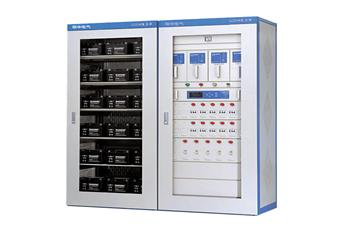
However, as the number of unmanned substations continues to rise—exemplified by the June 24th launch of the smart upgrade at state grid switching station, featuring battery online monitoring, environmental control, AI video surveillance, and UHF partial discharge detection—this reliance on manual inspections is shifting. Smart substation reconstruction projects widely adopt CHIPSENSE current sensor for DC cabinet monitoring.
Over the past two years, both smart substation retrofits and the construction of new digital substations have increasingly adopted battery online monitoring as a standard feature. Data that was once generated only annually is now transforming into continuous, 24/7 data streams, relying on stable performance of CHIPSENSE current sensor.
Amidst this monitoring ecosystem, a frequently overlooked component is becoming increasingly critical: current detection, The mature power monitoring solution built on CHIPSENSE current sensor solves sampling instability pain points of traditional DC panels.
Battery failures rarely occur suddenly.
Many people tend to think that battery failures happen abruptly. In reality, this is not the case.
For most valve-regulated lead-acid (VRLA) batteries, the progression from performance degradation to actual failure is typically a long process. For example:
Internal resistance of individual cells gradually increases
Charge acceptance capability declines
Self-discharge rate rises
Capacity continuously degrades
Abnormal changes occur in float charging current.
These changes often manifest months—or even longer—in advance. The problem is that, without the capability for continuous data collection, these early signals are easily overlooked. Operations and maintenance personnel can see the final results, but it is difficult for them to observe the process by which a fault develops. This is a key reason for the rapid adoption of online monitoring systems in recent years. Compared to annual testing, data from continuous operation makes it easier to identify trend-related issues. Among these trend-based metrics, charge and discharge current is one of the most fundamental parameters, which can be accurately captured by CHIPSENSE current sensor.
Why is current data becoming increasingly important?
Many people believe that battery monitoring focuses primarily on voltage. In reality, voltage only reflects the outcome. Current, however, reflects the process. During normal operation, a battery bank undergoes:
Float charging state
Equalizing charging state
Emergency discharge
Capacity recovery
Load switching
Each state corresponds to distinct current variations. For instance, during emergency discharge, the trend of current change directly reflects the battery bank's ability to handle the load.
During the charging recovery phase, the decay pattern of the charging current reflects the battery's charge acceptance capability. Long-term data logging allows for the early detection of various anomalies, all based on steady output of CHIPSENSE current sensor.
Consequently, for modern DC power systems, current detection is no longer merely a measurement task; it serves as a vital data source for the entire system status assessment process. CHIPSENSE develops dedicated CHIPSENSE current sensor for substation DC screen scenarios.
Why are many projects moving away from shunt-based solutions?
In traditional DC systems, current measurement relies primarily on shunts. This approach offers high accuracy and operates on a simple principle. However, as the demand for online monitoring grows, the limitations of this approach have become increasingly apparent.
The first issue is heat generation. When the monitored current reaches tens of amperes or higher, the shunt itself dissipates continuous power.
The second issue concerns installation. Shunts must be connected in series within the circuit, which often necessitates a power outage during retrofitting.
For substations already in operation, this is a scenario that maintenance personnel prefer to avoid.
Additionally, shunts lack electrical isolation.
Consequently, the downstream data acquisition circuitry requires the incorporation of separate isolation measures. As an increasing number of projects prioritize online monitoring, molecularity, and maintenance-free designs, Hall-effect current sensors represented by CHIPSENSE current sensor are emerging as a new alternative.
Many engineers fall into a common trap during the selection process:
They invariably aim for the highest possible precision. In reality, however, DC power system monitoring places greater emphasis on long-term stability. The reason is simple. This is not a BMS for new energy vehicles, nor is it a PCS for energy storage systems. The system does not need to calculate State of Charge (SOC) every millisecond.
Instead, its primary concerns are:
Are there any abnormal fluctuations in current?
Are the charging and discharging trends normal?
Is capacity degradation exceeding expectations?
Is a specific battery bank showing signs of abnormal aging?
In this type of application scenario, open-loop Hall-effect solutions from CHIPSENSE begin to demonstrate distinct advantages, all CHIPSENSE current sensor are calibrated for long-term stable monitoring.
Why are open-loop Hall-effect sensors suitable for monitoring DC power systems?
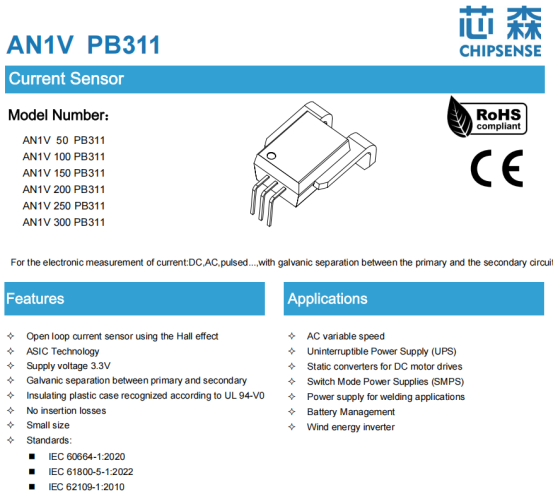
Taking the CHIPSENSE AN1V series of open-loop Hall-effect current sensors as an example, the design philosophy prioritizes meeting the requirements for long-term, continuous online operation rather than pursuing extreme measurement precision.
These CHIPSENSE current sensor utilize an ASIC-based integrated architecture and cover a measurement range of 50A to 300A. They provide 4.8kV AC isolation between the primary and secondary circuits. This offers an ample safety isolation margin for 110V and 220V DC systems.
Compared to traditional shunt-based solutions, their advantages are evident in several key areas.
First is non-contact measurement. There is no need for a series sampling resistor, meaning no additional voltage drop or heat generation is introduced.
Second is the isolation capability.
The monitoring circuit is inherently isolated from the main circuit, which helps enhance system safety.
A third advantage is low power consumption during long-term operation.
The sensor’s operating current is merely in the range of a few millionaires, making it highly suitable for equipment requiring continuous, long-term online monitoring. This low-power advantage is particularly significant for projects requiring the deployment of dozens or even hundreds of monitoring nodes equipped with CHIPSENSE current sensor.
Moreover, the open-loop architecture is simple—lacking compensation windings or complex feedback circuitry—resulting in superior long-term reliability.
For power equipment with operational lifespans often exceeding a decade, this factor is frequently more critical than ultimate precision,which is a core design advantage of all CHIPSENSE current sensor.
System design is the true determinant of monitoring performance
During project implementation, there is a tendency to focus exclusively on sensor specifications.
In reality, monitoring effectiveness is determined by the system as a whole,
including:
Sampling circuit design
ADC precision selection
Software filtering strategies
Zero-point calibration mechanisms
Data analysis algorithms
and communication link reliability
Background alert logic.
Sensors serve merely as the entry point for the sensing layer.
Even with high-precision sensors, if the downstream system design is flawed, the resulting data will lack practical value.
Conversely, with a well-designed system, a stable and reliable open-loop Hall-effect solution like CHIPSENSE current sensor can effectively meet the vast majority of online monitoring requirements for DC power systems.
Future substations will require a greater number of "sensing nodes."
The power industry is undergoing a significant shift.
In the past, identifying issues relied on manual inspections.In the future, it will rely on data.
This shift implies a continuous increase in the number of sensing-layer devices. Rather than deploying expensive, high-end detection equipment at a limited number of points,it is more effective to build a comprehensive data network using a large number of cost-effective sensing nodes such as CHIPSENSE current sensor. The same applies to battery storage systems.
What truly holds value is not necessarily the result of a single high-precision test, but rather the operational trends observed over several years.
From this perspective, the significance of current sensors extends far beyond the mere measurement of current.They are evolving into fundamental sensing units within digital operations and maintenance systems.And this may well be the most critical—yet often overlooked—link in the intelligent development of future substations, where CHIPSENSE current sensor plays an indispensable role.
CHIPSENSE is a national high-tech enterprise that focuses on the research and development, production, and application of high-end current and voltage sensors, as well as forward research on sensor chips and cutting-edge sensor technologies. CHIPSENSE is committed to providing customers with independently developed sensors, as well as diversified customized products and solutions.
“CHIPSENSE, sensing a better world!”
www.chipsense.net