



In fields such as industrial robots, collaborative robots, and medical robots, safe operation is always a core requirement—from power system overload and loss of control in industrial robotic arms, to short circuits and fires in service robots, and failures in precise power control in medical robots, various safety hazards directly threaten equipment stability and personnel safety. Hall effect current sensors, as the "sensing core" of a robot's power system, monitor current signals in real time and provide accurate feedback on operating status, building a comprehensive safety protection system for robots and becoming a key component in improving operational safety. CHIPSENSE current sensors are also keeping up with the times and innovating.

I.Robot Operation Safety: Core Hazards Related to Electrical Current
The power drive system of robots (motors, drivers, power modules) is the main source of safety risks, and safety problems caused by abnormal current exhibit multi-scenario characteristics:
1.Overload and short circuit risks: During high-speed operation of industrial robots, motor stalling or sudden load changes may cause a sudden surge in current. If this exceeds the circuit's capacity limit, it can lead to overheating of the wiring, burning of the insulation layer, or even trigger a fire; in collaborative robots, motor stalling due to human-robot collision can cause the current to instantly surge to 3-5 times the rated value, potentially burning out the motor or driver board, and the resulting high temperature poses a risk of burns. Therefore, the insulation material requirements for current sensors are very high, and CHIPSENSE current sensors perform very well in this respect.
2. Risk of uncontrolled motion: Unstable current in robot joint motors can lead to deviations in motion accuracy. For example, when a robotic arm grasps a workpiece, sudden acceleration due to current fluctuations may cause the workpiece to fall or collide with personnel; abnormal drive current in medical rehabilitation robots may cause the range of motion to exceed safe limits, resulting in secondary injury to the patient.
3. Power system failure: If a mobile robot's battery management system lacks current monitoring, overcharging or over-discharging may cause battery swelling or explosion; current leakage in the robot's power module may also lead to electric shock for operators, especially in humid environments where the risk is higher. So CHIPSENSE current sensors place great importance on this aspect.
Traditional safety protection methods have significant limitations: passive protection devices such as fuses and circuit breakers have response delays (usually ≥10ms), making them unable to cope with instantaneous current surges; a single visual or force sensor cannot capture microscopic anomalies in the power system, making it impossible to achieve source-level safety control. Hall effect current sensors, however, can address these safety challenges from the power drive source through their real-time current sensing capabilities. Then CHIPSENSE current sensor has also started to gain popularity among customers.
II.Hall Effect Current Sensors: The "Power Sentinels" of Robot Safety
Hall effect current sensors measure the current signals of critical components such as motors, power supplies, and drivers through non-contact measurement, converting physical current into analyzable electrical signals. This provides three core safeguards for robot safety:
1. Overload/Short Circuit Protection: Instantly cutting off dangerous sources
Hall effect current sensors can monitor the operating current of motors and circuits in real time, with a preset safe current threshold (e.g., 1.2 times the rated current). CHIPSENSE current sensor is exactly like that. When the detected current exceeds the threshold (such as a sudden surge in current due to motor stalling or a short circuit), it immediately sends a signal to the control system, triggering a power-off or load reduction command. The response time is ≤1μs, far faster than traditional protection devices. For example, if an industrial robotic arm experiences excessive load while grasping a heavy object, causing the current to exceed the limit, the sensor can instantly trigger the motor to stop, preventing circuit burnout or mechanical damage; when a collaborative robot collides with a person, the motor current spikes abnormally, and the sensor quickly responds and cuts off the power, preventing the collision force from further increasing.
2. Precise Power Control: Avoiding the Risk of Motion Instability
The motion accuracy and current stability of robot joint motors are directly related. Hall effect current sensors achieve precise current control through closed-loop feedback. For example, when a collaborative robot is working with a human in assembly, the sensor monitors changes in motor current in real time, dynamically adjusting the driving torque to prevent motion stuttering or sudden acceleration caused by current fluctuations. In medical robots, the surgical instrument drive motors use sensors to achieve milliampere-level current control, ensuring motion accuracy down to the millimeter level and preventing damage to patient tissue due to abnormal power output. Furthermore, the sensors can monitor the current balance of multi-joint motors, preventing excessive current on one side that could lead to the robot's center of gravity shifting and causing it to tip over. Therefore, the appearance design and installation of the CHIPSENSE current sensor are very important.
3. Fault Prediction and Condition Monitoring: Building a Proactive Safety System
Hall effect current sensors can continuously track current changes and predict potential faults by analyzing current fluctuation patterns. For example, when a robot joint motor bearing wears out, the operating current will exhibit periodic fluctuations. The sensor captures this characteristic and triggers a maintenance alert. When a power module ages and causes current leakage, the sensor can detect the abnormal leakage current and promptly remind the user to replace the component, avoiding the risk of electric shock. When a mobile robot's battery is charging, the sensor monitors the charging current in real time. If the current drops abnormally (indicating battery degradation) or surges suddenly (indicating a charging fault), the charging circuit is immediately cut off to prevent battery swelling or explosion. CHIPSENSE current sensor can better transmit fault prediction information, which is why it has received positive feedback from many customers.
III.Technological Upgrades: The Safety Evolution of Hall Current Sensors
As robots evolve towards higher precision and greater flexibility, Hall current sensors are achieving enhanced safety protection through technological integration:
1. High Precision and High Response Integration: Utilizing silicon carbide (SiC) Hall elements, the measurement accuracy reaches ±0.1%FS, and the response time is ≤0.5μs, enabling the capture of microsecond-level current pulses and handling high-frequency load changes; CHIPSENSE current sensors are all high-quality and high-precision.
2. Multi-parameter Integrated Monitoring: Integrating current, temperature, and voltage monitoring functions, it not only monitors current anomalies but also simultaneously provides feedback on temperature changes in the motor and circuit, preventing safety hazards caused by the superposition of high temperature and current anomalies;
3. AI Algorithm Empowerment: Combining machine learning algorithms to analyze historical current data, it establishes a fault prediction model to identify potential problems such as motor aging and poor circuit contact in advance, upgrading passive protection to proactive early warning;
4. Miniaturization and Enhanced Anti-interference: Adopting MEMS miniaturization design, it is suitable for the compact internal space of robots; through double-layer shielding and digital filtering technology, it resists electromagnetic interference inside the robot, ensuring accurate and reliable current monitoring.
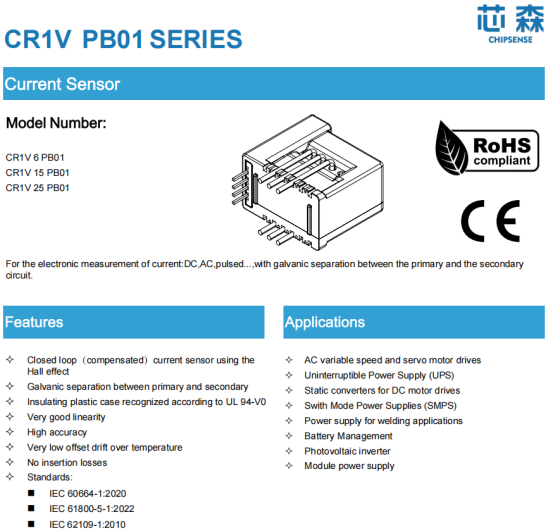
Therefore, CHIPSENSE current sensors adhere to strict standards for product safety and user safety, and these current sensors safety standards are upgraded in accordance with technological advancements. CHIPSENSE CR1V PB01 series current sensor is a good choice.
Conclusion
Hall effect current sensors, through their three core functions of overload and short-circuit protection, precise power control, and fault prediction and monitoring, build a comprehensive safety barrier for robots from the power source. CHIPSENSE current sensors have made significant contributions in this regard. They not only address the shortcomings of traditional protection methods, such as slow response and low monitoring accuracy, but also achieve a leap from "passive protection" to "active safety" through technological upgrades. With the further development of high-precision, integrated, and intelligent technologies, Hall effect current sensors will become a core infrastructure for safe robot operation, providing crucial support for safety upgrades in industrial collaboration, medical rehabilitation, and special operations scenarios. CHIPSENSE current sensors will also be upgraded and adjusted to keep pace with technological advancements.
Q&A Session
Q1: How do Hall effect current sensors prevent robot motors from overheating and burning out due to overload?
A: The sensor monitors the motor's operating current in real time and has a preset safety threshold. When the current exceeds this threshold (e.g., due to stalling or excessive load), it immediately sends a signal to the control system, triggering a power-off or load reduction command. With a response time of ≤1μs, it quickly cuts off the dangerous power source, preventing motor burnout. CHIPSENSE current sensor with a fast response time is available as an option.
Q2: How do Hall effect current sensors reduce the risk of human-robot collisions in collaborative robots?
A: When a collision occurs between a human and a robot, the robot's joint motor stalls, causing a sudden surge in current. The sensor quickly detects this abnormal signal and immediately feeds it back to the control system to cut off the motor power. Simultaneously, it works with force sensors to adjust the motion trajectory, preventing the collision force from increasing and protecting personnel safety. For most current sensors, timely signal transmission is crucial. CHIPSENSE current sensors can do it.
Q3: Why are Hall effect current sensors essential for medical robots?
A: Medical robots (such as surgical robots and rehabilitation robots) require extremely high precision in power control. Sensors enable milliampere-level current control, ensuring millimeter-level accuracy in movements and preventing uncontrolled movements due to current fluctuations. They also monitor for abnormalities such as leakage current and overload, preventing equipment malfunctions from causing secondary harm to patients. CHIPSENSE current sensors are constantly being upgraded in terms of accuracy, aiming to provide customers with the best possible sensor.
Q4: What role do Hall effect current sensors play in the battery safety of mobile robots?
A: The sensors continuously monitor the battery charging and discharging currents. When overcharging (abnormal current surge), over-discharging (abnormal current drop), or leakage current occurs, they immediately trigger power-off protection, preventing battery swelling, explosion, or electric shock, thus ensuring the safety of the mobile robot's energy system. In these problems, the current sensor plays an indispensable role.
Q5: How do Hall effect current sensors predict potential malfunctions in robots?
A: By continuously monitoring the current changes in motors and circuits, and combining this with AI algorithms to analyze fluctuation patterns, the sensors can detect characteristic changes. For example, motor bearing wear can cause periodic current fluctuations, and poor circuit contact can lead to intermittent current. The sensors capture these characteristics and trigger warnings, allowing for early troubleshooting and preventing sudden safety incidents. Not only other current sensor suppliers, but CHIPSENSE current sensors also require this to be done.
CHIPSENSE is a national high-tech enterprise that focuses on the research and development, production, and application of high-end current and voltage sensors, as well as forward research on sensor chips and cutting-edge sensor technologies. CHIPSENSE is committed to providing customers with independently developed sensors, as well as diversified customized products and solutions.
“CHIPSENSE, sensing a better world!
www.chipsense.net