


Recently, the National Development and Reform Commission, the National Energy Administration, the Ministry of Industry and Information Technology, and the Ministry of Transport jointly issued the "Notice on Promoting the Scientific Planning and Construction of High-Power Charging Facilities," which clearly states that by the end of 2027, there will be more than 100,000 high-power charging facilities nationwide with a single charging power of 250 kilowatts or more. This policy not only represents a dual improvement in the quantity and quality of charging infrastructure but also a comprehensive test of power electronics technology, safety monitoring, and energy efficiency management. The widespread adoption of high-power charging piles will accelerate the intelligent upgrading of new energy vehicle charging networks, promote the deep integration of electric vehicles, energy storage systems, and smart grids, and reshape the entire new energy industry ecosystem. CHIPSENSE current sensor has also been paying attention to this issue.
I. Knowledge of High-Power Charging Piles
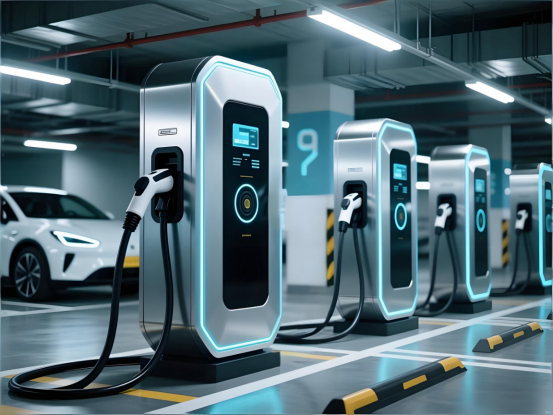
High-power charging piles refer to charging equipment with high power output capabilities, primarily used for fast charging, which can significantly shorten charging time. According to the definition of the China Electric Vehicle Charging Infrastructure Promotion Alliance, high-power charging piles are mainly concentrated in public charging stations with DC charging capabilities, commonly referred to as fast charging piles of 120 kW or higher, and also include supercharging piles of 480 kW or higher.
1.1Technical Principles
High-power charging primarily increases the amount of electricity delivered to the battery per unit time by increasing the charging voltage, increasing the charging current, or both. For example, traditional charging may use lower voltage and current, while high-power charging may use higher voltage (e.g., 800V or even 1000V) or higher current (e.g., 800A, 1500A). CHIPSENSE current sensors also offer a wide range of products with different measurement ranges to choose from. Simultaneously, intelligent charging management technology monitors the battery status in real time and automatically adjusts charging parameters to ensure the safety and efficiency of the charging process.
1.2Current Monitoring Requirements for High-Power Charging Piles
Current monitoring of high-power charging piles is a crucial aspect of ensuring their safe and efficient operation, requiring high precision, wide range, and rapid response. The following is a comprehensive analysis combining industry technical standards and equipment selection criteria:
Core Monitoring Requirements
Wide Current Range Coverage: High-power charging piles (such as 300kW superchargers) typically have a current range of 1A-300A, requiring monitoring of the entire process from trickle charging (1A-5A) to full-load high current (e.g., 300A). For example, home slow charging piles need to detect milliampere-level current fluctuations, while commercial fast charging piles need to support stable output of 300A high current. CHIPSENSE current sensor made product adjustments based on this demand.
High Precision and Resolution: Current monitoring accuracy needs to reach 0.1A-level resolution (percentage values typically reaching 0.7%), especially in low-current stages (e.g., 1A-5A), to avoid battery life loss due to parameter drift. High-precision sensors (e.g., 0.1A-level) can capture details such as current ripple and three-phase imbalance. The accuracy of CHIPSENSE current sensors is not a concern for customers.
Fast Dynamic Response: Charging piles need to achieve millisecond-level response (e.g., ≤1μs) in scenarios such as startup and fault protection to cope with transient current surges (e.g., 3 times the rated current). For example, Zhimao Technology's detection equipment supports zero-delay dynamic detection to ensure timely triggering of protection mechanisms.
Environmental adaptability and reliability: The monitoring equipment must have industrial-grade protection (such as IP54), intelligent heat dissipation system, adapt to complex outdoor environments such as high temperature and dust, and support long-term high-load operation.
1.3 Key Monitoring Points
1. AC Input Side:
Monitor three-phase input current to optimize PFC circuit and improve power factor.
2. DC Output Busbar:
Monitor charging current in real time to provide feedback to BMS and control system.
3. DC-DC Converter Module:
Monitor phase current of power devices (such as IGBTs) to optimize PWM control.
4. Insulation Fault Detection:
Detect leakage current to ensure charging safety.
1.4 Monitoring Technical Requirements
High Precision: CHIPSENSE current sensor error must be less than ±0.5%.
Fast Response: Response time must be less than 1μs, suitable for high-frequency switching signals.
High Insulation: Withstand voltage must reach 3kV or higher, suitable for 800V high-voltage systems.
II. Application of Hall Current Sensors in High-Power Charging Piles
2.1 Why Choose Hall Current Sensors?
Non-contact Measurement: No insertion loss, suitable for high-power applications.
High Insulation Performance: Primary and secondary side insulation withstand voltage reaches 3kV, current sensor conforming to IEC 61800-5-1 standard.
Wide Operating Temperature Range: Suitable for outdoor environments from -40°C to 85°.
2.2 Application Scenarios Comparison
| Monitoring Points | Applicable Sensor Types | Key Functions |
| AC Input Side | Hall Sensor/Shunt Unit | Power factor optimization,overload protection; |
| DC Output Busbar | Hall Sensor (CHIPSENSE CR1A dc current sensor) | accurate billing, overcurrent protection; |
| DC-DC Converter Module | Hall Sensor (CHIPSENSE CR1A current sensor) | PWM control feedback, power device protection; |
| Insulation Fault Detection | Zero-Sequence Current Transformer | leakage current detection. |
III. CHIPSENSE CR1A Series Hall Current Sensors
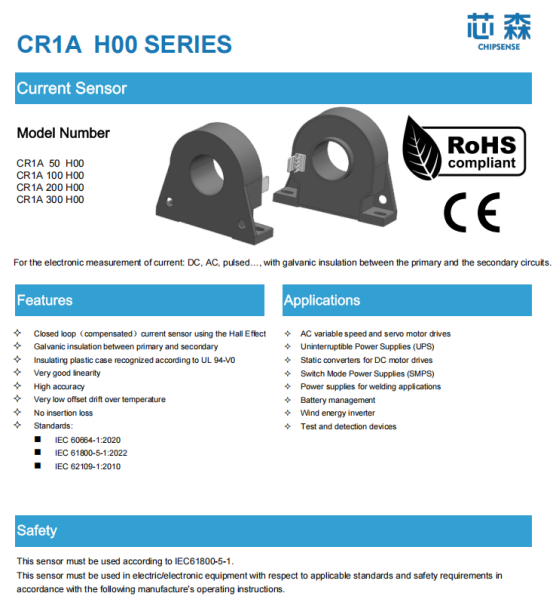
The CR1A series is a Hall closed-loop current sensor independently developed by CHIPSENSE, used to measure DC, AC, and pulse currents.The main characteristics of CHIPSENSE CR1A current sensor are as follows:
3.1 CHIPSENSE High-Precision Measurement
Accuracy: CHIPSENSE CR1A series current sensors have a measurement error as low as ±0.5%, suitable for billing and safety monitoring of charging piles.
Linearity: Excellent linearity (<0.1%) ensures consistent accuracy throughout the measurement range.
3.2 Non-Contact Measurement
No Insertion Loss: The non-contact design avoids the power loss of traditional shunts, suitable for high-power applications.
Easy Installation: CHIPSENSE current sensor directly mounted on busbars or cables without disconnecting the circuit.
3.3 CHIPSENSE High Insulation Performance Current Sensor
Insulation Withstand Voltage: Primary and secondary side insulation withstand voltage up to 3kV, CHIPSENSE CR1A current sensor conforming to IEC61800-5-1 standard, suitable for 800V high-voltage systems.
Safety: Ensures reliable operation in high-voltage environments.
3.4 Fast Response
Response Time: <1μs, suitable for dynamic current monitoring, such as PWM control signals.
Bandwidth: 200kHz, CHIPSENSE CR1A current sensor suitable for monitoring high-frequency switching currents.
3.5 Wide Operating Temperature Range
Operating temperature: -40°C to 85°C, suitable for complex outdoor environments.
Stability: Low temperature drift characteristics ensure measurement accuracy under extreme temperatures. Most CHIPSENSE current sensors are like this.
3.6 Mechanical Compatibility
Perforation Design: Circular perforations (e.g., Φ23.0mm) are compatible with standard busbar sizes.
Compact Size: 58×68×50mm, suitable for confined spaces inside charging stations.
7. CHIPSENSE CR1A current sensor Application and Deployment in High-Power Charging Stations
Final DC Output Busbar
Deployment Location: Inverter output terminal, before connecting the charging cable.
Application Value:
Real-time monitoring of charging current to ensure it does not exceed the rated value (e.g., 500A).
Extends the measurement range through multi-turn perforation (e.g., 2-turn perforation converts 500A to a 250A measurement).
Provides accurate data to the BMS for closed-loop control.
DC-DC Conversion Module
Deployment Location: Input/output busbars of the power module.
Application Value:
Monitor IGBT phase current and optimize switching timing.
Detect overcurrent or short circuit to protect power devices.
Summary of the application value of CHIPSENSE CR1A series current sensors
| Application Scenarios | Applicability | Sensor Models | Deployment Scheme |
| Final DC Output Busbar | ★★★★★ | CHIPSENSE CR1A 300 H00 | Multi-turn perforation method |
| DC-DC Conversion Module | ★★★★☆ | CHIPSENSE CR1A 200 H00 | Phase current monitoring |
| Insulation Fault Detection | ★☆☆☆☆ | Professional Sensors | Not applicable |
| Charging Gun/Cable | ★☆☆☆☆ | Miniature Sensors | CR1A is too large |
In conclusion, the optimal application scenarios for the CR1A series Hall current sensors in high-power charging piles are concentrated on the DC side, particularly the final DC output busbar and DC-DC converter modules. Through the multi-turn perforation method, the CR1A 300 H00 can expand its measurement range to meet high current requirements. However, for insulation fault detection and charging gun/cable monitoring, more specialized sensors are required. CHIPSENSE CR1A series current sensor, with its high accuracy, non-contact measurement, and high insulation, is an ideal choice for DC-side current monitoring in high-power charging piles.
CHIPSENSE is a national high-tech enterprise that focuses on the research and development, production, and application of high-end current and voltage sensors, as well as forward research on sensor chips and cutting-edge sensor technologies. CHIPSENSE is committed to providing customers with independently developed sensors, as well as diversified customized products and solutions.
“CHIPSENSE, sensing a better world!
www.chipsense.net